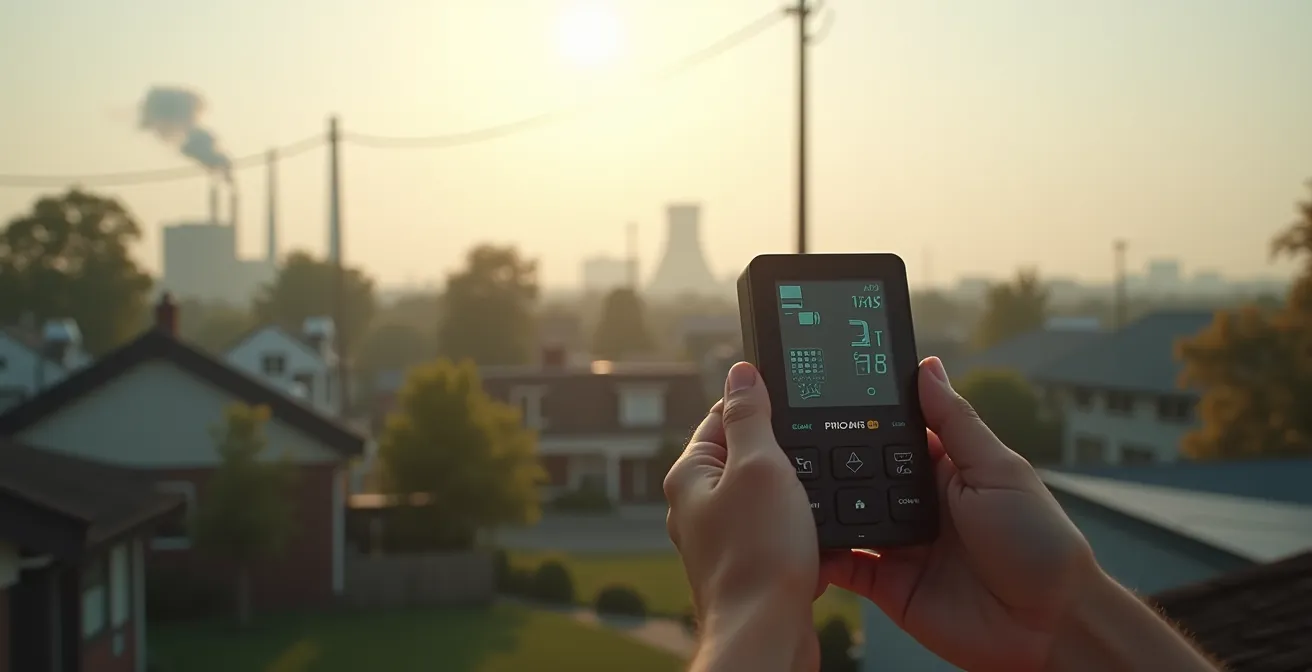
Holding polluters accountable is not about activism; it’s about building a legally sound body of evidence that regulators cannot dismiss.
- Effective complaints require systematic documentation—turning casual observations into a formal “chain of custody.”
- Decoding corporate “sustainability” reports against federal databases is critical to exposing hidden non-compliance.
Recommendation: Start by treating every observation as potential evidence, documenting time, place, and visual characteristics with the precision of a legal case file.
You notice it on your walk home—a strange acrid smell, a persistent haze, or a fine layer of dust coating your car. Your instinct tells you something is wrong, likely originating from the industrial facility on the edge of town. Many people in this situation might post on social media or make a quick, frustrated call to a generic government hotline. While these actions raise awareness, they rarely lead to meaningful enforcement. They are often dismissed as anecdotal and lack the structured evidence required for regulatory action.
The common advice to “take a photo” or “tell the EPA” is fundamentally incomplete. It overlooks the legalistic rigor needed to move a complaint from the “nuisance” pile to the “urgent investigation” desk. The key to accountability isn’t just about reporting; it’s about building a case. But what if the secret to forcing action wasn’t in the volume of complaints, but in the meticulous, evidence-based quality of a single, well-documented report? What if you, as a concerned citizen, could compile evidence with the precision of a paralegal, creating a record that an agency or court finds compelling?
This guide is your legal framework. We will bypass generic advice and focus on the strategic, methodical process of documenting violations, interpreting what you see, and leveraging public data to hold corporate polluters accountable. We will explore how to file a complaint that triggers an inspection, how to visually assess emissions without expensive equipment, and how to use a company’s own reports against them. It’s time to transform your concern into a compelling, evidence-based case for enforcement.
This article provides a structured, step-by-step framework to empower you. The following sections will detail the precise actions you can take to build your case and demand accountability effectively.
Summary: A Lawyer’s Framework for Environmental Accountability
- How to File an Effective Pollution Complaint That Triggers an Inspection?
- How to Interpret Industrial Smokestack Opacity Without Professional Equipment?
- Steam or Toxic Plume: How to Identify Dangerous Emissions Visually?
- The “Sustainability Report” Trick Companies Use to Hide Emissions
- When to Form a Neighborhood Watch Group for Environmental Monitoring?
- How to Minimize Your Daily Exposure to Environmental Pollutants in an Urban Setting?
- How to Manage a Self-Build Housing Project Without Exceeding the Budget by 20%?
- How to Create a Wildlife Corridor in an Urban Backyard to Support Local Species?
How to File an Effective Pollution Complaint That Triggers an Inspection?
An effective pollution complaint is not a plea; it is a formal, evidence-based report designed to compel a regulatory response. The goal is to present an agency, such as the Environmental Protection Agency (EPA) or a state-level equivalent, with information so specific and well-documented that ignoring it becomes a liability. The difference between a dismissed complaint and one that triggers a regulatory trigger—a mandatory inspection—lies in the quality of your documentation. You must shift your mindset from “resident” to “fact-finder.”
Your first step is to establish a meticulous chain of custody for your observations. Every piece of evidence must be logged with precision. This includes the exact date and time of the emission event, the specific address or landmark of the facility, and detailed notes on weather conditions like wind direction and cloud cover. Photos and videos are crucial, but they must be timestamped. When you file, do so simultaneously with the regulatory agency and, for maximum pressure, send a registered letter detailing the complaint to the facility’s CEO and its parent company. This creates a formal record they cannot claim to have never received.
The objective is to make it as easy as possible for an inspector to verify your claim. Offer to meet the inspector on-site to point out the exact source of the emissions. This proactive approach demonstrates your seriousness and can significantly expedite the investigation process. Persistent, documented community reporting is a powerful tool for enforcement.
Case Study: Delaware Refinery Held Accountable After Community Complaints
In a clear demonstration of this principle, Delaware’s environmental agency issued a Notice of Violation to the Delaware City Refining Company in June 2025. This action was a direct result of community reports detailing visible black smoke and sulfur dioxide emissions. The enforcement targeted a 10-hour unpermitted discharge and a separate 19-day sulfur dioxide incident. This outcome proves that consistent and specific citizen reporting can successfully trigger regulatory investigations and formal violations against major industrial operators, holding them accountable for their actions.
By compiling a file that resembles a legal submission, you transform your complaint from a simple grievance into an undeniable call for action.
How to Interpret Industrial Smokestack Opacity Without Professional Equipment?
One of the most powerful pieces of evidence you can gather is a visual assessment of smokestack opacity. While it may seem subjective, there are legally recognized methods for citizens to estimate smoke density without professional equipment. The most established of these is the Ringelmann Chart method. This simple tool consists of a series of shaded charts used to visually grade the opacity of smoke plumes. Method 40CFR60, Appendix A, Method 9, used by regulators, is based on this principle, and citizen evidence gathered using a similar methodology can carry significant weight.
To create compelling evidence, you must document a pattern of violation, not just a single event. Use a smartphone to create time-lapse videos over a one-hour period. This can capture intermittent puffs of dark smoke that a single photo might miss. Crucially, your observation log must accompany this visual evidence. For each observation, record the estimated opacity (e.g., “40% black,” corresponding to Ringelmann No. 2) and the duration of the event. Supplementing your visual log with data from public sources like PurpleAir can further strengthen your case by correlating your observations with real-time particulate matter readings.
Furthermore, look beyond the main smokestack. Document “fugitive emissions”—leaks from pipes, valves, and storage tanks. These are often clear signs of poor maintenance and can constitute separate violations. Every observation, meticulously logged with GPS coordinates and timestamps, becomes another piece of your evidence-based complaint.

As the image suggests, the technique relies on a direct, methodical comparison. By holding a standardized chart at arm’s length and comparing its shades to the smoke plume against the sky, you can produce a semi-quantitative estimate that is far more powerful than a simple description of “dark smoke.” This transforms a subjective observation into structured data.
This systematic approach to visual evidence provides the factual basis needed to elevate your complaint and demonstrate a consistent pattern of non-compliance.
Steam or Toxic Plume: How to Identify Dangerous Emissions Visually?
A common defense from industrial facilities is that a visible plume is “just harmless steam.” While this is sometimes true, there are distinct visual characteristics that can help you differentiate between benign water vapor and a potentially toxic release. Misidentification can weaken your complaint, so learning these cues is a critical part of building a credible evidence file. The stakes are high; The American Lung Association’s 2024 “State of the Air” report reveals that over 90.7 million Americans live in counties with unhealthy levels of particle pollution, making accurate identification essential for public health.
Clean steam is typically brilliant white, rises quickly, and dissipates into the atmosphere, often vanishing within seconds. A toxic plume behaves differently. Its color can be a major indicator: yellow often suggests sulfur compounds, brown can indicate nitrogen oxides, and grey or black points to particulate matter (soot). The plume’s behavior is also revealing. Toxic emissions tend to linger, drift long distances without dissipating, and may hang low to the ground during temperature inversions. Finally, observe the plume’s edges; steam has soft, billowy edges, whereas a chemical plume often has sharper, more defined, or oily-looking boundaries.
Your documentation must include these specific visual descriptors. Note any signs on the ground, such as stressed or dying vegetation, oily residues, or distinct chemical odors, which would never be caused by simple steam. This detailed analysis provides the specific, factual basis needed to challenge a facility’s “harmless steam” defense.
The following guide, based on characteristics outlined in public data from agencies like the EPA, provides a clear framework for visual identification. A review of pollutant trends data shows these visual differences are consistent markers.
| Characteristic | Clean Steam | Toxic Plume |
|---|---|---|
| Color | Brilliant white | Yellow (sulfur), Brown (nitrogen oxides), Gray/Black |
| Dissipation | Rises and vanishes quickly (seconds) | Lingers and travels long distances |
| Weather behavior | Dense on cold days but still rises | May hang low during inversions |
| Ground signs | None | Stressed vegetation, oily residues, chemical odors |
| Edge appearance | Soft, billowy edges | Sharp, oily-looking edges |
By using this structured approach, you can confidently and accurately describe what you are seeing, providing regulators with the precise details they need to investigate a potential violation.
The “Sustainability Report” Trick Companies Use to Hide Emissions
In the face of public scrutiny, many corporations publish glossy “Sustainability” or “Corporate Responsibility” reports. From a legalistic standpoint, these documents are often exercises in strategic misdirection. They are designed to create an image of environmental stewardship while obscuring actual pollution data. As a citizen investigator, you must learn to pierce this corporate veil by cross-referencing their marketing claims with hard data.
A common tactic is to report on “emissions intensity” rather than absolute emissions. A company might boast that its “emissions per unit of product” have decreased, while its overall factory production—and therefore its total, absolute emissions—has actually increased significantly. This is a classic greenwashing technique. Another is the use of vague, non-committal language. Be wary of phrases like “we aim to,” “we strive for,” or “we are exploring options,” as they carry no legal weight and are not enforceable commitments.
Your task is to be the auditor. The most powerful tool at your disposal in the United States is the EPA’s Toxic Release Inventory (TRI). This publicly accessible database requires many facilities to report their chemical releases. You must compare the optimistic narrative in a company’s sustainability report with the raw data in the TRI for that specific facility. Discrepancies between the two are powerful evidence of corporate greenwashing and can be included in your complaint to demonstrate a pattern of public deception.
Action Plan: How to Decode Corporate Greenwashing
- Compare Metrics: Contrast the company’s “emissions intensity” claims from their report with the absolute emissions totals found in official databases.
- Cross-Check Data: Verify the sustainability report’s claims against hard data from the EPA’s Toxic Release Inventory (TRI) and other enforcement databases.
- Identify Weasel Words: Scrutinize the report for non-binding language like “aim to,” “strive for,” and “exploring options,” which signal a lack of firm commitment.
- Analyze Offsets: If the company claims carbon offsets, verify whether these programs address the co-pollutants (like VOCs and particulates) that are directly impacting your local community.
- Request Specifics: Formally request Scope 1 emissions data, which covers direct emissions from owned or controlled sources, for the specific facility in your area.
By treating corporate sustainability reports not as truth but as a set of claims to be verified, you add a powerful layer of accountability to your efforts.
When to Form a Neighborhood Watch Group for Environmental Monitoring?
While an individual can build a strong case, there is a strategic threshold where forming a neighborhood environmental watch group becomes essential. This transition should occur when you need to establish a widespread pattern of violation that a single person cannot reasonably document, or when the cost of professional monitoring or legal advice becomes necessary. A group can pool resources, coordinate monitoring across a wider geographic area, and present a united front to regulators, lending significant political weight to your complaints.
The primary function of such a group is to move beyond anecdotal reports to a coordinated, data-driven monitoring network. By deploying multiple low-cost sensors (like those from PurpleAir) and creating a shared log, a group can create a detailed pollution map of the neighborhood. This can identify hotspots and demonstrate how emissions travel, providing a level of evidence that is difficult for regulators to ignore. This “citizen science” approach is increasingly recognized as a valid method for supplementing sparse official monitoring networks.

As the image shows, the power of a group lies in its ability to collaboratively analyze data and form a collective strategy. This shared investment of time and resources is what transforms individual concerns into a formidable community-led initiative. The Georgetown Climate Center highlights models where communities successfully pool small household contributions to fund professional air quality assessments, turning a collection of small budgets into powerful, legally relevant data.
Case Study: Citizen Scientists Transform Air Quality Monitoring
The impact of community monitoring is profound. In Denver, residents using PurpleAir sensors discovered a radon hotspot where 80% of homes exceeded EPA action levels, a discovery missed by official monitoring. Similarly, in Port Harcourt, Nigeria, a single citizen scientist’s monitor revealed emergency-level pollution spikes, empowering the community with critical health data that was previously unavailable. These examples show that organized citizen monitoring can fill crucial data gaps and drive action where government oversight is lacking.
When a pattern of pollution affects an entire community, a collective, data-driven response is the most powerful legal and political tool you have.
How to Minimize Your Daily Exposure to Environmental Pollutants in an Urban Setting?
While building a case for enforcement is a long-term offensive strategy, you must also implement defensive measures to protect your health and your family’s health now. Minimizing your daily exposure to pollutants is critical, especially given that official monitoring is often inadequate. Indeed, sobering research on monitoring deserts shows that two-thirds of U.S. counties have no official air quality monitors, leaving millions of people unaware of the air they breathe.
Your first line of defense is information. Before opening windows or planning outdoor exercise, consult real-time air quality maps like the government’s AirNow and the citizen-science network PurpleAir. These tools can help you make informed decisions based on current conditions and wind patterns. For example, if the wind is blowing from the direction of a known polluter, it is wise to keep windows closed and limit time outdoors.
Indoors, you can create a safer environment. High-efficiency particulate air (HEPA) filters are extremely effective at removing fine particulate matter from the air. If volatile organic compounds (VOCs) are a local concern, use filters that also contain activated carbon. Establish a decontamination routine when entering your home after being outside on a high-pollution day: remove shoes at the door, change clothes, and wash exposed skin to avoid tracking pollutants inside. Using portable air quality monitors can also help you identify “cleaner” microenvironments within your own neighborhood for short walks or errands, allowing you to navigate your urban environment more safely.
By taking these proactive, defensive steps, you can mitigate immediate health risks while you continue the important work of holding polluters accountable.
How to Manage a Self-Build Housing Project Without Exceeding the Budget by 20%?
In the context of environmental action, the “self-build project” is not one of bricks and mortar, but of building a legal and scientific case against a polluter. Just like a construction project, it is fraught with potential for budget overruns—not in materials, but in expert fees, monitoring equipment, and legal costs. Managing this “project budget” is crucial for the long-term success of a community campaign, ensuring it doesn’t falter due to financial exhaustion.
The most effective budget management strategy is resource pooling. As discussed in the context of forming a neighborhood watch, a collective fund can achieve what no single household can. A budget of $10,000 to $15,000, which is unattainable for one family, becomes feasible when shared among 100 households contributing $100 each. This budget can be used to hire an independent environmental consultant to conduct professional air sampling or a lawyer specializing in environmental law to review your case and draft formal notices.
To stay within budget, prioritize high-impact, low-cost evidence. The meticulous, citizen-led documentation described throughout this guide—timestamped photos, opacity logs, and detailed incident reports—costs nothing but time and diligence. This body of evidence is the foundation of your case. Only once this foundation is solidly built should the group consider allocating funds for more expensive professional services. Many environmental law clinics at universities also offer pro bono (free) legal services to community groups, a resource that should be explored before any funds are spent on legal counsel. By focusing on a phased approach—foundational evidence first, expert services second—you can manage your “project” without exceeding your financial capacity.
By treating your advocacy as a project to be managed with fiscal discipline, your community can sustain the pressure needed to achieve its goals.
Key Takeaways
- An effective complaint is an evidence-based report designed to trigger a regulatory inspection, not an emotional plea.
- Use legally-recognized citizen science methods, like the Ringelmann Chart, to turn subjective observations into semi-quantitative data.
- Pierce the “corporate veil” by auditing sustainability reports against hard data from public sources like the EPA’s Toxic Release Inventory.
How to Create a Wildlife Corridor in an Urban Backyard to Support Local Species?
While a wildlife corridor is typically about connecting habitats, in the context of environmental accountability, local wildlife serves a more immediate, critical function: as a sentinel of ecosystem health. The health and behavior of local species can be a powerful, visible bio-indicator of air and water quality, providing a form of evidence that is intuitive and compelling to regulators and the public alike.
Your backyard is not just a garden; it is a monitoring station. The decline of certain species or the appearance of sickness can be directly linked to pollution. For example, many species of lichen are extremely sensitive to sulfur dioxide and will disappear from trees in areas with poor air quality. The decline of local amphibian populations can indicate water contamination. Sick or dead birds can be a sign of acute toxic exposure. Documenting these changes—with photos, dates, and detailed notes—adds a powerful, ecological dimension to your complaint file. The EPA’s own reports demonstrate that reductions in key pollutants have a direct, positive impact on restoring wildlife habitats, proving the causal link between emissions and ecosystem health.
This approach transforms your environmental advocacy from being purely about human health to being about the entire local ecosystem, which often garners broader support. As you build your case against a polluter, documenting the impact on local fauna and flora provides a narrative that is hard to ignore.
The decline or sickness of specific local wildlife like lichens on trees, amphibians, and certain bird species can be used as visible, compelling evidence of poor air or water quality in environmental complaints.
– Dr. Sarah Mitchell, Urban Wildlife as Environmental Indicators Study
The next logical step is to begin systematically documenting not only the industrial emissions but also the corresponding health of your local environment, using this framework as your guide to build an undeniable case for action.