In summary:
- Shift your mindset from a passive tourist to an active apprentice to unlock deeper learning and cultural connection.
- Focus on finding authentic craftsmen by visiting local guilds and asking technical questions, rather than relying on tourist-heavy demonstrations.
- Identify and avoid “tourist trap” workshops that are primarily sales pitches disguised as cultural experiences.
- Use a structured practice schedule, like spaced repetition, upon returning home to solidify your new skill for the long term.
- True learning on vacation is not about collecting souvenirs, but about acquiring and retaining genuine, hands-on knowledge.
The modern traveler is changing. The endless scroll of photo-ops and checklist-style sightseeing is leaving many feeling unfulfilled, as if they’ve skimmed the surface of a destination without ever truly touching it. You return with a camera full of pictures but an experience that feels hollow. Many try to fix this by booking a generic cooking class or a language lesson, only to find themselves in a sterile environment, disconnected from the very culture they came to explore. This approach treats learning as just another tourist activity to be consumed.
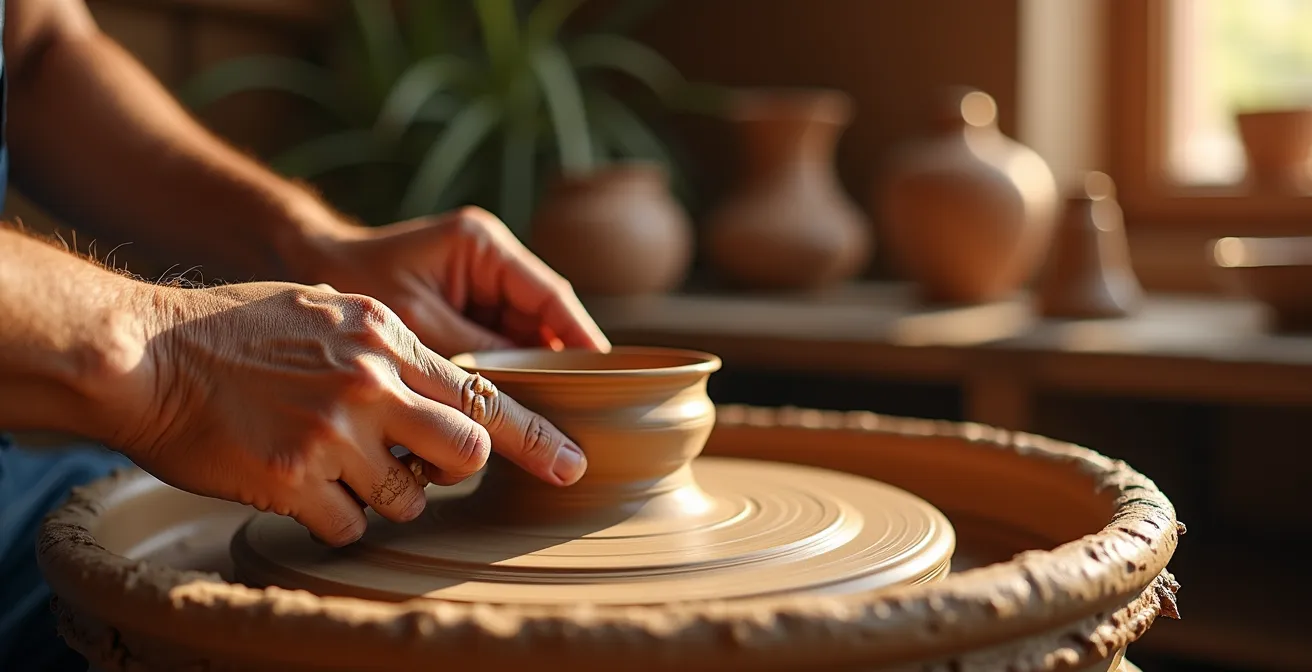
But what if the goal wasn’t just to “do an activity,” but to engineer a genuine learning experience? What if you could adopt an apprenticeship mindset, even for a short time, and connect with a place through the hands-on mastery of a traditional skill? This isn’t about becoming a professional potter in a week; it’s about a fundamental shift in how you travel. It’s about seeking out the signal of true craftsmanship amidst the noise of the tourist economy and engaging with a culture through contribution and respect, not just consumption.
This guide moves beyond the platitudes of “learning holidays.” We’ll explore the science of why learning in a new place is so effective, provide a framework for finding authentic mentors, and show you how to identify the sales pitches masquerading as workshops. Finally, we’ll give you a concrete plan to ensure the skills you learn on the road don’t fade the moment you get home. It’s time to transform your vacation from a passive escape into an active, skill-building sabbatical.
To help you navigate this transformative approach, this article is structured to guide you step-by-step from the theory to the practical application. The following summary outlines the key stages of your journey from tourist to apprentice.
Summary: The Art of the Learning Sabbatical
- Why Learning a Skill in a New Environment Boosts Memory Retention?
- How to Find Craftsmen Willing to Teach You vs. Tourist Demonstrations?
- Group Class or Private Mentor: Which Is Better for Learning Local Arts?
- The “Traditional Factory” Tour That Is Actually a Sales Pitch
- When to Practice Your New Skill at Home to Prevent Forgetting It?
- How to Experience Local Culture Without Being an Intrusive Tourist?
- How to Identify and Buy Authentic Artisan Crafts Without Exploiting Locals?
- How to Manage a Round-the-World Trip Budget to Travel for 12 Months?
Why Learning a Skill in a New Environment Boosts Memory Retention?
Have you ever noticed how vividly you remember the taste of a certain meal you ate on a trip years ago? This isn’t just nostalgia; it’s a neurological phenomenon. Learning a new skill in a novel environment leverages a powerful cognitive principle known as context-dependent memory. Your brain doesn’t just store the “what” (the skill itself); it creates a rich tapestry of associations with the “where” and “who”—the smell of the wood in a carver’s shop, the sound of a foreign language in the background, the specific light of a new city. These sensory cues act as powerful retrieval hooks, making the memory of the skill more robust and easier to access later.
When you learn to cook a dish in its region of origin, you’re not just following a recipe. You’re absorbing the context: the local ingredients, the climate, the cultural importance of the food. This multi-sensory immersion creates stronger, more interconnected neural pathways than learning the same skill in a familiar, sterile classroom at home. The uniqueness of the environment forces your brain to pay closer attention, encoding the information more deeply.
This effect is backed by science. For instance, recent research from Frontiers in Psychology reveals that low-frequency or unique locations enhance this context-dependent memory effect, especially when you spend more time there. The more distinct the setting, the more “tags” your brain attaches to the memory, making it less likely to be forgotten. This is why learning permaculture in a Balinese garden or weaving in a Peruvian village is not just more memorable—it’s neurologically more effective.
How to Find Craftsmen Willing to Teach You vs. Tourist Demonstrations?
The greatest challenge in experiential travel is separating the authentic master from the performer. A tourist demonstration is designed for passive observation and quick photos; a true learning opportunity is about active participation and knowledge transfer. The key is to adopt an apprenticeship mindset and seek out the signals of genuine craftsmanship. Forget the main tourist squares and polished tour operator websites. Your search should start where the locals go.
Begin by visiting local artisan guilds, university art departments, or even cooperatives. These organizations are hubs for professionals, not entertainers. When you find a potential mentor, your approach matters. Instead of asking, “Do you give classes?”, which frames the interaction as a commercial transaction, show genuine interest in their work. Ask specific, technical questions like, “What’s the most challenging part of this process?” or “Who taught you this craft?” This signals that you respect their skill and are not just another tourist looking for a quick experience.

Another powerful indicator is the clientele. Look for workshops where locals are also customers or students. A craftsman who makes pieces for their own community or for personal use, not just for sale to tourists, is often a sign of deep-rooted authenticity. To show your commitment, you can even offer to help with menial tasks like preparation or cleanup. This gesture of humility can open doors that money cannot, transforming a potential transaction into a genuine human connection and a real learning opportunity.
Your Guide to Vetting Authentic Learning Opportunities
- Visit local artisan guilds and university art departments rather than tourist centers to find practicing professionals.
- Ask specific technical questions like, “What’s the most difficult part of this process?” or “Who taught you this craft?” to gauge their depth of knowledge.
- Look for workshops where locals are customers or students, not just other tourists.
- Offer to help with preparation or cleanup tasks to demonstrate genuine interest and respect for the craft.
- Check if the instructor makes pieces for their personal use or for the local community, not just for the tourist market.
Group Class or Private Mentor: Which Is Better for Learning Local Arts?
Once you’ve located potential learning opportunities, you’ll often face a choice: join a structured group class or seek one-on-one mentorship. There’s no single right answer; the best option depends entirely on your goals, budget, and learning style. Understanding the trade-offs is key to engineering the right experience for you.
Group classes are excellent for beginners, social learners, and those on a tighter budget. They provide a structured curriculum at a standardized pace, ensuring you cover the fundamentals. The social environment can be highly motivating, allowing you to connect with fellow travelers who share your interests. However, the instruction is generalized, and you’ll receive less personal attention, which can slow down your progress if you’re a particularly fast or slow learner.
A private mentor, on the other hand, offers a path to deep immersion. The learning is entirely customized to your skill level and specific goals. You can ask detailed questions and receive immediate, personalized feedback. This one-on-one focus fosters a much deeper cultural connection and often leads to a more profound understanding of the craft’s nuances. The primary drawbacks are the significantly higher cost and the lack of a built-in social group. This format is ideal for serious learners, introverts, or those who want to achieve a specific, advanced outcome.
The following table breaks down the key differences to help you decide which path aligns best with your travel and learning objectives. As this comparative analysis highlights, the choice is a balance between cost, social interaction, and the depth of skill progression you desire.
| Criteria | Group Classes | Private Mentor |
|---|---|---|
| Cost | $45-100 per session | $150-300+ per session |
| Social Interaction | High – meet other learners | Low – one-on-one focus |
| Skill Progression | Standardized pace | Customized to your level |
| Cultural Immersion | Moderate | Deep – personal connection |
| Schedule Flexibility | Fixed times | Negotiable |
| Best For | Beginners, social learners, budget-conscious | Serious learners, introverts, specific goals |
The “Traditional Factory” Tour That Is Actually a Sales Pitch
One of the most common pitfalls for eager learners is the “traditional factory” tour. It’s often advertised as an authentic cultural experience but is, in reality, a meticulously crafted sales funnel. The experience typically involves a charming host, a compelling story about “secret ancient techniques,” and a high-pressure sales environment at the end, often with “limited-time tourist offers.” Learning to spot these traps is essential to protect both your time and your wallet.
The first red flag is an overemphasis on emotional heritage stories rather than on technical processes. If the guide spends more time talking about their great-grandmother’s legacy than explaining the tools in front of you, be wary. Another warning sign is a lack of transparency. In a genuine workshop, processes are open and questions are welcomed. In a sales pitch, the “demonstration” is often brief and superficial, quickly leading to a showroom of finished products.
To navigate these situations, turn the tables by asking pointed, technical questions about machinery, material sourcing, and production time. This shifts the focus from the sales narrative to the actual craft. If you feel pressured to buy, have polite exit phrases ready, such as, “I need some time to think about it,” or “I have a policy of not making large purchases on my first day of visiting a place.” Your goal should be to extract real value by observing the techniques, not by succumbing to a well-rehearsed pitch. Focus your camera on the processes and tools for later study, not just the polished final products.
Your Pre-Booking Authenticity Audit
- Points of Contact: Are you finding the workshop through a tourist office, or a local guild/community referral? The source is a strong signal of intent.
- Collecte: Review their online presence. Are the photos all of smiling tourists, or do they show the messy reality of a working studio and locals engaging?
- Cohérence: Does the “story” feel too perfect? Confront their narrative with technical questions about their process. A real artisan loves to talk shop; a salesperson will redirect to the product.
- Mémorabilité/Émotion: Is the primary appeal based on a “secret ancient technique” or a “dying art”? These are common emotional hooks for tourist traps.
- Plan d’Intégration: What is the ratio of “learning” time to “shopping” time? If the tour ends in a large, polished showroom, it’s likely a sales pitch.
When to Practice Your New Skill at Home to Prevent Forgetting It?
The exhilarating experience of learning a new skill abroad can quickly fade upon returning to your daily routine. The beautiful calligraphy strokes become clumsy, the perfectly balanced spice mix is forgotten. This is the “forgetting curve” in action. To prevent your hard-earned knowledge from evaporating, you need a deliberate strategy for skill consolidation. The key isn’t just to practice, but to practice at the right intervals.
This is where the science of spaced repetition comes in. This learning technique involves reviewing information at increasing intervals over time. Instead of cramming practice sessions into one weekend, you strategically space them out to interrupt the forgetting process and transfer the skill from short-term to long-term memory. A simple yet powerful schedule is the 1-3-7-30 model: practice on day 1 after returning, then again on day 3, day 7, and finally a review session on day 30.

As research published in PNAS demonstrates that learners using optimized spaced repetition algorithms memorize information far more effectively than those using traditional study schedules. To make this work, you must be proactive. Before your trip even ends, order any necessary supplies so they arrive when you do. Even more importantly, block out these practice sessions in your calendar before you leave for vacation. Treat them as non-negotiable appointments with your future self. This discipline is what turns a fleeting holiday memory into a lasting, lifelong skill.
The 1-3-7-30 Spaced Repetition Schedule for Skill Retention
- Day 1: Schedule a practice session immediately after returning home to combat initial forgetting.
- Day 3: Hold a second practice session just two days later to reinforce the neural pathways.
- Day 7: Engage in a third session after another four days to begin moving the skill to long-term memory.
- Day 30: Conduct a monthly review session to fully consolidate the skill and make it a durable part of your repertoire.
- Pro-Tip: Pre-order any necessary supplies before your trip so they are waiting for you when you return, removing any friction to starting.
How to Experience Local Culture Without Being an Intrusive Tourist?
The pursuit of authentic learning carries a responsibility: to engage with a culture respectfully, as a participant rather than a mere consumer. An intrusive tourist takes; a respectful learner gives back. This shift from a consumptive to a contributory mindset is the hallmark of a true experiential traveler. It’s about creating a two-way exchange that enriches both you and the community you are visiting.
One of the most powerful ways to contribute is by offering your own skills in exchange for learning. Are you a web designer, a writer, or a photographer? Perhaps you can help your artisan mentor create a simple website or take professional photos of their work. This transforms the dynamic from a simple transaction to a collaborative partnership. Even without specific professional skills, you can contribute by participating in community activities, such as local market days, neighborhood clean-ups, or cultural festivals. Spending time in non-tourist areas like local libraries or parks shows an interest in the community’s daily life, not just its attractions.
Language is a fundamental bridge. Learning basic phrases beyond “hello” and “thank you” demonstrates a profound level of respect. Ask open-ended questions about local customs, traditions, and the meaning behind the art you are learning. This communicates genuine curiosity and a desire to understand, not just to observe. As the team at Responsible Travel notes, the goal is to become part of a welcoming environment.
Best of all, youll be in welcoming communities where knowledge is shared. Learn from our local guides, from fellow guests, and from members of the wider community on our inspirational selection of trips.
– Responsible Travel, Learning Vacations Travel Guide
By focusing on contribution and genuine interest, you cease to be an outsider looking in and become, even for a short while, a welcome part of the community’s fabric.
How to Identify and Buy Authentic Artisan Crafts Without Exploiting Locals?
Part of the joy of learning a craft is bringing home a piece of it—not as a mere souvenir, but as a tangible connection to the artisan and their story. However, the line between supporting a local artist and inadvertently participating in an exploitative system can be thin. Buying authentic crafts fairly requires observation, conversation, and a commitment to paying a price that respects both time and materials.
Mass-produced items are often disguised as “handmade” in tourist markets. To cut through the noise, use a simple but effective Three-Question Authenticity Test. First, ask directly: “Did you make this with your own hands?” Watch their body language as much as their words. Second, follow up with: “Where is your workshop? Could I visit it?” A genuine artisan is usually proud of their workspace, while a reseller will be evasive. Finally, ask: “What is the story behind this design or pattern?” True artisans possess a deep well of knowledge about the symbolism and history of their work, a story that a simple merchant cannot replicate.
Once you’ve established authenticity, the issue of price arises. Haggling is part of many cultures, but it should be done with respect. Understand that the price reflects not just materials but countless hours of skilled labor. Paying a fair price is the most direct way to support the artist and their craft. If you are truly dedicated, consider commissioning a custom piece. This not only guarantees authenticity but also creates a unique collaboration between you and the maker. Ultimately, you are not just buying an object; you are investing in a story, a tradition, and the livelihood of a person who shared their knowledge with you.
Key takeaways
- True learning happens when you shift from a passive tourist to an active, curious apprentice.
- Vet your learning opportunities by seeking out local guilds and asking technical questions to separate real artisans from tourist performers.
- Ensure your new skill lasts by using a spaced repetition practice schedule (1, 3, 7, and 30 days) upon returning home.
- Engage with the local culture respectfully by contributing your own skills and showing genuine interest, transforming the experience into a two-way exchange.
How to Manage a Round-the-World Trip Budget to Travel for 12 Months?
Transforming a single vacation into a skill-building experience is powerful, but extending that journey into a long-term, round-the-world trip is the ultimate dream for many aspiring learners. A 12-month sabbatical dedicated to acquiring skills across different cultures requires a completely different approach to financial planning. It’s not about luxury; it’s about sustainability and smart resource allocation.
The total budget can vary dramatically, but a realistic starting point is crucial. For example, experienced digital nomads report spending between $41,000 to $60,000 per couple for a full year of travel. The primary lever for controlling this cost is your choice of destination. Your travel funds will stretch significantly further in regions where the cost of living—and learning—is lower. Integrating skill acquisition into your budget means prioritizing destinations that offer high-value learning opportunities at an affordable price.
For a long-term journey, your budget strategy should be built around a “cost-per-day” model that includes not just accommodation and food, but also a dedicated “learning fund.” This approach allows you to make strategic decisions, perhaps spending a month learning to dive in affordable Southeast Asia to offset a more expensive week of cheese-making in Western Europe. The key is to see learning not as an occasional splurge but as an integral, budgeted component of your travels. This long-term financial planning is what makes a world-spanning apprenticeship possible.
| Region | Daily Budget | Skill Learning Cost | Best Skills to Learn |
|---|---|---|---|
| Southeast Asia | $30-50 | $5-20/class | Diving, cooking, massage |
| Latin America | $35-60 | $10-30/class | Spanish, surfing, salsa |
| Eastern Europe | $40-70 | $15-40/class | Traditional crafts, cooking |
| Western Europe | $80-150 | $50-100/class | Wine tasting, art, cheese making |
Your journey from tourist to traveler begins not with a ticket, but with a plan. Start mapping out your own learning sabbatical today by researching your first skill and destination, and build the budget that will turn your dream into a reality.