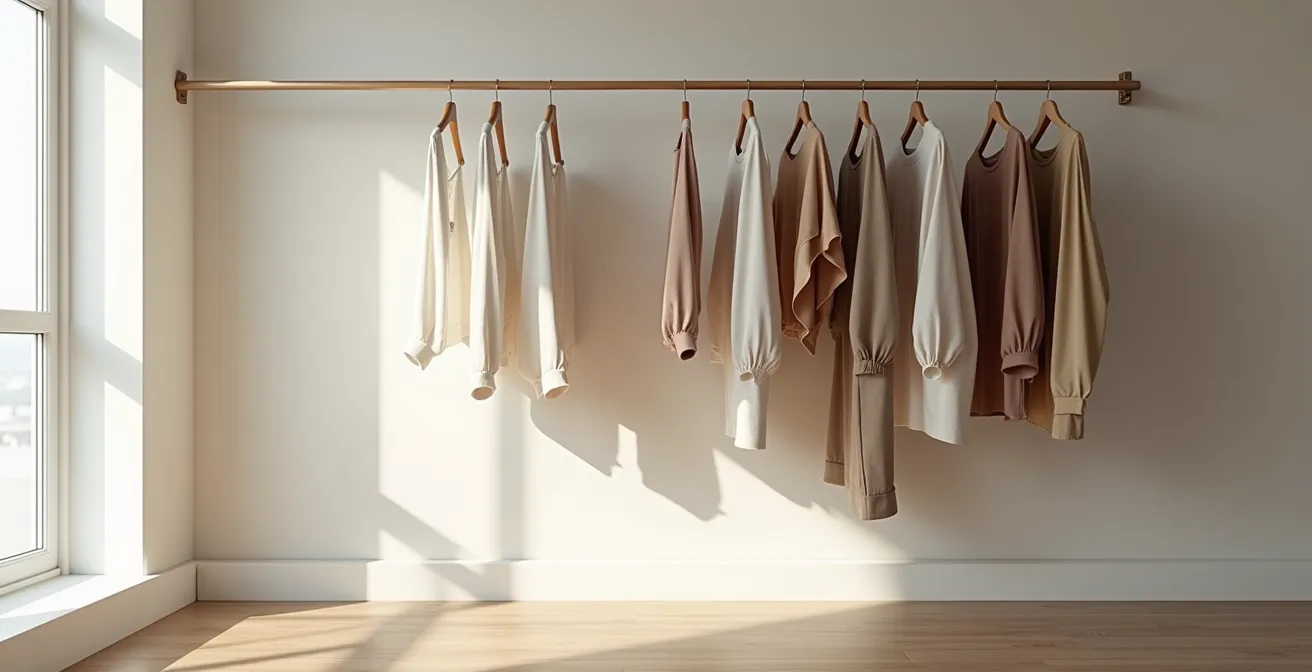
In summary:
- Stop decluttering aimlessly and start building a strategic “wardrobe architecture” based on your lifestyle.
- Prioritize investment in timeless basics by understanding their long-term value through “cost-per-wear.”
- Master color science to choose shades that enhance your natural complexion, eliminating items that wash you out.
- Learn to identify garment quality through tangible details like seam integrity and fabric recovery, regardless of the brand.
- Apply these core principles to other areas, from second-hand shopping to makeup, for a cohesive personal aesthetic.
You stand before a closet overflowing with clothes, yet the familiar frustration hits: “I have nothing to wear.” This paradox isn’t about a lack of options; it’s about a lack of strategy. The common advice is to declutter, to count pieces, or to chase a minimalist ideal. But these are superficial fixes for a deeper structural problem. You haven’t bought individual clothes; you’ve unknowingly bought confusion.
A truly functional wardrobe isn’t built on rigid rules or empty hangers. It’s an engineered system, a personal “wardrobe architecture” designed around your life, your body, and your aesthetic. The key isn’t simply owning less, but curating more intelligently. It’s about shifting your mindset from the one-time cost of a garment to its long-term value, a concept we call cost-per-wear.
This guide moves beyond the platitudes. We won’t just tell you to “buy classics” or “find your colors.” We will provide the foundational principles to transform you from a passive consumer into a decisive curator of your own style. You will learn the science behind color, the economics of quality, and the strategic frameworks that make getting dressed an act of effortless confidence, not daily-decision fatigue. Prepare to build a wardrobe where every single piece earns its place.
Summary: A Stylist’s Guide to Building a Capsule Wardrobe
- Why Owning Fewer Clothes Can Make Getting Dressed Faster and Easier?
- How to Determine Your Season to Stop Buying Colors That Wash You Out?
- Trendy Statement or Classic Basic: Which Should You Spend More Money On?
- The Fast Fashion Seam Defect That Signals a Garment Will Warp
- When to Pack Away Winter Clothes to Keep Your Wardrobe Inspiring?
- How to Curate a High-End Wardrobe Exclusively Through Ethical Second-Hand Shopping?
- How to Curate a Personal Home Aesthetic That Transcends Fleeting Trends?
- How to Use Color Theory to Choose Makeup Shades That Enhance Your Features?
Why Owning Fewer Clothes Can Make Getting Dressed Faster and Easier?
The promise of a capsule wardrobe isn’t about deprivation; it’s about liberation from decision fatigue. Every moment spent debating mismatched items or ill-fitting clothes is mental energy that could be better spent elsewhere. By curating a smaller, more intentional collection, you eliminate the noise. Each piece is chosen to work with the others, transforming your closet from a chaotic archive into a functional toolkit.
Case Study: The “Project 333” Minimalist Fashion Challenge
When Courtney Carver created Project 333, a challenge to dress with just 33 items for 3 months, it was a response to her own need for simplicity after a life-changing diagnosis. Over a decade later, thousands of participants report not just saving money, but a significant reduction in daily stress and a surprising increase in confidence. The constraint didn’t limit them; it empowered them by forcing intentionality and creativity with what they already owned.
The core principle is moving from a collection of individual items to a system of interchangeable “modules.” A module is a small cluster of items—pants, tops, a layer, shoes—that are all designed to work together seamlessly. Instead of having one top that only goes with one pair of pants, you have a system where multiple tops work with multiple bottoms, exponentially increasing your outfit possibilities without increasing your inventory. This is the foundation of true wardrobe architecture.
Your Action Plan: Building Your First Wardrobe Module
- Understand the Basic Module: Start with a simple formula: 2 pairs of pants, 3 tops, 1 outer layer, and 1 pair of shoes. These 7 items should all be interchangeable.
- Assess Your Lifestyle: Realistically count how many days a month you need casual, polished casual, and dressy outfits. Build your modules to serve your most frequent activities first.
- Build 3-4 Core Modules: Create distinct modules based on your assessment. You might have a “Work Week” module, a “Weekend Casual” module, and a “Social Evening” module.
- Ensure Interchangeability: This is the crucial test. Every top in a module must work with every bottom. The outer layer must work over every top.
- Test Your Combinations: Before committing, physically create the outfits. Can you genuinely get a week’s worth of distinct looks from a single module? Adjust until you can.
How to Determine Your Season to Stop Buying Colors That Wash You Out?
Choosing the right colors is not a matter of opinion; it’s a science based on your skin’s unique undertones. Have you ever tried on a color that looked vibrant on the hanger, only to find it makes you look tired or sallow in the mirror? This happens when a color’s undertone (cool, warm, or neutral) clashes with your own. Mastering your personal color palette is the single most effective way to ensure every piece you own makes you look radiant and healthy.
The process involves identifying whether your skin has cool (blue, pink, red) or warm (yellow, golden, peach) undertones. This has nothing to do with how light or dark your skin is; it’s about the color that lies just beneath the surface. Holding different colored fabrics near your face in natural light is the most direct way to see this effect in action. The right colors will make your eyes sparkle and your skin glow, while the wrong ones can emphasize dark circles and imperfections.

As you can see, the interaction is immediate. Once you identify your undertone, you can build your wardrobe’s foundation using 2-3 powerful neutral colors that harmonize with your skin. From there, you can confidently add accent colors from your seasonal palette (Winter, Spring, Summer, or Autumn), knowing they will always enhance your features rather than fight against them. This systematic approach ends the expensive cycle of buying “mistake” colors for good.
Checklist: Determine Your Color Season in 4 Steps
- Check Your Undertone: In natural light, look at the veins on the inside of your wrist. If they appear mostly blue or purple, you have cool undertones. If they look greenish, you have warm undertones. A mix of both indicates a neutral undertone.
- Perform the Jewelry Test: Does silver jewelry flatter your skin more, making it look bright and clear? You’re likely cool-toned. If gold makes you glow, you’re likely warm-toned. If both look great, you may be neutral.
- Observe Sun Reaction: Think about how your skin responds to sun exposure. If you tend to burn easily and turn pink first, you’re likely cool. If you tan easily and turn a golden-brown, you’re likely warm.
- Build Your Palette: Once you’ve identified your undertone, start your capsule with 2-3 base neutrals that match it (e.g., navy and charcoal for Cools; camel and cream for Warms). Then, layer in accent colors from your corresponding seasonal palette.
Trendy Statement or Classic Basic: Which Should You Spend More Money On?
The most common mistake in wardrobe budgeting is allocating funds based on excitement rather than utility. A trendy statement piece offers a fleeting thrill, while a high-quality basic feels like a less glamorous purchase. To build a lasting wardrobe, you must reverse this thinking and adopt the principle of Cost-Per-Wear (CPW). This metric reveals the true cost of an item by dividing its price tag by the number of times you’ll realistically wear it.
The 70/30 Budget Allocation Strategy
Wardrobe strategist Daria Andronescu has guided over 15,000 women with her 70/30 rule. This framework dictates allocating 70% of your clothing budget to high-quality basics—items made from natural fabrics with timeless silhouettes—and the remaining 30% to exploring trends, ideally through accessories or second-hand finds. Following this, her students report saving an average of 40% on annual clothing expenses while simultaneously building more cohesive and satisfying wardrobes.
When viewed through the CPW lens, a $400 wool coat worn 200 times costs just $2.00 per wear. A $60 trendy top worn only 5 times before it’s out of style costs a staggering $12.00 per wear. The “expensive” coat is, in reality, the more economical investment. Your core basics—the perfect jeans, a timeless coat, quality leather boots—are the workhorses of your wardrobe. Spending more on these items ensures they will last longer, fit better, and provide a reliable foundation for countless outfits. Trends should be treated as fashionable accents, not foundational investments.
| Item Type | Purchase Price | Estimated Wears | Cost Per Wear | Investment Priority |
|---|---|---|---|---|
| Classic Wool Coat | $400 | 200 | $2.00 | High Priority |
| Trendy Statement Top | $60 | 5 | $12.00 | Low Priority |
| Quality Leather Boots | $300 | 300 | $1.00 | High Priority |
| Fast Fashion Dress | $40 | 8 | $5.00 | Low Priority |
| Cashmere Sweater | $200 | 150 | $1.33 | High Priority |
The Fast Fashion Seam Defect That Signals a Garment Will Warp
The price tag is often the worst indicator of a garment’s quality. A high price can hide poor construction, while a low price can signal a piece destined to fall apart after a few washes. The secret to building a lasting wardrobe is learning to assess garment integrity with your own hands and eyes. One of the most telling signs of poor, rushed construction in fast fashion is the “leg twist” defect in pants and the twisting of side seams on t-shirts.
This occurs when fabric is cut off-grain to save material on the cutting room floor. When the garment is washed, the fabric tries to relax back to its natural grain, causing the seams to twist and the entire garment to warp, losing its shape permanently. A well-made garment will have seams that run perfectly straight along the grain of the fabric. This attention to detail is a hallmark of quality that has little to do with the brand name and everything to do with the manufacturing process.
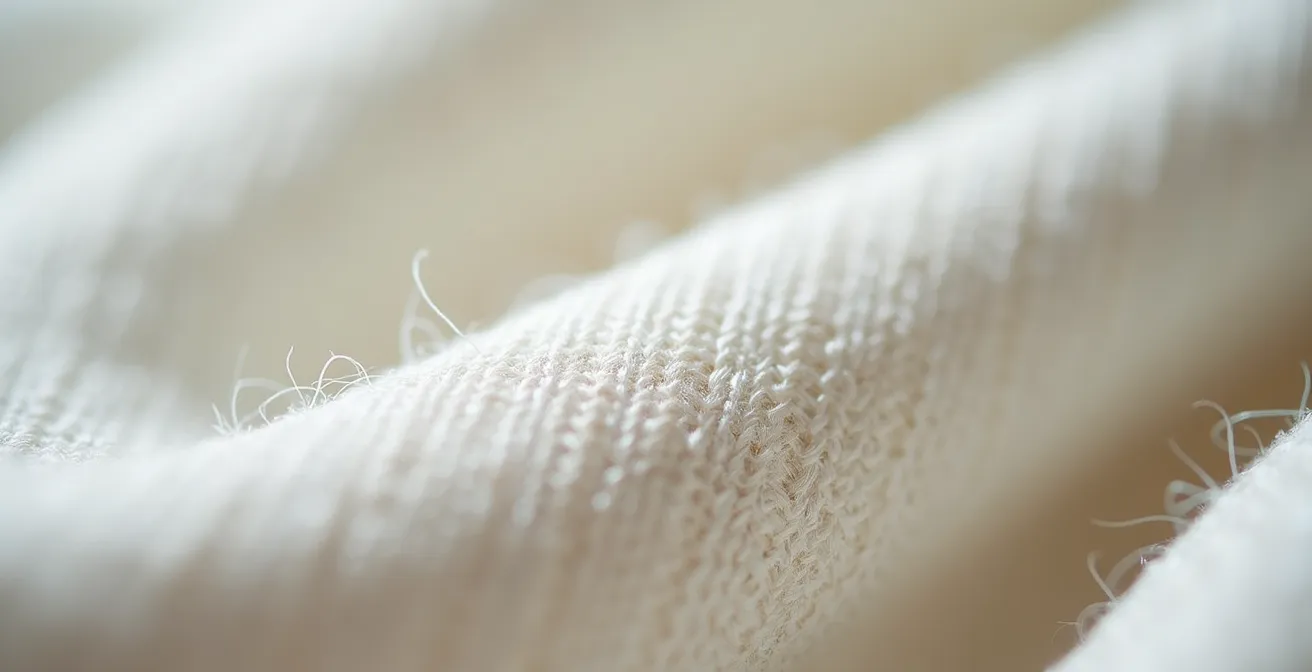
Beyond seams, the feel of the fabric itself tells a story. Quality fabric has a certain density and recovery. When you gently stretch a cuff, it should snap back immediately. This indicates strong fibers that will hold their shape over time. Learning to spot these physical clues in the dressing room empowers you to make smarter investments, ensuring the pieces you buy are built to last.
Your Checklist: The 5-Point Dressing Room Quality Audit
- The Seam Leg Twist Test: Hold a pair of pants by the waistband and let the legs hang freely. If the side seams twist or spiral around the leg instead of hanging straight, the fabric was cut off-grain. It will warp after washing.
- The Fabric Recovery Test: Gently stretch a small section of the fabric, like a cuff or hem, for a few seconds and then release. High-quality fabric will snap back to its original shape instantly. Poor quality fabric will remain slightly stretched or “bagged out.”
- The Button & Buttonhole Check: Examine the stitching around the buttonholes. It should be dense, tight, and neat. Loose or frayed threads are a clear sign of rushed production and a future point of failure.
- The Pattern Matching Test: On striped or patterned garments, check if the patterns align at the major seams (side seams, shoulder seams). Misalignment is a tell-tale sign that speed was prioritized over quality.
- The Hardware & Zipper Check: Look for branded zippers like YKK, which are known for their durability. Generic, unbranded metal or plastic hardware is often a weak point that will break or tarnish quickly.
When to Pack Away Winter Clothes to Keep Your Wardrobe Inspiring?
The conventional wisdom is to perform a biannual “wardrobe switch,” packing away all winter clothes to make room for summer items, and vice versa. This all-or-nothing approach, however, often creates a rigid, uninspiring closet that can’t adapt to unpredictable weather. A more strategic approach is to maintain a core of trans-seasonal pieces that live in your closet year-round, serving as the bridge between seasons.
Think of items like merino wool sweaters, silk camisoles, classic trench coats, leather jackets, and dark-wash denim. These pieces are layering powerhouses. A merino wool sweater is light enough to be worn on a cool spring evening but warm enough to be layered under a coat in the dead of winter. A silk camisole works under a blazer in the office or on its own on a hot summer day. A study on capsule wardrobes found that maintaining these core pieces reduces wardrobe transition stress by 60% and provides much-needed flexibility for unexpected temperature drops or heatwaves.
When it comes time for seasonal storage, the goal is not just to hide clothes but to preserve their longevity. Storing items properly—clean, in breathable containers, and folded or hung correctly—ensures they return to you next season in perfect condition. Create a “re-entry box” for pieces you’re unsure about. If you don’t miss them or reach for them by the next season, it’s a clear sign you can donate them with confidence.
Your Checklist: Professional Storage Guide for Garment Longevity
- Clean Everything Before Storage: This is non-negotiable. Wash or dry-clean every single item before it goes into storage. Moths and other pests are attracted to microscopic sweat, perfume, and food stains.
- Use Breathable Containers: Avoid storing clothes in the plastic bags from the dry cleaner, as they trap moisture and can cause yellowing. Opt for breathable cotton garment bags or archival boxes.
- Fold Knits, Hang Wovens: Heavy knit sweaters should always be folded flat to prevent the weight of the garment from stretching out the shoulders on a hanger. Use padded hangers for structured items like blazers and coats.
- Add Natural Moth Prevention: Place cedar blocks or dried lavender sachets in your storage containers. They are an effective, natural alternative to chemical mothballs, which can leave a persistent odor and damage fabrics.
- Create a ‘Re-entry Box’: For items you’re on the fence about, place them in a separate, clearly labeled box. If you go an entire season without once thinking of retrieving an item from that box, you can let it go.
How to Curate a High-End Wardrobe Exclusively Through Ethical Second-Hand Shopping?
Building a high-end wardrobe doesn’t have to mean paying high-end retail prices. The second-hand market offers an ethical and economical pathway to acquiring luxury goods, from Loro Piana cashmere to a classic Burberry trench. The key to success in this arena is shifting from passive browsing to a strategic hunt. This requires patience, knowledge, and a highly specific plan of attack.
Your first step is to create a “Most Wanted” list. This isn’t a vague wish list; it’s a detailed dossier for each item you’re seeking, including the exact brand, model name, size, preferred color, and material. With this specificity, you can set up saved searches and alerts on digital consignment platforms like Vestiaire Collective, The RealReal, or eBay. This lets technology do the heavy lifting, notifying you the moment an item matching your criteria is listed.
While digital platforms offer vast inventory, don’t underestimate the power of local consignment shops. Building a relationship with the owners or staff can give you first-look access to new arrivals before they even hit the sales floor. Finally, you must become your own authenticator. Learn the basics of identifying fakes for your target brands: study the font on the logos, the engravings on the hardware, and the consistency of the stitching. This knowledge is your best defense and ensures your investment is in genuine, lasting quality.
Your Checklist: The Strategic Hunt Method for Second-Hand Luxury
- Create a Hyper-Specific ‘Most Wanted’ List: Be precise. Instead of “a black bag,” specify “Celine Classic Box Bag, Medium, Black, Calfskin.” Know the exact details of what you’re looking for.
- Set Up Digital Alerts: Use your specific list to create saved searches and push notifications on platforms like The RealReal, Vestiaire Collective, and eBay. Let the algorithms hunt for you 24/7.
- Build Local Relationships: Introduce yourself at high-end local consignment stores. Let them know what you’re looking for. They often keep a list for their best clients and will call you first.
- Learn Authentication Basics: For each of your target brands, research their specific markers of authenticity. Pay close attention to stitching, logo fonts, hardware engravings, and date codes.
- Focus on Durability Brands: Prioritize your search on brands known for their longevity and craftsmanship, which hold their value in the second-hand market. Think Burberry for trenches, Loro Piana for cashmere, and Totême for modern tailoring.
Key takeaways
- Your wardrobe is an architecture, not an archive. Success comes from building a system of interchangeable modules, not from owning a specific number of items.
- Shift your financial mindset from “price tag” to “cost-per-wear.” The most valuable items are not the cheapest, but the ones you wear most often.
- Quality is a tangible skill you can learn. Assess garment integrity through physical checks of seams, fabric, and hardware to invest in pieces that last.
How to Curate a Personal Home Aesthetic That Transcends Fleeting Trends?
The same principles that create a functional, timeless wardrobe can be applied to create a personal and enduring home aesthetic. Just as with clothing, the home decor market is saturated with fast, fleeting trends designed to be replaced season after season. Resisting this cycle requires applying the capsule philosophy: build a foundation of high-quality, versatile “basics” and use smaller, less expensive items to introduce color and personality.
Your “basics” in this context are your big-ticket furniture items: your sofa, dining table, and bed frame. Just as you would invest in a classic wool coat, you should invest in furniture made from solid, durable materials with timeless silhouettes. A solid wood table may have a higher initial cost than a trendy particleboard alternative, but its lifespan can be measured in decades, not years, making its cost-per-year significantly lower.
This exact approach is gaining traction globally. In a notable trend, Korean interior designers have reported that applying capsule wardrobe principles directly to home design—using versatile neutrals for large pieces and changing accents like pillows and throws seasonally— reduces redecorating costs by an average of 70%. This demonstrates the power of a foundational system. By anchoring your space with quality and versatility, you create a canvas that can evolve with you, reflecting your personal taste without requiring a complete overhaul every time a new trend emerges.
How to Use Color Theory to Choose Makeup Shades That Enhance Your Features?
The final layer of a cohesive personal style is makeup, and here too, the principles of a capsule wardrobe apply. A “capsule makeup” collection is built on the same foundation of color theory used to select your clothing. The goal is to curate a small, effective collection of products in shades that are guaranteed to enhance your natural features, eliminating the drawer full of barely-used “mistake” purchases.
Start by identifying your color season (Winter, Spring, Summer, or Autumn) using the same skin undertone analysis from your wardrobe curation. This will be your infallible guide for choosing color products like lipstick, blush, and eyeshadow. A “Winter,” for example, will be radiant in cool-toned ruby red or fuchsia lipsticks, while a “Spring” will glow in warm, clear shades of coral and peach. Choosing within your palette ensures harmony between your makeup, your clothing, and your complexion.
Apply the 70/30 investment rule here as well. Invest the bulk of your budget in high-quality “skin” products where a perfect, lasting match is paramount—your foundation, concealer, and a flattering neutral blush. Save money on more trend-driven color items like bold eyeshadows or seasonal nail polishes, which can be explored with more affordable options. This creates a reliable, high-performing daily routine while still allowing for playful experimentation.
The most ethical garment is the one already in your closet. You just have to fall in love with it and wear it again.
– Daria Andronescu, Morning Lazziness Interview
This philosophy extends to every aspect of your aesthetic. By mastering these core principles, you move from chasing trends to defining a timeless personal style that is both sustainable and uniquely you. You learn to shop with intention, build a system that serves you, and find joy and confidence in the pieces you choose to live with.
By adopting a strategic, curatorial mindset, you can transform your relationship with your belongings. The next logical step is to begin your own wardrobe audit with this new perspective. Start today by assessing just one section of your closet using the cost-per-wear and quality audit principles.