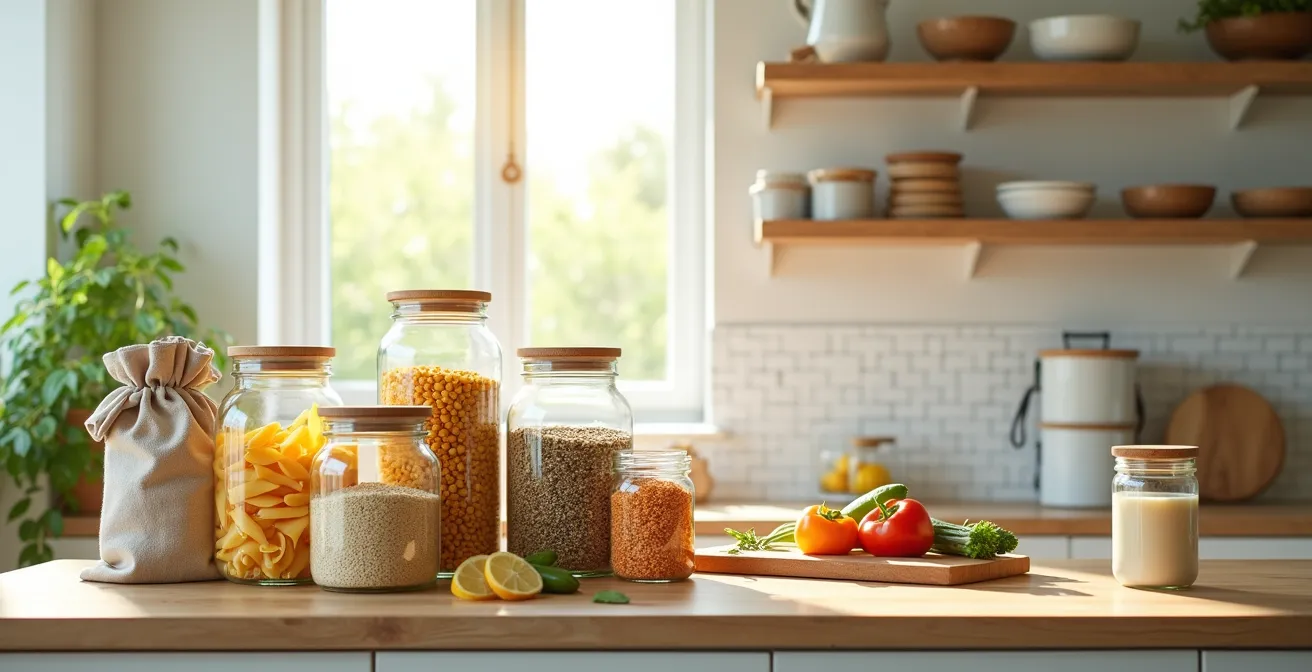
Achieving a zero-waste kitchen isn’t about buying a pantry full of matching glass jars; it’s about adopting frugal systems that fight waste at its source.
- Hidden issues, like microplastics from cutting boards, pose a greater risk than a visually cluttered pantry.
- Smart techniques, like two-stage bulk shopping and analyzing lifecycle costs, save far more money than any single “eco-friendly” purchase.
Recommendation: Start with one “system audit” in your kitchen this week, such as tracking your food wrap usage or implementing the FIFO method for your pantry.
The vision of a zero-waste kitchen often conjures images of perfectly aligned, aesthetically pleasing glass jars, minimalist countertops, and a sense of serene order. While beautiful, this Instagram-worthy ideal creates a significant barrier to entry for many. The perceived need to invest in a whole new set of expensive containers can make the entire lifestyle feel inaccessible, especially for a budget-conscious household. This pressure to purchase turns a movement about reduction into another form of consumerism, missing the point entirely.
The common advice—buy in bulk, use reusables, compost—is sound, but it often lacks practical, frugal guidance. But what if the key to a truly low-waste kitchen wasn’t about what you buy, but about the systems you build? The secret lies not in fancy jars but in a fundamental shift of perspective: from aesthetics to function, from products to processes. It’s about tackling the invisible sources of waste and contamination, optimizing what you already own, and making choices based on long-term value rather than initial appeal.
This guide demystifies the process by focusing on practical, frugal strategies that deliver real impact. We’ll explore how to identify hidden kitchen contaminants, shop smarter without the heavy lifting, analyze the true cost of common “eco” products, and implement simple systems that reduce both waste and mental clutter. It’s time to build a kitchen that is effective, not just elegant.
For those who prefer a visual format, the following video offers a fantastic look at realistic and often free zero-waste habits that complement the principles discussed in this guide.
To navigate this practical journey, we have structured the article around key questions and challenges every aspiring zero-waste household faces. The following summary outlines the path we will take, from identifying unseen problems to implementing permanent solutions.
Summary: A Practical Guide to a Low-Cost, Zero-Waste Kitchen
- Why Plastic Cutting Boards Might Be Contaminating Your Dinner?
- How to Shop the Bulk Aisle Without Carrying Heavy Glass Jars?
- Silicone or Beeswax Wraps: Which Is the Better Long-Term Investment?
- The Recycling Bin Error That Contaminates the Entire Truckload
- How to Compost Kitchen Scraps in an Apartment Without Fruit Flies?
- How to Adopt Eco-Minimalism to Reduce Stress and Waste Simultaneously?
- How to Identify Truly Sustainable Manufacturing Processes Behind Everyday Products?
- How to Integrate Smart Storage Solutions That Hide Clutter Permanently?
Why Plastic Cutting Boards Might Be Contaminating Your Dinner?
One of the most overlooked sources of contamination in the modern kitchen is not unwashed produce or expired food, but the very surface on which we prepare our meals. Plastic cutting boards, while cheap and convenient, shed microscopic particles with every slice of the knife. This isn’t a minor issue; individuals might be consuming between 7.4 to 50.7 grams of microplastics annually, which is the equivalent of eating a credit card’s worth of plastic every year from this source alone. These particles can enter our food and, consequently, our bodies.
The problem lies in the material itself. Polyethylene and polypropylene boards are soft to be gentle on knife edges, but this softness means they are easily scored. These grooves not only harbor bacteria but also release a constant stream of plastic fragments. The image below provides a macro view of this degradation, showing how knife scores create a landscape of plastic debris.

As the visual demonstrates, the damage is not just cosmetic. Choosing an alternative is a crucial first step in reducing this hidden contamination. The following table, based on a detailed analysis of cutting board materials, compares the most common options to help you make an informed, health-conscious decision.
| Material | Microplastic Release | Knife Impact | Hygiene | End-of-Life |
|---|---|---|---|---|
| Plastic (PE/PP) | High – millions of particles annually | Gentle on knives | Harbors bacteria in grooves | Difficult to recycle |
| Wood | None | Gentle on knives | Pores can harbor bacteria if not properly maintained | Compostable |
| Bamboo | None | Moderate | Naturally antimicrobial | Biodegradable |
| Glass | None | Harsh on knives | Most hygienic | Recyclable |
Ultimately, switching to a wood, bamboo, or even a glass cutting board (while being mindful of knife dulling) is a one-time change that permanently eliminates a significant source of plastic ingestion from your daily routine.
How to Shop the Bulk Aisle Without Carrying Heavy Glass Jars?
Shopping the bulk aisle is a cornerstone of a zero-waste kitchen, but the logistics can be daunting. The popular image involves lugging a set of heavy, clanking glass jars to the store, which is both inconvenient and impractical for most people. A far more effective and frugal approach is the two-stage decanting method. This system separates the act of shopping from the act of storing, making the process lightweight and efficient.
The principle is simple: use lightweight containers for transport and transfer the goods into your permanent storage at home. This eliminates the need to carry heavy glass and allows you to use what you already have. The most common tools for this are reusable cotton or mesh produce bags. They are light, foldable, and easy to bring on any shopping trip. By pre-weighing them, you ensure you only pay for the product, not the packaging.
Here’s how the system works in practice:
- Before shopping, take your empty cotton or mesh bags to customer service to have them weighed. Write this “tare” weight directly on the bag’s tag with a washable marker.
- Fill your bags with bulk items like oats, nuts, flour, or pasta. Use the washable marker to write the product code (PLU) on the bag.
- At the checkout, the cashier will subtract the tare weight from the total, so you’re not paying for the weight of the bag.
- Once home, decant the contents from the bags into your permanent containers—these can be the very glass jars you didn’t want to carry, repurposed takeout containers, or any airtight canister you already own.
- Finally, simply wash and dry the bags, ready for your next trip.
By adopting this two-stage process, you get all the waste-reduction benefits of bulk buying without the back-breaking effort, proving that effective systems are more valuable than expensive matching containers.
Silicone or Beeswax Wraps: Which Is the Better Long-Term Investment?
Moving away from single-use plastic wrap is a huge win for any zero-waste kitchen, but the market for alternatives can be confusing. The two most popular contenders are silicone lids/covers and beeswax wraps. Deciding between them isn’t just about which one works better, but which one represents a smarter long-term investment from both a financial and practical standpoint. The answer depends heavily on how you actually manage leftovers in your home.
Beeswax wraps are lauded for their natural, compostable properties. They are excellent for wrapping dry goods like bread, cheese, or covering a bowl of salad. However, they have a shorter lifespan (about a year) and are less effective for wet or oily foods. Silicone covers, on the other hand, are extremely durable, last for years, are dishwasher-safe, and excel at creating an airtight seal on bowls, making them perfect for soups, sauces, and freezer storage. Their downside is a higher initial cost and a more complex end-of-life, as they require specialized recycling.
To make a truly frugal choice, you must look at the total cost of ownership, not just the sticker price. The following table breaks down the key differences to help you assess which option better fits your kitchen’s needs and budget over time.
| Factor | Silicone Covers | Beeswax Wraps |
|---|---|---|
| Initial Cost | $15-30 for set | $20-25 for set |
| Lifespan | 2-3 years | 1 year (re-waxable) |
| Cost per Year | $5-15 | $20-25 (or $5 if re-waxed) |
| Best Use Cases | Wet/oily foods, freezer storage | Bread, cheese, bowl covers |
| End-of-Life | Requires special recycling (TerraCycle) | Fully compostable |
If you frequently store liquids or use the freezer, the durability of silicone will likely offer a better return on investment. If you primarily wrap sandwiches and cover dry bowls, the compostable nature and lower re-waxing cost of beeswax wraps may be the superior choice. The most sustainable product is the one you will actually use to its fullest potential.
The Recycling Bin Error That Contaminates the Entire Truckload
Diligently sorting recyclables is a habit many of us practice with good intentions. However, one common and seemingly small error can undermine the entire effort: wish-cycling. This is the act of putting an item in the recycling bin hoping it can be recycled, even if it can’t. The most damaging form of wish-cycling is tossing in containers with food residue. A greasy pizza box, a half-empty yogurt cup, or a jar with peanut butter residue can contaminate an entire bale of paper or plastic, forcing the whole batch to be sent to a landfill.
The scale of food-related waste is staggering, and it directly impacts the recycling stream. It’s a critical issue, especially when considering that 119 billion pounds of food is wasted annually in the United States alone, with a significant portion originating in home kitchens. When this food waste clings to our recyclables, it ruins the process. A quick rinse is often all that’s needed to ensure a plastic bottle or glass jar is actually recoverable.
Beyond food contamination, packaging itself can be deceptive. Many products are made of mixed materials that are impossible to separate and recycle. To avoid these common pitfalls, you need to become a packaging detective. The following checklist provides a simple framework for vetting items before they hit your bin.
Action Plan: Decoding Deceptive Packaging
- Check the resin code (the number 1-7 in the triangle), but understand that only #1 (PET) and #2 (HDPE) are widely and easily recycled in most municipalities.
- Ignore vague claims like “made from recycled content,” as this does not guarantee the item itself is recyclable.
- Inspect for fused materials. If a package combines paper and plastic that cannot be separated (like some coffee bags or frozen food pouches), it belongs in the trash.
- Rinse all containers thoroughly. A clean recycling stream is a functional one; food and liquid residues are the primary contaminants.
- When in doubt, check your local municipality’s recycling website. Rules vary significantly by location, and their guide is the ultimate authority.
By focusing on sending only clean, acceptable materials, you transition from a “wish-cycler” to an effective recycler, ensuring your positive actions have a real impact down the line.
How to Compost Kitchen Scraps in an Apartment Without Fruit Flies?
Composting is a powerful way to reduce kitchen waste, but for apartment dwellers, the fear of odors and pests—especially fruit flies—can be a major deterrent. Fortunately, several innovative and compact systems are designed specifically for small indoor spaces, keeping the process clean, contained, and pest-free. The key is to choose a method that either seals the food away or processes it too quickly for flies and smells to develop.
One of the simplest and most frugal methods is the Freezer Bag Method. This involves simply collecting your kitchen scraps (vegetable peels, coffee grounds, eggshells) in a large reusable bag or container in your freezer. It completely eliminates odors and pests and buys you time until you can drop the scraps off at a local community garden, farmers’ market, or municipal collection site. It requires no special equipment beyond a container.
For those who want to create nutrient-rich soil at home, Bokashi composting is an excellent anaerobic option. This method uses a special bucket with a spigot and an inoculated bran to ferment kitchen scraps, including meat and dairy. The system is airtight, so it remains odor-free when sealed. A particularly effective technique, as highlighted in a detailed case study on Bokashi-vermicomposting integration, is to add the fermented Bokashi material directly to a worm bin (vermicomposting), which further breaks it down into valuable compost without attracting pests.
Case Study: The No-Odor Bokashi and Worm Farm System
Many home composters have successfully integrated Bokashi and vermicomposting to create a powerful, odor-free system. Users report that by pre-fermenting all kitchen scraps in a sealed Bokashi bucket, they can then feed this material directly to their worm farm. The fermentation process neutralizes the odors that typically attract pests, and the worms efficiently process the material into rich vermicompost. This two-step method allows for the composting of a wider variety of food waste (including meat and dairy) entirely indoors without the common problems of smells or fruit flies.
Other options include electric composters, which dehydrate and grind food scraps in hours, or a well-maintained worm bin. With these modern solutions, living in an apartment is no longer a barrier to diverting your food waste from the landfill.
How to Adopt Eco-Minimalism to Reduce Stress and Waste Simultaneously?
The quest for a zero-waste kitchen can paradoxically lead to more clutter. We acquire reusable bags, a multitude of containers, special cleaning tools, and a pantry full of bulk goods. Eco-minimalism offers a powerful antidote. It’s a philosophy that merges the environmental consciousness of zero-waste with the intentionality of minimalism. The goal is not just to reduce waste but to reduce *everything*: possessions, mental clutter, and decision fatigue. It’s about owning fewer, better things and creating efficient systems.
This approach directly challenges the idea that you need specialized gadgets for every task. A truly eco-minimalist kitchen is not empty, but it is streamlined. It contains only the tools and ingredients that are used regularly, freeing up physical and mental space. This mindset is about creating a circular flow where everything has a purpose and is used to its fullest potential. As the team at SuperBee Eco Products states in their guide, How to Be a Zero Waste Kitchen:
Zero waste minimalism is about creating a circular system in the kitchen where everything is used to its fullest potential, leaving little to nothing to be discarded – it’s about creating kitchens that are not only environmentally responsible but also economically sensible and efficiently managed.
– SuperBee Eco Products, How to Be a Zero Waste Kitchen Guide
A practical way to implement this is through the “Kitchen Uniform” concept. Just as some people wear a personal uniform to simplify daily dressing, you can define a “uniform” of core tools and ingredients for your kitchen. This involves auditing your current habits to identify what you truly need and use, and then consciously removing the excess. The process is simple: track the handful of tools you use for 80% of your cooking, identify your core pantry staples, and temporarily store or donate the duplicates and single-use gadgets that only create clutter.
By focusing on function over form and sufficiency over abundance, eco-minimalism makes a zero-waste lifestyle more achievable, less stressful, and ultimately more sustainable in the long run.
How to Identify Truly Sustainable Manufacturing Processes Behind Everyday Products?
As consumers, our power extends beyond our own bins; it lies in the purchasing decisions we make. Supporting brands with genuinely sustainable practices is one of the most impactful ways to drive change. However, the marketplace is flooded with “greenwashing”—vague, misleading claims designed to make products appear more environmentally friendly than they are. Words like “eco-friendly,” “natural,” and “green” are often meaningless without proof. Learning to see past this marketing requires a critical eye and a bit of detective work.
A truly sustainable company is transparent. They don’t just make promises; they provide data. They are open about their supply chain, their material sourcing, and their end-of-life plans for their products. This often involves seeking out third-party certifications, which act as an independent verification of a company’s claims. For example, a B Corp certification is a rigorous assessment of a company’s entire social and environmental performance, making it a much stronger signal than a simple “carbon-neutral” sticker, which can sometimes be achieved just by purchasing offsets.
To quickly vet a brand’s sustainability claims, you can use a simple checklist to look for concrete evidence of their commitment:
- Check for a dedicated sustainability page: Look for specific metrics, goals, and progress reports, not just vague mission statements.
- Look for supply chain transparency: Do they name their factories or the regions where their materials are sourced?
- Verify material sourcing: Do they specify the type of materials (e.g., FSC-certified wood, GOTS-certified organic cotton) and explain why they were chosen?
- Assess end-of-life programs: Does the company offer a repair program, sell replacement parts, or have a take-back program for recycling their products?
- Prioritize rigorous certifications: B Corp, Fair Trade, and Global Organic Textile Standard (GOTS) are examples of robust, third-party verifications.
While no company is perfect, choosing those that demonstrate genuine transparency and a commitment to circular design—creating products built to last and be repurposed—sends a powerful message that you value durability and responsibility over disposability.
Key Takeaways
- A zero-waste kitchen is built on frugal, practical systems, not expensive, aesthetic containers.
- Hidden contaminants, like microplastics from plastic cutting boards, are a significant health and environmental concern that can be eliminated with simple swaps.
- Effective waste reduction relies on understanding processes like proper recycling and lifecycle costs, which empowers you to make smarter, more impactful choices.
How to Integrate Smart Storage Solutions That Hide Clutter Permanently?
A zero-waste lifestyle often means buying in bulk and preparing more food from scratch, which can quickly lead to a cluttered and disorganized pantry. The solution isn’t necessarily more storage space, but *smarter* storage systems. The ultimate goal is to create a flow that ensures food is used efficiently, minimizing waste and making it easy to see what you have at a glance. The most powerful and frugal system for this is FIFO: First In, First Out.
FIFO is a simple inventory management principle used by restaurants and grocery stores that you can easily adopt at home. It means you always use the oldest items first. When you unpack groceries, you place the new items at the back of the shelf and move the older items to the front. This systematic rotation prevents food from getting lost in the back of the cupboard and expiring before you have a chance to use it. Proper storage methods are critical, as they can significantly extend the shelf life of food and substantially cut down on household food waste.
Implementing FIFO doesn’t require any special equipment. You can start today with what you already own. Repurposed glass jars from pasta sauce or pickles, and even clear takeout containers, can be used to create a uniform and transparent storage system. Using clear containers is key, as it allows you to see exactly what you have without needing to open every lid. For opaque containers, a simple label with the “opened on” date can work wonders. The core of the system is creating a designated “use first” area—a specific shelf or bin at eye level where you place items that need to be consumed soon.
By shifting the focus from simply storing items to managing them in a deliberate flow, you transform your pantry from a source of clutter and waste into an efficient, money-saving engine for your kitchen.