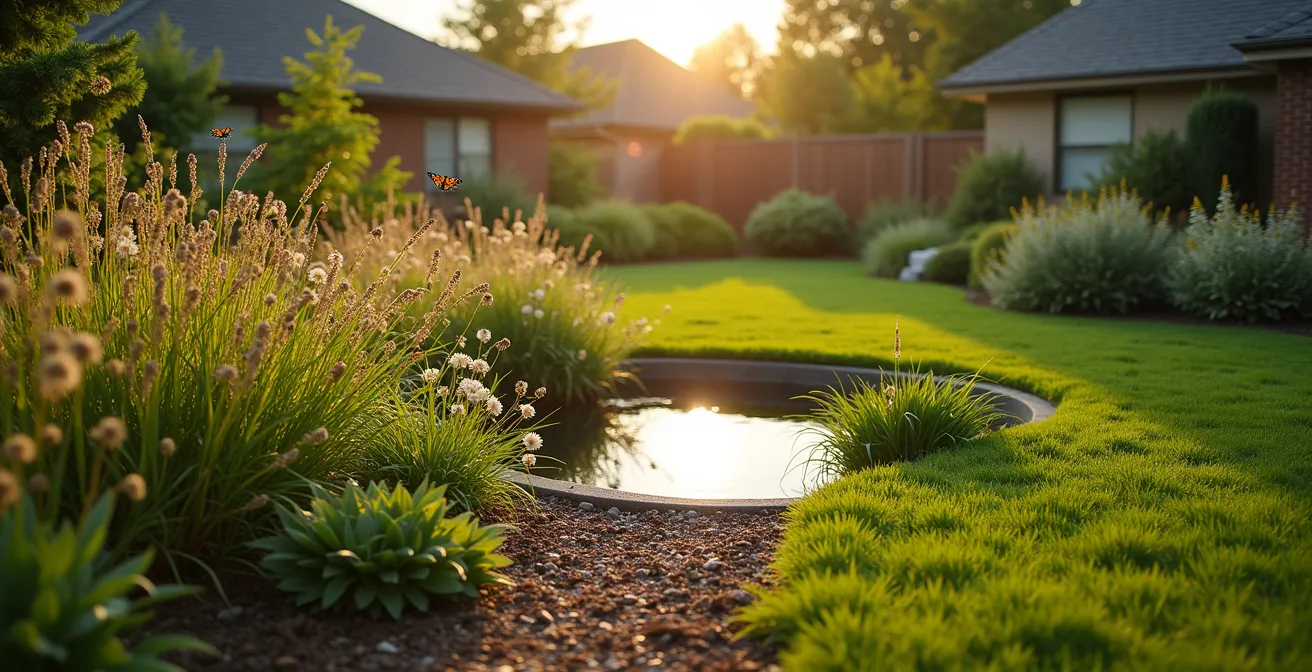
Contrary to popular belief, a wildlife-friendly garden is not about adding a few ‘correct’ plants; it’s about designing a resilient, interconnected ecosystem that largely takes care of itself.
- The pristine, green lawn is an “ecological desert” that actively harms biodiversity through a process of continental-scale homogenization.
- Building a garden with layers, from ground cover to canopy trees, creates a self-regulating system that provides food and shelter for a complex web of life.
Recommendation: Stop thinking of your yard as a space to decorate and start viewing it as a small nature reserve you can design and steward.
For many eco-conscious homeowners, the desire to support nature starts right outside the back door. You see the manicured lawns, the perfectly trimmed hedges, and you feel a growing disconnect. This image of the “perfect” suburban yard—a vast, sterile carpet of green—is deeply ingrained in our culture, but it represents a profound ecological loss. We’ve been taught to tidy, to control, and to sanitize our outdoor spaces, inadvertently silencing the buzz of bees and the songs of local birds. The common advice often circles around planting a few flowers for pollinators or putting up a bird feeder, treating nature as an accessory.
But what if the goal wasn’t just to attract wildlife, but to build a world for it? The true potential of a suburban garden lies not in being a decorated space, but a functional one. This requires a fundamental shift in perspective: from gardener as a decorator to gardener as an ecosystem designer. It’s about moving beyond simply adding ‘features’ and instead orchestrating a symphony of native plants, beneficial insects, and healthy soil that work in cooperative harmony. This approach doesn’t just create a beautiful space; it creates a resilient, low-maintenance habitat that becomes a vital node in a larger, fragmented landscape.
This guide is designed to walk you through that paradigm shift. We will deconstruct the myth of the perfect lawn, explore the power of native plant systems, and reveal how to design a garden that functions as a complete, multi-layered ecosystem. By the end, you will have the knowledge to transform your yard from a simple plot of land into a thriving, beautiful, and ecologically significant sanctuary.
To guide you on this journey of ecological transformation, this article is structured to build your understanding from the ground up. We’ll start by diagnosing the problem with modern landscapes and progressively build towards holistic design solutions that you can implement in your own backyard.
Summary: A Guide to Creating a Functional Garden Ecosystem
- Why Sterile Lawns Are “Green Deserts” for Local Wildlife?
- How to Select Native Plants That Require Zero Supplemental Watering?
- Chemical Pesticides or Beneficial Insects: Which Solves Aphid Problems Permanently?
- The Invasive Plant Mistake That Can Take Over Your Neighbor’s Yard
- How to Design a “Food Forest” Layering System in a Suburban Backyard?
- How to Create a Wildlife Corridor in an Urban Backyard to Support Local Species?
- How to Maintain a Lush Landscape All Year With Minimal Weekly Effort?
- How to Minimize Your Daily Exposure to Environmental Pollutants in an Urban Setting?
Why Sterile Lawns Are “Green Deserts” for Local Wildlife?
The quintessential image of a home—a house surrounded by a lush, green lawn—is an ecological mirage. While green, this monoculture of turfgrass offers virtually nothing to support local ecosystems. It lacks the floral resources required by pollinators, the foliage needed by insect herbivores, and the structural diversity that provides shelter for birds and small mammals. This issue is more than just a missed opportunity; it’s an active contributor to biodiversity loss. According to WWF’s 2024 Living Planet Report, there has been a devastating 73% average decline in monitored wildlife populations since 1970, a collapse driven primarily by habitat loss.
The suburban lawn is a primary actor in this crisis. Research funded by the NSF across major US cities revealed that lawn maintenance is driving a process of ecological homogenization. This means that regardless of whether you are in arid Phoenix or temperate Boston, residential lawns are becoming strikingly similar, dominated by a handful of non-native turfgrass species. This erases regional ecological identity and creates vast “green deserts” that are inhospitable to native fauna, which have co-evolved over millennia with specific local plants.
These lawns demand intensive resources—water, fertilizers, and pesticides—that further degrade the environment. They are static, lifeless spaces in a world that desperately needs dynamic, living ones. The first step in creating a biodiverse garden is recognizing the lawn not as a default landscape, but as an ecological void that you have the power to transform into a thriving habitat.
How to Select Native Plants That Require Zero Supplemental Watering?
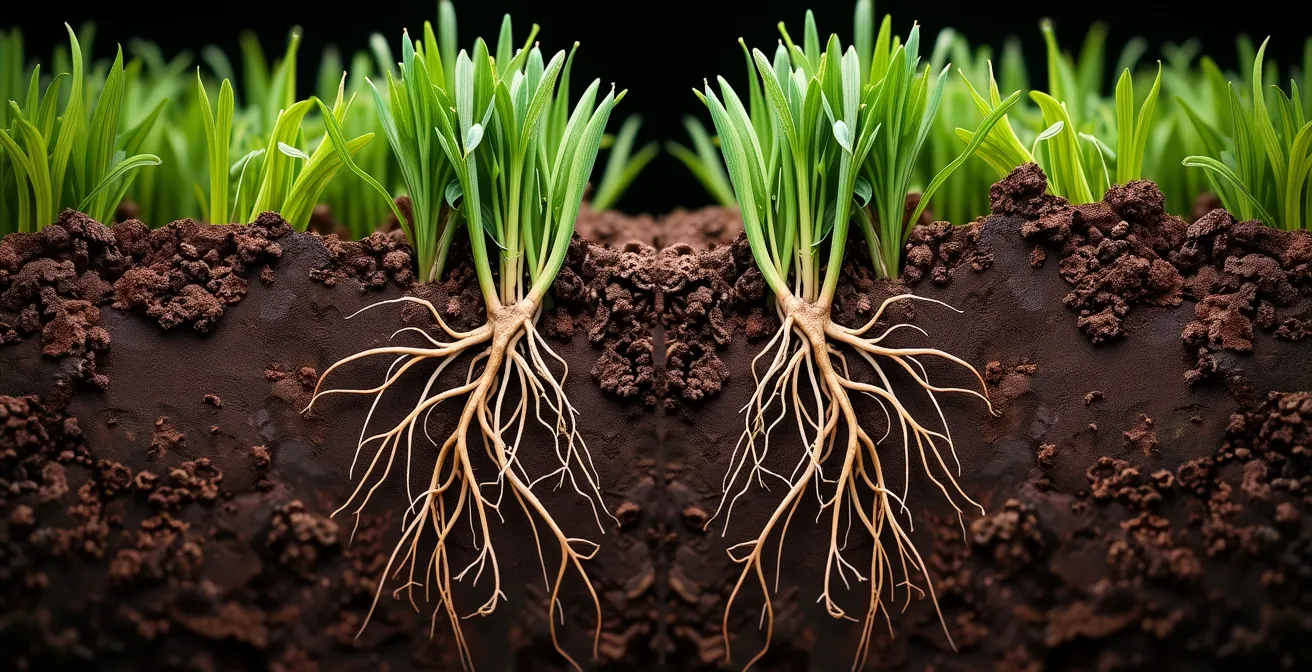
The secret to a low-maintenance, drought-proof garden lies in working with nature, not against it. The key is selecting plants that are already perfectly adapted to your specific climate, soil, and rainfall patterns: native plants. Unlike thirsty lawn grasses or exotic ornamentals, native species have evolved deep, extensive root systems that are incredibly efficient at finding and storing water. These roots not only make the plants resilient but also improve soil structure, increase water infiltration, and prevent erosion.
This illustration powerfully contrasts the shallow, needy roots of typical turfgrass with the deep, self-sufficient root systems of native prairie plants. This visual difference is the core reason why a native garden can thrive with little to no supplemental watering once established, while a lawn requires constant irrigation.
Choosing the right native plant isn’t just about picking any species from your region. It requires a more granular observation of your own yard. You must identify your specific microclimates—is an area in full sun with sandy, fast-draining soil, or is it a shady corner with heavy clay? The goal is to match the plant to the place. A plant that naturally grows in a damp, shady woodland will not survive in a hot, dry sun patch, even if it’s native to your state. By honoring these specific site conditions, you create a garden that works in harmony, reducing your workload and creating a more resilient landscape.
Chemical Pesticides or Beneficial Insects: Which Solves Aphid Problems Permanently?
When an outbreak of aphids appears on your prized roses, the immediate temptation is to reach for a chemical spray. This approach, however, is a short-term fix that creates a long-term problem. Chemical pesticides are indiscriminate; they kill the aphids, but they also wipe out the beneficial insects that are nature’s own pest control service—ladybugs, lacewings, and hoverflies. This creates a sterile environment, a vacuum that pests, which reproduce quickly, will be the first to re-colonize, leading to a perpetual cycle of spray-and-reinfest known as the “pesticide treadmill.” Beyond the garden, these chemicals have devastating impacts; the U.N. reports that approximately 200,000 people die each year from acute pesticide poisoning.
The permanent solution is to foster a garden that polices itself. This means creating a habitat that supports a healthy population of predatory insects. You do this by planting a diverse range of native species that provide nectar, pollen, and shelter for these “good bugs” throughout the year. A garden with layers of complexity—different flower shapes, continuous blooms, and places for insects to overwinter—builds systemic resilience. When aphids appear in a balanced ecosystem, they are not a “problem” to be eliminated, but a food source that attracts predators. This is a core principle of ecological design: the problem becomes the solution.
Research consistently shows a direct correlation between native plant diversity and native animal diversity. Studies in Florida, for instance, demonstrate that native bird, insect, and spider diversity declines sharply in urban areas dominated by turf and non-native plants. By cultivating a complex, native-plant-based habitat, you are not just avoiding chemicals; you are building a living, breathing food web—a set of trophic layers where balance is maintained naturally and permanently.
The Invasive Plant Mistake That Can Take Over Your Neighbor’s Yard
While enthusiasm for planting is wonderful, one of the most damaging mistakes a gardener can make is introducing a non-native invasive species. These are plants that, freed from the natural competitors and diseases of their home ecosystems, spread aggressively and outcompete native flora. Research identifies the spread of non-native species as the second-greatest threat to biodiversity, right after direct habitat loss. An invasive plant in your garden doesn’t stay in your garden; its seeds can be carried by wind or birds, infesting local parks, natural areas, and your neighbors’ yards, causing ecological and economic damage that can last for decades.
It’s crucial to distinguish between an aggressive native plant, which might spread but is part of the local ecosystem, and a true non-native invasive. Many popular ornamental plants sold in garden centers are known invasives, such as English Ivy or Japanese Barberry. Furthermore, some plants are “sleeper invasives,” appearing well-behaved for years until a change in climate or reaching maturity triggers explosive growth. Prevention is the only effective cure. This requires vigilance and a commitment to understanding what you are planting.
The best defense is a good offense: learn to identify the common invasive species in your region and remove them immediately if found. Regular monitoring of your property and the surrounding area can prevent a small problem from becoming an uncontrollable infestation that impacts the entire community. This diligence is a core responsibility of an ecological gardener.
Your Action Plan: Invasive Species Audit
- Identification: Create a list of the top 5-10 invasive plants for your specific region (local conservation authorities are a great resource). Learn their appearance at different life stages.
- Survey Your Property: Walk your entire garden and methodically check for any of the identified invasives. Pay special attention to property lines and “wild” corners.
- Confront & Remove: If an invasive is found, research the correct removal method (some must be dug out completely, others can be cut back). Remove it immediately before it sets seed.
- Monitor for “Sleepers”: Keep an eye on any non-native plants that spread very quickly or seem overly dominant, even if not on an official invasive list. Watch for warning signs like rapid spreading after a few years.
- Plan for Replacement: Once an invasive is removed, have a plan to fill the empty space with a desirable, non-invasive native plant to prevent re-colonization.
How to Design a “Food Forest” Layering System in a Suburban Backyard?
A food forest, or forest garden, is the ultimate expression of a designed ecosystem. It’s a gardening technique that mimics the structure of a natural woodland to create an abundant, diverse, and largely self-maintaining system. Instead of planting in rows, you think in three dimensions, creating multiple vertical layers of plants that work together. This layering multiplies the productivity and habitat potential of even a small suburban backyard, turning it into a rich tapestry of life.
This illustration shows how the seven distinct layers of a food forest can be stacked within a compact space, creating immense ecological value.
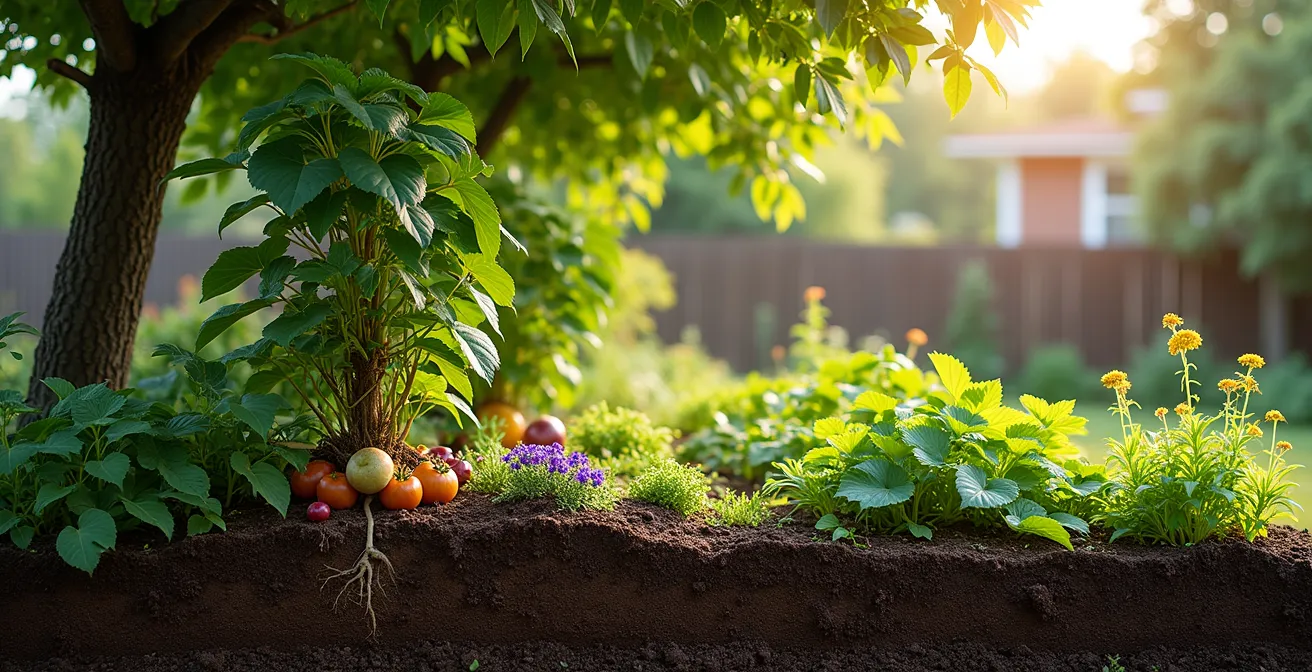
The design is based on cooperative plant communities. Unlike many non-native plants that fiercely compete for resources, many native species have evolved to share them. A food forest leverages this principle by stacking layers:
- The Canopy Layer: Tall fruit or nut trees.
- The Understory Layer: Dwarf fruit trees or large shrubs.
- The Shrub Layer: Berry bushes like blueberries or currants.
- The Herbaceous Layer: Perennial vegetables, herbs, and flowers.
- The Groundcover Layer: Low-growing edible plants like strawberries that suppress weeds.
- The Rhizosphere: Root crops like potatoes and carrots.
- The Vertical Layer: Climbing plants and vines like grapes or beans.
Each plant is chosen for the multiple functions it performs—providing food, attracting pollinators, fixing nitrogen in the soil, or repelling pests. This creates a closed-loop, resilient system that builds soil fertility and supports a huge diversity of life, from mycorrhizal fungi below ground to songbirds in the canopy. It is the pinnacle of creating a garden that is both beautiful and deeply, ecologically functional.
How to Create a Wildlife Corridor in an Urban Backyard to Support Local Species?
Your garden does not exist in isolation. It is, or has the potential to be, a vital part of a larger network of green spaces that function as wildlife corridors. For a turtle trying to reach a pond, a bee foraging for nectar, or a bird migrating through the city, fragmented habitats are a mortal threat. A backyard filled with native plants, a small water source, and shelter can serve as a crucial stepping-stone, allowing wildlife to move safely through the urban and suburban matrix. By connecting your garden to a neighbor’s, you begin to weave together a larger, more resilient ecological fabric.
The need for these corridors is urgent. Research shows that 40% of all insect species are declining at a rate eight times faster than that of mammals or birds, largely due to habitat fragmentation. Your garden can be a sanctuary. The power of even a small, “ordinary” suburban lot was magnificently demonstrated by ecologist Jennifer Owen. In a 30-year study of her own modest garden in Leicestershire, UK, she identified an astonishing 2,673 different species living in or passing through. Her yard wasn’t an untamed wilderness; it had a lawn, a small pond, and vegetable beds, proving that a thoughtfully managed space can serve as a biodiversity hotspot.
To create an effective corridor, think about connectivity. Plant a hedge of native shrubs along your property line instead of a sterile fence. Talk to your neighbors about their own planting efforts. A single garden is a refuge; a street of connected gardens becomes a highway for wildlife, dramatically increasing the ecological impact of your individual efforts and helping to sustain local populations of countless species.
How to Maintain a Lush Landscape All Year With Minimal Weekly Effort?
A biodiverse garden is not a “no-maintenance” garden, but it is a “low-maintenance” one that requires a different kind of care—stewardship rather than labor. The goal is to let the garden’s natural systems do most of the work for you. This means embracing a level of strategic messiness and resisting the urge to constantly “tidy up.” Nature, after all, is not neat.
When it comes to a biodiverse garden, some messiness is good. In the wild, an untidy woodland is a healthy woodland.
– Kew Gardens, Royal Botanic Gardens, Kew
This “messiness” is actually providing critical habitat. Instead of deadheading all your flowers, leave the seed heads on plants like coneflowers and sunflowers; they provide a vital food source for birds like goldfinches through the winter. Instead of raking up all the leaves in the fall, allow a layer of leaf litter to remain under shrubs and trees. This provides a crucial overwintering habitat for countless beneficial insects, including queen bumblebees and butterfly larvae, while also naturally mulching and enriching your soil as it decomposes.
Other low-effort, high-impact strategies include establishing permanent perennial sections that don’t require annual replanting and allowing parts of your lawn to grow long, especially in the spring (“No Mow May”), to support early-season pollinators. By shifting your mindset from “control” to “collaboration,” you will find that the garden begins to sustain itself. You spend less time working against nature and more time simply observing and enjoying the vibrant, living ecosystem you have helped to create.
Key Takeaways
- A sterile lawn is an “ecological desert” that contributes to wildlife decline through homogenization.
- Native plants with deep root systems are the foundation of a resilient, low-water garden.
- Designing a garden with multiple layers (a “food forest”) creates a self-regulating ecosystem that provides maximum habitat.
How to Minimize Your Daily Exposure to Environmental Pollutants in an Urban Setting?
Creating a biodiverse garden is not just an act of ecological generosity; it’s also a powerful act of self-care. The conventional model of lawn care relies heavily on a cocktail of synthetic fertilizers and chemical pesticides. These substances don’t stay where they are put. They can be tracked into your home on shoes and pet paws, they can volatilize into the air you breathe, and they can run off your property to pollute local waterways and groundwater. By transitioning to an organic, ecological approach, you are directly minimizing your family’s daily exposure to these harmful pollutants.
The resource waste of a conventional lawn is staggering. Data on typical lawn water consumption shows it uses around 30 gallons per square foot annually, whereas a native landscape can thrive on as little as 3-5 gallons. This reduction in water use is not only good for the planet but also for your utility bill. More importantly, eliminating the need for chemical inputs means you are creating a safe space for children and pets to play, free from the residues of pesticides and herbicides.
A biodiverse garden actively cleans the environment. The complex foliage of a multi-layered garden helps to trap airborne particulates and pollutants, while healthy, living soil acts as a powerful filter, breaking down contaminants. By choosing to cultivate a living ecosystem instead of a sterile monoculture, you are taking a tangible step to improve the health of your local environment and, most importantly, the health and well-being of your own family.
Now that you are equipped with this new ecological lens, the next step is to begin observing your own yard. Assess its sunny spots, its shady corners, its soil type, and start dreaming about the thriving, living system it could become.