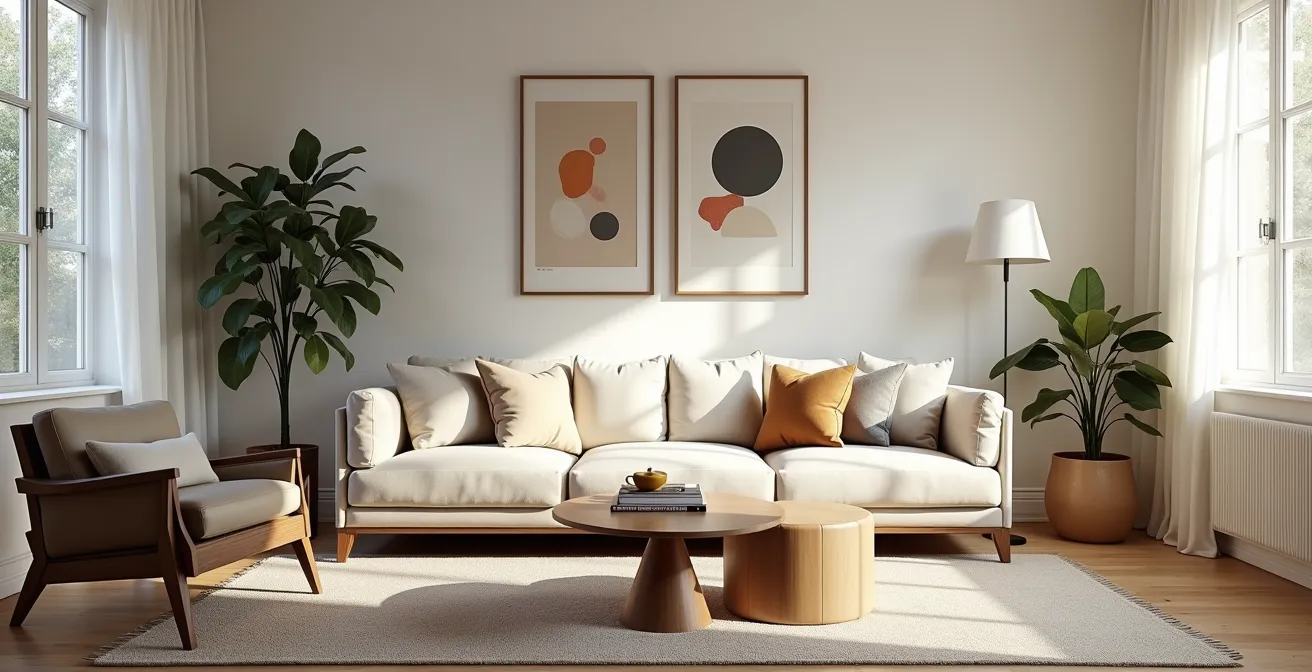
Achieving a high-end look is not about having an unlimited budget, but about adopting a professional’s strategic process.
- The biggest budget killer isn’t expensive taste; it’s the hidden costs of poor planning and logistical errors common in DIY projects.
- A cohesive design is born from a rigorous translation of inspiration into a tangible plan, using your unique “Design DNA” as a filter for every choice.
Recommendation: Instead of focusing on cutting costs everywhere, prioritize splurging on high-touch, high-impact items (like cabinetry and hardware) and save on easily replaceable decor.
Many homeowners with a keen eye for design believe that bringing their vision to life is a simple choice: either spend a fortune on a top-tier designer or brave the world of DIY to save money. The internet is filled with advice championing the latter, suggesting that a can of paint and some thrift store finds are all you need. This often leads to a frustrating reality where projects stall, budgets spiral, and the final result feels disjointed—a shadow of the beautiful images saved on a Pinterest board.
The common perception is that professional design is a luxury reserved for the few. However, the true value of a professional approach lies not in expensive finishes, but in a disciplined process that mitigates risk, maximizes impact, and prevents costly errors. The most expensive mistake is often not the price of a sofa, but having to redo an impractical kitchen layout or replace a trendy tile that looked dated in a matter of months. This is where the gap between amateur enthusiasm and professional execution becomes a chasm of wasted time and money.
But what if the key wasn’t simply to hire a designer, but to *think* like one? This guide is built on a counter-intuitive principle: achieving a professional-level result on a mid-range budget requires adopting the strategic mindset of an architect. It’s about shifting focus from simply “decorating” to managing a project with intention. It’s less about bargain hunting and more about value engineering—making informed decisions on where to invest and where to save, how to create a cohesive plan, and how to navigate the logistical minefield of a renovation.
This article will walk you through this professional framework. We will deconstruct the true costs of DIY, show you how to build a bulletproof design plan, identify where your money makes the most impact, and help you curate a timeless aesthetic that adds real value to your home. By the end, you will have the strategic tools to manage your project with the confidence and foresight of a seasoned professional, ensuring your budget is respected and your vision is fully realized.
To navigate this complex process, it is essential to understand each component, from initial financial planning to the final aesthetic choices. The following sections break down the core pillars of a professionally managed design project.
Summary: A Strategic Roadmap to Designing on a Budget
- Why DIY Renovations Often Cost 20% More Than Hiring a Designer?
- How to Translate Pinterest Inspiration Into a Cohesive Design Plan?
- Custom Cabinetry or Designer Lighting: Where Should You Splurge?
- The Trendy Tile Mistake That Will Look Dated within 3 Years
- When to Buy Furniture During a Renovation to Avoid Logistics Nightmares?
- How to Manage a Self-Build Housing Project Without Exceeding the Budget by 20%?
- How to Curate a Personal Home Aesthetic That Transcends Fleeting Trends?
- How to Strategically Increase Property Value With Low-Cost Cosmetic Updates?
Why DIY Renovations Often Cost 20% More Than Hiring a Designer?
The allure of a DIY renovation is powerful, promising creative control and significant cost savings. However, the financial reality is often starkly different. The primary reason for this discrepancy lies in the hidden costs that amateurs rarely anticipate but professionals are trained to avoid. These include rework due to errors, inefficient sourcing, and the lack of access to trade-only discounts. A professional’s network is one of their most valuable assets; their trade-only discounts and vendor relationships can save clients between 15-30% on furniture and materials, often offsetting a significant portion of their design fees.
Furthermore, the most expensive mistakes are not small cosmetic flaws but fundamental planning errors. As an architect, I frequently see homeowners invest heavily in a kitchen renovation only to be left with an impractical layout. Fixing structural or layout issues post-construction is exponentially more expensive than getting it right on paper first. This is a classic example of a “hidden cost” that can derail a DIY budget entirely. A professional process front-loads these critical decisions, ensuring functionality is perfected before a single wall is touched.
Believe it or not, hiring an interior designer can save you money. Using a professional will help you avoid costly trial-and-error mistakes while ensuring you get the look you desire. Additionally, some design services even pass on furniture and decor discounts not typically available to the public.
– Decorilla Design Team, Affordable Interior Design 2026
Ultimately, the “cost” of a project is not just the sum of your receipts. It also includes the value of your time, the stress of managing unforeseen problems, and the financial impact of mistakes that diminish your home’s functionality and value. A designer’s fee is an investment in risk mitigation and process efficiency. By navigating procurement, managing timelines, and foreseeing potential issues, they protect the single most important asset: your budget.
How to Translate Pinterest Inspiration Into a Cohesive Design Plan?
A Pinterest board is a fantastic tool for gathering inspiration, but it is not a design plan. It’s a collection of disparate ideas that often contradict each other. The professional’s first job is to distill this visual chaos into a cohesive and actionable strategy. This process is about identifying your “Design DNA”—the core, recurring elements that define your true aesthetic. Without this step, you risk creating a home that feels like a showroom of disconnected trends rather than a personal sanctuary.
The transition from digital inspiration to a physical plan is a critical phase. It involves moving from screen to reality by gathering actual material samples. An image of a wood floor can look completely different under your home’s specific lighting conditions. A fabric that looks plush online might feel coarse to the touch. Creating a materials tray with swatches of fabric, tile, wood, and metal finishes allows you to see and feel how the elements interact. It’s a low-cost, high-impact step that prevents expensive “I thought it would look different” moments.
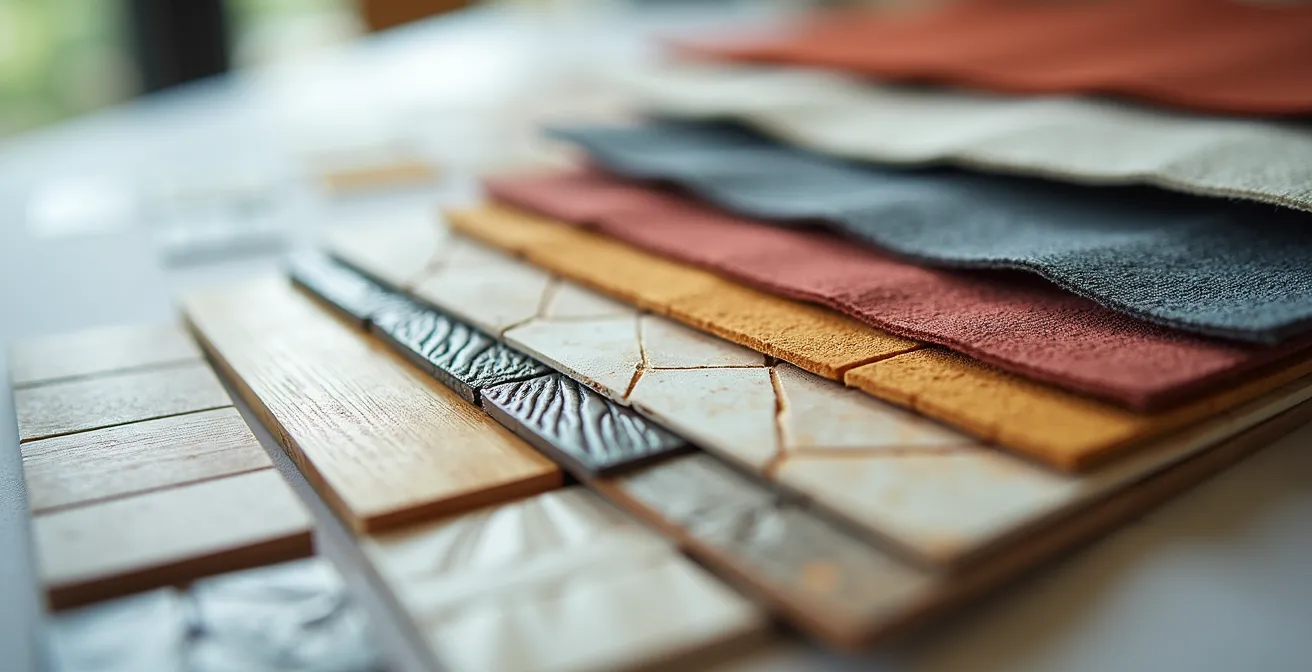
As the image above illustrates, this is a tactile process of curation. Once you have identified the key patterns, colors, and materials, the final step is to create a one-sentence concept statement. This becomes your cohesive filter for every single purchase. For example: “A serene and textural sanctuary blending Scandinavian simplicity with warm, organic materials.” If a piece of furniture or decor doesn’t align with this statement, it doesn’t make it into your home, no matter how trendy or appealing it is on its own.
Your Action Plan: The Design DNA Method
- Audit Your Inspiration: Systematically review your Pinterest board to extract the 3-5 most recurring materials (e.g., light oak, brass, linen).
- Define Your Palette: Identify the 3 key colors that appear most frequently across your saved images, establishing your primary and accent tones.
- Identify Common Forms: Note 2 common shapes or patterns (e.g., soft curves, clean geometric lines) that give your style its form.
- Create a Physical Tray: Collect actual samples of your chosen materials and colors to test them in your home’s light. This is your tangible mood board.
- Develop Your Filter: Write a one-sentence concept statement (e.g., “Warm minimalism meets industrial heritage”) that will serve as your guiding principle for every decision.
Custom Cabinetry or Designer Lighting: Where Should You Splurge?
With a mid-range budget, every dollar must be allocated with strategic intent. The most common mistake is spreading the budget too thinly across every item, resulting in a space where nothing truly stands out. The professional approach is to practice value engineering: identifying where to splurge for maximum impact and where to save without compromising the overall vision. A useful framework for this is the “Investment Matrix,” which evaluates items based on their daily interaction (High-Touch) and their visual presence (High-Impact).
Items that are both high-touch and high-impact are your prime candidates for investment. Think about what you interact with every single day: kitchen cabinetry, door handles, and faucets. These elements are not only central to your home’s functionality but are also made of materials whose quality is immediately apparent. Opting for high-quality, durable custom cabinetry provides a superior user experience and has a longevity that far outlasts trendy, cheaper alternatives. Similarly, the tactile sensation of solid, well-crafted hardware elevates the perception of the entire space.
Conversely, some items have a very high visual impact but low daily interaction. A statement pendant light in a dining room or a sculptural floor lamp can act as the “jewelry” of the room. While you don’t physically touch it often, its presence defines the space’s character and mood. This makes designer lighting a strategic splurge. On the other end of the spectrum are decorative items like pillows, throws, and vases. These are low-cost, low-commitment items perfect for experimenting with trends. They can be easily swapped out as your tastes evolve, allowing the core of your design to remain timeless.
The following table provides a clear framework for making these critical investment decisions. By focusing your budget on items with high touch-points and a long ROI timeline, you ensure that your investment is both felt and seen for years to come.
| Investment Area | Daily Touch Points | Visual Impact | ROI Timeline | Recommended Priority |
|---|---|---|---|---|
| Custom Cabinetry | High (20+ times/day) | Medium-High | 20+ years | Splurge |
| Designer Lighting | Low (visual only) | Very High | 10-15 years | Strategic Splurge |
| Hardware/Faucets | High (15+ times/day) | Medium | 15+ years | Splurge |
| Decorative Items | Low | Medium | 3-5 years | Save |
The Trendy Tile Mistake That Will Look Dated within 3 Years
Nowhere is the battle between trend and timelessness more fiercely fought than with tile. As a permanent, hard-to-replace finish, your tile choice has long-term consequences for both your home’s aesthetic and its resale value. The most common and costly mistake is selecting a tile based on a fleeting Instagram trend. Overly graphic, stylized patterns or high-gloss finishes, while exciting for a moment, can quickly make a space feel dated. In a few years, what once felt fresh can become the avocado-green-appliance of its time.
The antidote to this is to favor materials and finishes with inherent longevity. Matte-finish tiles, for example, tend to feel more relaxed, sophisticated, and timeless than their high-gloss counterparts. Glossy tiles reflect light in a way that can feel busy and show every fingerprint and water spot, while a matte or satin finish diffuses light, creating a calmer, more elegant atmosphere. This is less about a specific style and more about the intrinsic quality of the finish itself. A calm, sophisticated backdrop allows other elements in the room to shine.
To ensure your choices stand the test of time, follow a few key principles. First, prioritize classic geometric patterns like subway, hexagon, or herringbone over niche graphic designs. These shapes have been used for centuries and have a proven track record. Second, opt for tiles that mimic natural materials with realistic variations rather than stylized or artificial-looking patterns. Finally, and most importantly, ensure your tile choice is congruent with your home’s architectural style. A modern, minimalist tile will feel out of place in a historic Victorian home, and vice-versa. The goal is to create a cohesive dialogue between the fixed finishes and the home’s骨架 (skeleton).
If you are drawn to a trendy pattern, use it sparingly as an accent—perhaps in a small powder room or a kitchen backsplash—rather than for an entire master bathroom floor. This gives you the creative expression you crave without committing a large, expensive surface to a look that may not last. This strategic use of trend as an accent is a hallmark of professional design.
When to Buy Furniture During a Renovation to Avoid Logistics Nightmares?
In the excitement of a renovation, it’s easy to focus on the creative decisions and overlook the complex ballet of logistics. However, the timing of furniture ordering and delivery is one of the most critical aspects of project management. Ordering too early can lead to furniture arriving on a chaotic construction site where it can be damaged, while ordering too late can leave you living in an empty, echoing space for months after the contractors have left. This is where you must create logistical headroom.
The first step is to work backward. Before you even begin demolition, you must research the lead times for all your key furniture pieces. Custom sofas can take 12-16 weeks or more to arrive. By mapping these lead times on a calendar against your construction schedule, you can establish a clear ordering timeline. This prevents the nightmare scenario of your renovation being complete but your dining table being three months away. A crucial but often-forgotten step is to measure all delivery paths—doorways, stairwells, and elevators—before placing an order to ensure the pieces will actually fit into your home.
During the renovation itself, it’s vital to define “No-Fly Zones” for deliveries. Furniture should never arrive during the messiest phases like demolition, drywall installation, or painting. Dust and debris are the enemies of new upholstery and finishes. If a piece is scheduled to arrive early, it is far wiser to budget for a few months of off-site storage than to risk damage on site. This small expense is cheap insurance for a multi-thousand-dollar investment. The final, pristine cleaning of the renovated space should be the signal that it’s safe to schedule your deliveries.
A master timeline is not a suggestion; it’s a critical project management tool. A well-managed project feels seamless because every step has been anticipated. By treating furniture procurement with the same rigor as construction, you avoid the stress, delays, and costly damage that plague so many DIY renovations, ensuring a smooth transition from construction site to beautifully furnished home.
How to Manage a Self-Build Housing Project Without Exceeding the Budget by 20%?
Whether you’re embarking on a full self-build or a large-scale renovation, budget management is the single most important factor determining success or failure. It’s a well-documented phenomenon that self-managed projects face significant financial risk; without rigorous controls, a typical budget overrun for self-managed projects is around 20%. This isn’t due to a lack of will, but a lack of professional systems. Fortunately, these systems are not complex and can be implemented by any diligent homeowner.
The most crucial tool is a contingency fund. No project, no matter how well-planned, is free from surprises. You might discover hidden water damage, or a chosen material might be discontinued. A contingency fund of 15-20% of the total project cost is not “extra” money; it is an essential, non-negotiable part of the budget allocated specifically for unforeseen issues. It is the buffer that prevents a small problem from derailing the entire project. Touching this fund for anything other than a true, unexpected issue is a cardinal sin of project management.
Another key system is a formal Change Order Protocol. It’s natural for ideas to evolve during a project, but every change has a cost and time implication. Instead of making casual verbal agreements with contractors, any deviation from the original plan must be documented in a written change order that details the new scope, the associated cost, and the impact on the schedule. This formal process forces you to consciously evaluate whether the change is worth the impact, preventing “scope creep”—the slow, insidious expansion of a project that inevitably blows the budget.
The following table compares several effective budget control methods. Implementing a combination of these—especially a contingency fund and weekly budget reviews—provides a robust defense against cost overruns, transforming you from a hopeful amateur into a disciplined project manager.
These methods are cornerstones of professional practice. A comparative analysis, like the one from a recent breakdown of budget strategies, shows how simple systems create powerful protection.
| Control Method | Implementation Difficulty | Cost Impact | Time Investment |
|---|---|---|---|
| 15% Contingency Fund | Low | High Protection | Minimal |
| Change Order Protocol | Medium | Medium Protection | 1-2 hrs/week |
| Three-Quote System | Low | 15-25% Savings | 3-5 hrs/trade |
| Weekly Budget Reviews | Low | High Protection | 2 hrs/week |
How to Curate a Personal Home Aesthetic That Transcends Fleeting Trends?
A truly successful design project culminates in a home that feels like a personal reflection of its inhabitants, not a page from a current catalog. The danger of designing in the age of social media is the pressure to adopt an “ultra-trendy” look that can feel impersonal and become dated almost immediately. Curating a timeless aesthetic is an act of resistance against this pressure. It requires introspection and the confidence to invest in pieces that you will love for their intrinsic quality, not for their fleeting popularity.
The core principle is to differentiate between foundational pieces and decorative accents. Your largest, most expensive items—the sofa, the dining table, the bed frame—should be treated as long-term investments. For these pieces, prioritize classic shapes, quality craftsmanship, and neutral fabrics that you can see yourself using for a decade or more. This is where you invest in your “Design DNA.” The personality and trend-forward elements should come from less expensive, easily replaceable items.
We love trends as much as the next person, but take it from us: don’t buy the ultra-trendy sofa, the trendy $3,000 rug, the trendy coffee table, the list goes on. They’ll be out of style in a few months to years, and you’ll be shelling out thousands of dollars again for furniture you love. Instead, opt for larger pieces that you can see yourself using for years to come, and invest in trendy decorative accents like throw pillows, candles, and vases instead.
– Havenly Design Team, 8 Expensive Home Design Mistakes To Avoid
To build this timeless foundation, develop a “personal uniform” of materials that you consistently use throughout your home, such as a specific type of wood, a metal finish, and a textural fabric like linen or wool. This creates a cohesive thread that ties the spaces together. Then, layer in meaningful objects collected from travels, heirlooms, and pieces of art that tell your personal story. This is what transforms a house into a home. Before making any significant purchase, apply the “10-Year Test”: ask yourself, “Will I still love this in ten years, or do I only love it because I’ve seen it everywhere recently?” This simple question is a powerful filter against impulsive, trend-driven decisions.
Key Takeaways
- Professional process, not just professional hiring, is the key to saving money and achieving a high-end look.
- A cohesive design requires translating abstract inspiration (Pinterest) into a tangible plan with a “Design DNA” and material samples.
- Strategic splurging on high-touch (cabinetry, hardware) and high-impact (lighting) items provides the best return on investment and longevity.
How to Strategically Increase Property Value With Low-Cost Cosmetic Updates?
A well-executed interior design project is more than just an aesthetic exercise; it’s a financial investment in your property. While you are designing for your own enjoyment, keeping an eye on resale value is a smart strategy that pays dividends in the long run. The good news is that the updates that add the most value are often strategic and cosmetic, rather than requiring a complete overhaul. The highest impact areas are almost universally the kitchen and bathrooms. Even minor updates to these spaces can yield a significant financial benefit.
Studies consistently show a high return on investment for well-planned updates in these key areas. According to industry analysis, you can expect a 70-80% return on investment for kitchen and bathroom renovations. This is because these spaces are central to a potential buyer’s decision-making process. As This Old House design editor Tisha Leung notes, “Kitchen and bathrooms sell a house.” Therefore, focusing a portion of your budget on updating tile, countertops, fixtures, or even just hardware in these rooms is a sound financial move. A fresh, clean, and modern-feeling kitchen or bathroom signals to buyers that the home is well-maintained.
Beyond those two rooms, the focus should be on creating a powerful first impression and a “move-in ready” feel. This can be achieved with several low-cost, high-impact updates. Start at the front door: update the entryway lighting and door hardware. Inside, a fresh coat of paint in a sophisticated neutral—think greiges, warm off-whites, or soft charcoals—can instantly make a home feel more modern and expensive than stark builder’s white. Finally, create a cohesive look by replacing mismatched hardware (cabinet pulls, doorknobs) with a consistent finish, like matte black or brushed brass, throughout the house.
The ultimate goal is to eliminate any reason for a potential buyer to think, “I’ll have to fix that.” By systematically addressing small deferred maintenance issues like dripping faucets or old caulking, and presenting a polished, cohesive vision, you are not just selling a property; you are selling a turnkey lifestyle. This strategic approach to cosmetic updates can significantly elevate your property’s appeal and, ultimately, its market value.
By embracing these strategic principles, you can take control of your renovation, avoid common pitfalls, and create a beautiful, functional, and valuable home that truly reflects your taste—all without breaking the bank. The next logical step is to begin building your own strategic plan, starting with a clear assessment of your project’s scope and budget.