In summary:
- Effective organization isn’t about hiding clutter, but about creating systems that make tidiness the default behavior.
- Focus on building permanent “storage infrastructure” like entryway landing strips and under-stair units that add value to your home.
- Avoid the “storage container trap” by decluttering first and using transparency for visual accountability.
- Choose solutions based on long-term Return on Investment (ROI) and functionality, not just initial cost.
- Adopt an eco-minimalist mindset to reduce acquisitions and align your space with your values.
For many homeowners, the weekend brings a familiar cycle: a frantic effort to tidy up, reclaim surfaces, and restore order, only to watch clutter creep back in by midweek. You buy more containers, designate a “clutter drawer,” and promise to be more organized, yet the problem persists. This constant battle isn’t a sign of personal failure; it’s a symptom of a flawed system. The common advice to simply “buy more storage” often makes the problem worse, providing more places to hide items rather than dealing with the root cause of the disarray.
The solution lies not in adding more boxes, but in fundamentally rethinking your home’s organizational framework. The secret to a permanently tidy home is to design an integrated storage infrastructure with built-in “forcing functions”—systems that naturally guide you toward order and make putting things away the path of least resistance. It’s about shifting from reactive tidying to proactive, systemic organization. True smart storage doesn’t just conceal clutter; it prevents it from accumulating in the first place.
This guide will walk you through a professional organizer’s approach to creating these self-maintaining systems. We will deconstruct the problem, area by area, and provide structured solutions that transform your space from a source of stress into a sanctuary of calm efficiency. From the critical first point of entry to the philosophy behind what you own, you will learn how to build a home that works for you, not against you.
For those who prefer a visual format, the following video offers practical and inspiring ideas for organizing your kitchen, a key area where these principles can make a dramatic impact.
To help you navigate these transformative strategies, we’ve structured this article to address the most common and challenging areas of home organization. Each section provides a clear, systematic approach to solving a specific clutter problem, building upon the last to create a cohesive and comprehensive plan for your entire home.
Summary: Your Guide to Lasting Home Organization
- Why Your Entryway Is Always Messy and How a “Landing Strip” Fixes It?
- How to Build Under-Stair Storage That Adds Value to Your Home?
- Wire Shelving or Custom Laminate: Which Closet System Offers Better ROI?
- The Storage Container Trap That Actually Encourages Hoarding
- How to Organize Deep Corner Cabinets to Stop Losing Pots and Pans?
- How to Optimize Small Living Areas for Multi-Purpose Use Without Clutter?
- How to Execute a Professional-Level Interior Design Project on a Mid-Range Budget?
- How to Adopt Eco-Minimalism to Reduce Stress and Waste Simultaneously?
Why Your Entryway Is Always Messy and How a “Landing Strip” Fixes It?
The entryway is often the epicenter of household clutter. It’s the first place you drop everything upon arrival—keys, mail, bags, shoes—and the last place you scramble to find things before leaving. This chaos occurs because the space lacks a defined system. The solution is to create a “landing strip,” a designated, organized zone designed to catch all the items that enter and exit your home. This isn’t just a piece of furniture; it’s a forcing function that interrupts the habit of dropping items on the nearest flat surface, like the kitchen counter or dining table.
A well-designed landing strip provides a specific home for each category of item. Keys have a hook or a bowl, mail has a sorter, bags have a designated bench or set of hooks, and shoes have a tray or rack. By creating an intentional, easy-to-use system right at the point of entry, you make it simpler to be organized than to be messy. This small area becomes one of the most important components of an organized home, setting the tone for the rest of the space and helping the entire family team work together to maintain order.
Implementing this system requires a deliberate and structured approach. The goal is to analyze your family’s daily habits and build a zone that caters directly to those needs, ensuring it gets used consistently.
Your Action Plan: Setting Up a High-Efficiency Landing Strip
- Points of Contact: Determine your main entry point (garage, front door, or back entrance) to focus your efforts.
- Collect: Inventory the daily items that accumulate there (e.g., purses, keys, shoes, coats, backpacks, mail).
- Coherence: Confront these items with your goal of a clear entryway. Create designated spots for each family member’s belongings to establish clear ownership and responsibility.
- Mémorabilité/Émotion: Install hooks at appropriate heights for both adults and children, and add a small table or shelf. This makes the system intuitive and easy for everyone to use.
- Plan d’intégration: Include a basket for items that need to leave the house (returns, library books) and schedule a weekly 5-minute routine to process any accumulated mail or papers.
By establishing this single, highly functional zone, you solve a major source of daily clutter and build a foundational habit for home-wide organization.
How to Build Under-Stair Storage That Adds Value to Your Home?
The awkward, triangular space under a staircase is one of the most underutilized areas in a home. Often relegated to a dusty, inaccessible cupboard, it holds immense potential to become a highly functional and valuable storage asset. Transforming this space from a “clutter graveyard” into a bespoke storage system not only declutters your living areas but also offers a significant return on investment. In fact, smart space conversions are highly valued; according to the National Association of Realtors, a basement conversion to a living area provides an estimated 86% ROI, and well-designed storage follows a similar principle of adding tangible value.
The key to successful under-stair storage is zoned access. Instead of one deep, dark cavity, the space should be divided into sections based on frequency of use. The front, most accessible area can house daily-use items like shoes, umbrellas, or a charging station. The middle section is ideal for weekly items like vacuum cleaners or sports equipment, often using pull-out drawers or cupboards. The deepest, least accessible part of the triangle is perfect for long-term archival storage, such as holiday decorations or sentimental items.
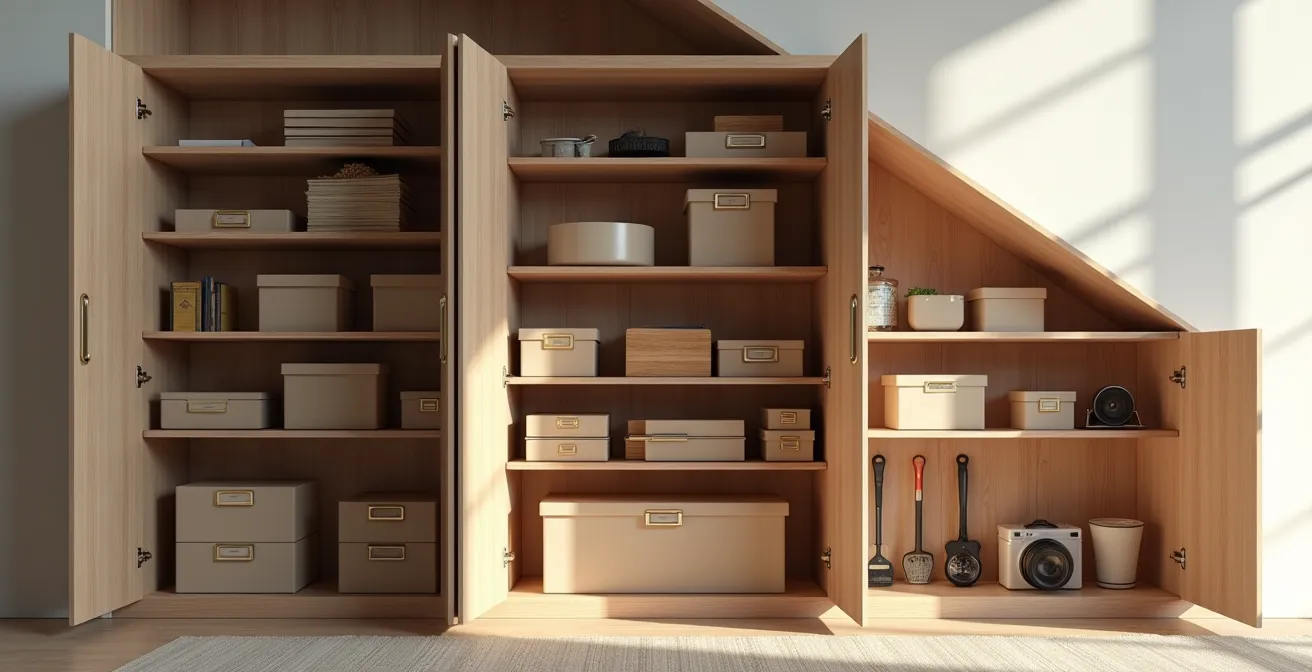
This zoned approach, often executed with a combination of custom drawers, cupboards, and open shelving, turns a chaotic space into a logical and efficient storage hub. The cost and complexity can vary significantly, so it’s essential to choose a solution that matches your budget and needs.
The following table provides a general comparison of common under-stair storage solutions available in the UK market, illustrating how investment levels correspond to different materials and installation requirements.
| Storage Type | Cost Range | Materials | Installation Time |
|---|---|---|---|
| Simple Shelving | £150-£500 | MDF/Plywood | 1 day |
| Three-Cupboard System | £1,000-£2,500 | HDF with shelves | 2-3 days |
| Custom with Drawers | £2,500-£5,000 | Hardwood/Premium | 3-4 days |
Ultimately, a well-planned under-stair system is more than just added storage; it’s an architectural upgrade that enhances your home’s functionality and market appeal.
Wire Shelving or Custom Laminate: Which Closet System Offers Better ROI?
When it comes to outfitting a closet, the choice often boils down to two popular options: affordable wire shelving or premium custom laminate. While wire systems are budget-friendly and flexible, custom laminate offers a polished look and superior durability. Deciding which provides a better Return on Investment (ROI) depends on your specific goals, your home’s value, and how long you plan to live there. This isn’t just about cost; it’s about investing in a system that supports long-term organization.
Wire shelving is the undisputed champion of low initial cost and adaptability. Its open design allows for air circulation, and shelves can be easily reconfigured as your needs change. This makes it an excellent choice for children’s closets, secondary storage areas, or for renters who need a non-permanent solution. However, its industrial aesthetic can feel unfinished, and lighter-gauge systems may sag under the weight of heavy items over time, diminishing their functional value.
Custom laminate systems, on the other hand, are a permanent upgrade. They offer a built-in, furniture-grade appearance that significantly elevates a closet’s visual appeal. With greater weight capacity and a lifespan that can exceed 20 years, laminate is an investment in your home’s infrastructure. While the initial cost is higher and the configuration is less flexible, the perceived value it adds can be a strong selling point in mid-range to luxury homes. The right system actively helps maintain order, which is the ultimate goal.
The secret of keeping your home clutter-free is forming a habit of getting things out of your home on a regular basis.
– Professional Organizer Beth Penn, House Beautiful Interview
This decision should be guided by a clear understanding of the trade-offs in cost, durability, and aesthetics.
| Criteria | Wire Shelving | Custom Laminate |
|---|---|---|
| Initial Cost | $200-$500 | $1,000-$3,000 |
| Flexibility | Highly adjustable | Fixed configuration |
| Durability | 10-15 years | 20+ years |
| Visual Appeal | Industrial/Basic | Premium/Finished |
| Weight Capacity | 50-75 lbs/shelf | 100+ lbs/shelf |
| Best For | Renters, changing needs | Permanent, luxury homes |
For a primary residence, investing in a durable laminate system often yields a better long-term ROI in both daily usability and eventual resale value.
The Storage Container Trap That Actually Encourages Hoarding
It’s a tempting and all-too-common scenario: faced with a cluttered room, you head to the store and return with an armful of matching plastic bins. For a moment, it feels like progress. But this instinct to buy containers *before* decluttering is a critical mistake that often encourages hoarding rather than solving the clutter problem. Instead of forcing you to make decisions about what to keep, opaque containers allow you to simply hide the problem out of sight, creating a system of “organized hoarding.” The items are technically tidy, but they remain an unmanaged and forgotten burden.
This tendency is reflected on a massive scale; in the US, there are now 6.32 square feet of self-storage space per person, indicating a widespread cultural habit of storing items indefinitely rather than mindfully curating possessions. Buying a container gives you permission to postpone a decision. The item isn’t useful enough to keep in your active living space, but you’re not ready to let it go, so it gets relegated to a bin in the garage, basement, or attic, where it will likely remain untouched for years.
The antidote to this trap is a two-part principle: declutter first, then use transparent containers for visual accountability. Before you even think about buying a storage solution, you must go through the items and decide what is truly worth keeping. For the items that make the cut, using clear bins is a powerful forcing function. When you can see the contents, you are constantly reminded of what you own. This visual cue prevents items from becoming “invisible” and forces you to periodically reassess their value. Combining this with clear labels that include a “Review By” date transforms storage from a passive graveyard into an active, managed inventory.

By following a strict “declutter first” rule and embracing transparency, you shift your mindset from hiding clutter to mindfully managing your possessions.
How to Organize Deep Corner Cabinets to Stop Losing Pots and Pans?
The deep, dark corner cabinet—often called a “blind corner”—is the bane of kitchen organization. Its awkward shape and difficult access make it a black hole where pots, pans, and small appliances go to be lost and forgotten. Reaching for an item in the back requires removing everything in the front, a frustrating process that discourages use and promotes chaos. However, modern kitchen engineering offers several ingenious solutions that can reclaim this valuable real estate and make every item easily accessible.
The key to taming the corner cabinet is to install a mechanism that brings the contents to you. This eliminates the need to kneel and dig through a mountain of cookware. As one expert architect noted when discussing smart built-ins, it’s crucial to control depth to maintain order. A professional tip from an architect in a This Old House feature on smart storage advises against making shelves more than 18 inches deep, as deeper recesses inevitably become cluttered. Since corner cabinets violate this rule by design, mechanical pull-outs are the only effective solution.
The most common solutions are Lazy Susans, kidney-shaped pull-outs, and “Magic Corner” systems. A Lazy Susan rotates to bring items to the front, but its round shape in a square cabinet leaves unused space. Kidney-shaped shelves slide out and pivot, offering better access and using more of the cabinet’s volume. The most advanced solutions, like Magic Corners, use a sophisticated articulated mechanism to pull a front set of shelves out of the way while simultaneously sliding the back shelves forward into the open space, maximizing both storage and accessibility.
Choosing the right solution involves balancing usable space, ease of access, and cost. This table breaks down the most popular options to help you decide.
| Solution Type | Usable Space % | Access Ease | Cost Range | Best For |
|---|---|---|---|---|
| Lazy Susan | 65% | Good | $100-$300 | Light items, spices |
| Kidney Pull-Outs | 85% | Excellent | $400-$800 | Heavy pots, appliances |
| Blind Corner Drawers | 75% | Very Good | $500-$1000 | Mixed kitchen items |
| Magic Corner | 90% | Excellent | $600-$1200 | Maximum storage needs |
While these systems represent an upfront investment, the daily convenience and recovery of usable space provide a significant return in functionality and reduced frustration.
How to Optimize Small Living Areas for Multi-Purpose Use Without Clutter?
In modern homes, especially in urban areas, rooms are often required to serve multiple functions. A living room might also be a home office, a guest room, and a children’s play area. The challenge is to enable this flexibility without succumbing to perpetual clutter. The key is to select furniture and create systems that have low “transformation friction”—meaning the effort required to switch from one function to another is minimal. If it takes more than a minute to convert the space, you’re less likely to do it, and clutter will win.
This means prioritizing multi-functional furniture that is truly effortless. Think of a coffee table that lifts to become a desk with a smooth, spring-loaded mechanism, not one that requires you to clear everything off first. Consider an ottoman with a hinged lid for storing blankets, rather than a heavy, unattached top. Wall-mounted fold-down desks, Murphy beds, and modular seating are all excellent examples of low-friction solutions. The goal is to make the “put away” state as easy to achieve as the “in use” state. This kind of thoughtful organization is highly appealing, as research shows that 81% of buyers find it easier to visualize a property as their future home when it features well-organized spaces.
To support this, create pre-organized “activity kits.” Instead of having craft supplies scattered in a drawer, store them in a portable caddy. Keep work-from-home essentials (laptop, notebook, chargers) on a single tray that can be moved from the dining table to a shelf in seconds. These kits reduce the setup and cleanup time for any activity, making transitions seamless. By focusing on reducing the friction of transformation, you create a space that is adaptable, functional, and consistently clutter-free.
Here are key strategies to lower transformation friction:
- Choose furniture that transforms in under 10 seconds.
- Create pre-organized “activity kits” in portable caddies or trays.
- Install wall-mounted fold-down surfaces for instant workspaces.
- Use ottoman storage with hinged lids for quick access.
- Set up smart home scenes (e.g., “Work Mode,” “Relax Mode”) to adjust lighting and ambiance automatically.
By investing in low-friction furniture and systems, you empower your space to adapt to your life, not the other way around.
How to Execute a Professional-Level Interior Design Project on a Mid-Range Budget?
Achieving a high-end, professionally designed look doesn’t necessarily require an unlimited budget. The secret lies in strategic allocation of funds, focusing on high-impact upgrades that deliver the best visual and financial return on investment (ROI). Instead of spreading your budget thinly across many small, insignificant changes, a professional approach involves identifying a few key areas where a quality investment will elevate the entire space. For homeowners, this often means prioritizing elements that enhance both functionality and perceived value.
One of the most effective strategies is the 80/20 rule of design budgeting: allocate 80% of your funds to a few “hero” pieces or features that will define the space, and 20% to smaller, more affordable accessories. In the context of organization, this could mean investing in a high-quality, custom closet system or a statement built-in bookshelf, and then complementing it with inexpensive baskets and decorative objects. This approach creates a focal point of quality that makes the entire room feel more luxurious.
Furthermore, prioritize upgrades that have a proven high ROI. While aesthetic choices are personal, certain improvements consistently add more value at resale. Surprisingly, some of the highest returns come from improving storage and curb appeal. For instance, data on home improvements shows that a garage door replacement offers an astonishing 194% ROI, demonstrating how much buyers value functional, visually appealing storage infrastructure. Similarly, investing in smart closet systems or transforming unused space into organized storage is often more valuable than purely decorative changes.
By focusing your spending on high-impact, high-ROI storage solutions and built-ins, you can achieve a polished, professional result that enhances your daily life and increases your home’s long-term value.
Key Takeaways
- Permanent organization is built on systems and infrastructure, not just containers.
- Focus on “forcing functions” that make tidiness the easiest option, like entryway landing strips.
- Invest in high-ROI storage solutions like built-ins and quality closet systems that add tangible value to your home.
- Avoid the “storage trap” by decluttering before you buy containers and using transparency for visual accountability.
How to Adopt Eco-Minimalism to Reduce Stress and Waste Simultaneously?
At its core, chronic clutter is often a symptom of over-consumption. Eco-minimalism addresses this root cause by merging the principles of minimalism (owning only what you need and love) with an environmental consciousness (reducing waste and consumption). It’s a lifestyle philosophy that creates not only a tidier home but also a less stressful life and a smaller environmental footprint. Adopting this mindset is the final and most profound step in creating a permanently organized home, as it shifts the focus from managing stuff to questioning its presence in the first place.
The journey begins with understanding your personal “clutter threshold,” a concept that is crucial for sustainable organization. This threshold is the point at which the amount of stuff you own becomes overwhelming to manage effectively.
I have a clutter threshold. Everyone has a clutter threshold. What that means is it’s the point at which you personally can keep the things in your home under control.
– Dana K. White, The Mel Robbins Podcast
Eco-minimalism encourages you to identify and respect this threshold. It involves a rigorous decluttering process—like the popular KonMari method or 3-box technique (keep, donate, discard)—followed by the implementation of a strict acquisition framework. Before bringing any new item into your home, you must subject it to a series of critical questions. This intentional friction prevents impulse purchases and ensures that every item you own has a purpose, a designated home, and aligns with your values.
This framework forces you to be a gatekeeper for your own home. Ask yourself these questions before any new purchase:
- Does this replace something that is broken or completely worn out?
- Can this new item serve at least three different purposes?
- Do I have a permanent, designated home for it right now?
- Will I use it within the next 30 days?
- Does its production and disposal align with my environmental values?
- Is it possible to borrow or rent this item instead of buying it?
By adopting an eco-minimalist mindset, you move beyond simple tidying and create a sustainable system of consumption and ownership that brings lasting peace and order to your home.