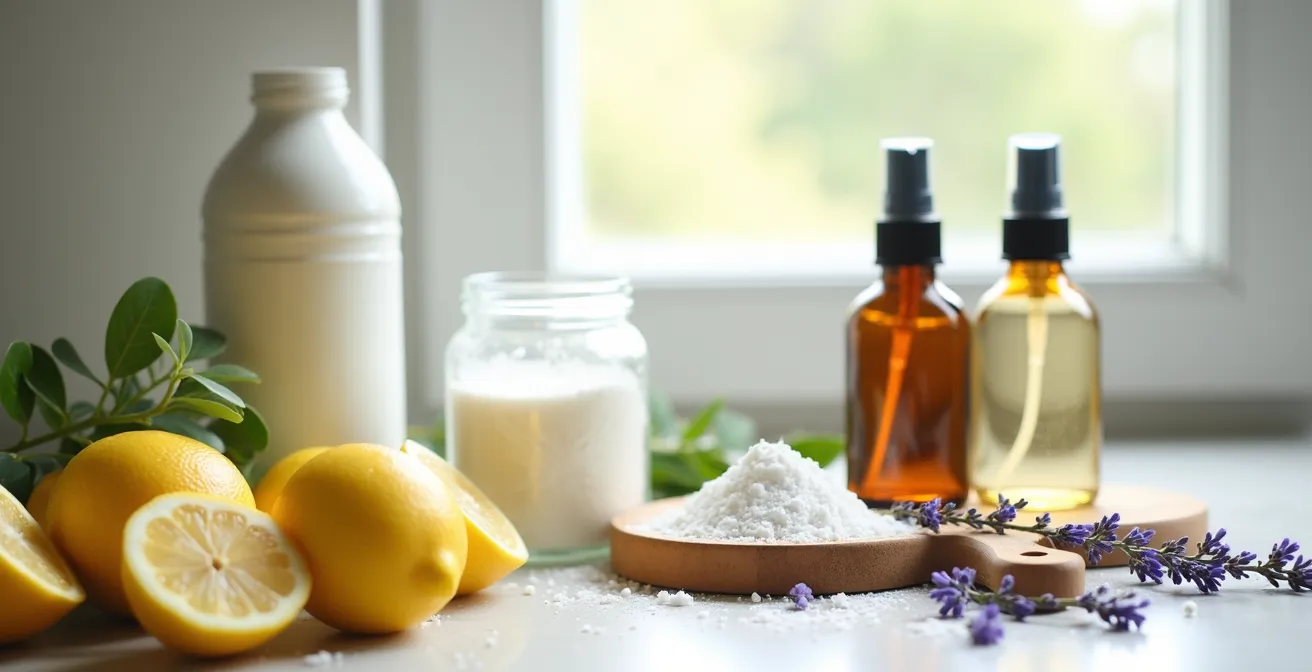
The secret to non-toxic cleaning isn’t a magic recipe; it’s understanding basic chemistry to maximize effectiveness while ensuring your family’s safety.
- Many commercial “fresh scents” are linked to migraines and poor indoor air quality due to undisclosed Volatile Organic Compounds (VOCs).
- Common DIY mixtures, like vinegar and baking soda, can neutralize each other, rendering them ineffective if not used correctly.
Recommendation: Prioritize safety by learning which ingredients should never be mixed, understanding the limitations of natural disinfectants, and always labeling your homemade solutions.
As a health-conscious parent, the cleaning aisle can feel like a minefield. Brightly colored bottles promise a sparkling, germ-free home, but the lengthy warning labels and overpowering chemical smells raise a serious question: are these products doing more harm than good? The desire to protect your family from harsh chemicals often leads down the path of DIY cleaning solutions, a world filled with promises of simple, all-natural alternatives using ingredients like vinegar, baking soda, and essential oils.
However, this path is riddled with misinformation. Many online “hacks” and recipes overlook crucial safety principles, promote ineffective mixtures, and create a false sense of security. They focus on what to mix, but rarely explain the *why*—or more importantly, the *why not*. The key to truly replacing toxic products isn’t just about swapping bottles; it’s about becoming an educated creator of your own cleaning arsenal. It’s about understanding the simple science that makes these ingredients work, recognizing their limitations, and knowing the non-negotiable safety rules.
This guide moves beyond simple recipes. We will break down the science behind common ingredients, highlight critical dangers that are often ignored, and provide the knowledge you need to make genuinely safe and effective cleaning choices. By focusing on chemical principles instead of myths, you can confidently create a healthier environment for your family.
This article will guide you through the essential knowledge needed to switch to homemade cleaners safely and effectively. Below is a summary of the topics we will cover to empower your transition.
Summary: Your Guide to Safe and Effective Homemade Cleaning
- Why Scented Cleaning Sprays Are Triggering Your Migraines?
- How to Mix Vinegar and Baking Soda Correctly for Maximum Cleaning Power?
- Lemon or Tea Tree Oil: Which Essential Oil Is Better for Disinfecting?
- The Bleach and Ammonia Mistake That Can Be Fatal in Minutes
- When to Discard Homemade Cleaners That Have Lost Their Potency?
- How to Minimize Your Daily Exposure to Environmental Pollutants in an Urban Setting?
- How to Select Sustainable Home Textiles That Are Durable and Toxin-Free?
- How to Repair a Damaged Skin Barrier to Stop Breakouts and Redness?
Why Scented Cleaning Sprays Are Triggering Your Migraines?
If that “fresh linen” or “citrus burst” scent from a cleaning spray is followed by a throbbing headache, you are not alone. The connection between synthetic fragrances and migraines is well-documented, and the culprit often hides behind the vague term “fragrance” on an ingredient label. These scents are composed of a complex mixture of chemicals, many of which are Volatile Organic Compounds (VOCs). When you spray a cleaner, these VOCs are released into the air and can act as powerful neurological and respiratory triggers.
The problem is compounded indoors, where ventilation is limited. According to the U.S. Environmental Protection Agency, EPA research reveals that VOC concentrations are often 2 to 5 times higher indoors than outdoors. This confined exposure increases the likelihood of triggering adverse health effects, ranging from migraines and dizziness to asthma attacks and long-term respiratory issues. For a parent, this means the very act of cleaning could be degrading the home’s air quality and impacting a child’s sensitive, developing systems.
Switching to homemade, unscented cleaners or using pure essential oils sparingly is a direct way to eliminate this major source of indoor air pollution. By controlling the ingredients, you remove the mystery “fragrance” cocktail and take a significant step toward a home that is not only clean but also supports your family’s well-being. This puts you in charge of your home’s scent and, more importantly, its air quality.
How to Mix Vinegar and Baking Soda Correctly for Maximum Cleaning Power?
The fizzing reaction of vinegar and baking soda is the poster child of DIY cleaning, but a fundamental misunderstanding often renders it useless. Many believe this volcanic eruption is a sign of super-powered cleaning. The truth is, it’s a sign of chemistry in action—specifically, an acid (vinegar) and a base (baking soda) neutralizing each other to create carbon dioxide gas, water, and sodium acetate. Once the fizzing stops, the resulting liquid is mostly just slightly salty water, with very little cleaning power left.
As one natural cleaning expert from The Ultimate Guide to Homemade All-Natural Cleaning Recipes states, “When you mix baking soda and vinegar together, the chemical reaction of a base(alkaline) and acid neutralizing itself does not mean it is ‘cleaning'”. Instead of mixing them, a green chemistry educator would advise using them sequentially to harness their individual strengths. Baking soda is a fantastic mild abrasive for scrubbing, while vinegar’s acidity is excellent for dissolving mineral deposits (like hard water stains) and cutting through grease.

The visual drama of the reaction is impressive, but it signals the end of the ingredients’ individual effectiveness. To use them properly, apply one, scrub or let it sit, and then apply the other to create a brief, cleansing reaction on the surface itself before rinsing.
Case Study: The Sequential Application Technique for Drain Cleaning
A common and effective use of this principle is for clearing a clogged drain. Instead of mixing the ingredients beforehand, the method involves pouring a cup of dry baking soda down the drain first. This is followed by a half-cup of hydrogen peroxide (or vinegar for a similar, though different, reaction). The reaction occurs inside the pipe, physically breaking down the clog. Following this with boiling water flushes away the residue, demonstrating how harnessing the reaction in place—not in a bottle—is the key to success.
Lemon or Tea Tree Oil: Which Essential Oil Is Better for Disinfecting?
When moving away from synthetic fragrances, many turn to essential oils to add scent and a perceived cleaning boost to their homemade solutions. Lemon and tea tree oil are two of the most popular choices, but they are not interchangeable. Their effectiveness depends entirely on their unique chemical compositions and the specific cleaning job you need them to do. From a green chemistry perspective, choosing the right oil is about matching the tool to the task.
It’s crucial to understand a key distinction: cleaning is not the same as disinfecting. Cleaning removes dirt and grime, while disinfecting kills pathogens like bacteria and viruses. While some essential oils have antimicrobial properties, they are not registered as disinfectants. In fact, according to guidance from the University of Arkansas System Division of Agriculture, EPA regulations state that 0% of homemade solutions qualify as official disinfectants. They can help reduce microbes on a surface, but they cannot be relied upon for hospital-grade sterilization, a critical fact for a health-conscious parent.
The choice between lemon and tea tree oil depends on the surface and the goal. The table below breaks down their properties to help you make an informed decision.
| Property | Lemon Oil | Tea Tree Oil |
|---|---|---|
| Main Component | Limonene | Terpinen-4-ol |
| Antibacterial | Good (especially with grease) | Excellent |
| Antifungal | Limited | Strong |
| Antiviral | Moderate | Strong |
| Best Use | Kitchen surfaces, degreasing | Bathrooms, mold-prone areas |
| Pet Safety | Generally safe | Toxic to cats |
As the data shows, lemon oil is a great choice for daily kitchen degreasing, while tea tree oil’s potent antifungal and antibacterial properties make it better suited for damp environments like bathrooms. However, the most important line for a parent might be the last one: tea tree oil is toxic to cats. This highlights the absolute necessity of researching every ingredient, even natural ones, before introducing them into a home with pets and children.
The Bleach and Ammonia Mistake That Can Be Fatal in Minutes
This is the most critical safety lesson in all of home chemistry: never, under any circumstances, mix bleach with ammonia. While many are aware of this rule, the danger is often underestimated, and the sources of ammonia are not always obvious. The combination of these two common household chemicals is not just a bad idea—it’s potentially lethal. The instant they are combined, a chemical reaction occurs that produces a toxic substance you cannot afford to have in your home.
Specifically, mixing bleach with ammonia produces toxic chloramine gas immediately. Inhaling this gas, even in small amounts, can cause severe respiratory tract irritation, shortness of breath, chest pain, nausea, and fluid in the lungs. In a poorly ventilated space, like a small bathroom, the concentration can quickly become high enough to be fatal. This isn’t a theoretical risk; it’s a real and present danger that leads to thousands of poison control calls each year.

The risk is magnified because ammonia is a hidden ingredient in many other cleaning products, such as some window cleaners and all-purpose sprays. A person might innocently use a bleach-based toilet cleaner and then a glass cleaner on the shower door, unknowingly creating a toxic cloud. This is why the first principle of green chemistry at home is to simplify your supplies and always read the labels. Safe storage, with clear separation of incompatible products, is non-negotiable.
Your Safety Checklist: Identifying and Separating Incompatible Cleaners
- Check window cleaner labels: Scrutinize all glass and window cleaners for any form of ammonia.
- Identify toilet bowl cleaners: Inventory your toilet bowl cleaners to see if they are bleach-based or acid-based, as both can react dangerously with other chemicals.
- Review all-purpose cleaners: Check the ingredients of all multi-surface sprays for bleach, which is often a primary component.
- Store products separately: Physically separate bleach-containing products from ammonia- or acid-containing products in your storage area.
- Label homemade solutions clearly: If you make your own cleaners, label every bottle with all its ingredients. Never trust your memory.
When to Discard Homemade Cleaners That Have Lost Their Potency?
One of the key differences between commercial cleaners and homemade ones is stability. Commercial products are formulated with preservatives to give them a shelf life of years. Your DIY solutions, made from fresh ingredients, are not. Using a homemade cleaner that has expired is not just ineffective; in some cases, it can be risky, as it may have become a breeding ground for bacteria. Knowing when to discard your creations is a crucial part of a safe and effective green cleaning routine.
The shelf life of a homemade cleaner depends entirely on its ingredients, especially whether it contains water and fresh organic matter (like citrus peels). Water-based solutions are susceptible to mold and bacterial growth, while mixtures containing fresh fruit or vegetable matter will degrade very quickly. A simple vinegar-and-water spray will last much longer than one infused with lemon rinds. As a general rule from a Wellness Mama study, a typical all-purpose cleaner stored away from direct light and heat should last for about 3 months when stored properly.
However, this can vary dramatically. Light and heat accelerate the degradation of essential oils and other active components, reducing their potency. To maintain effectiveness, always store your cleaners in a cool, dark place and preferably in opaque glass containers to protect them from light.
The following table provides a more detailed guideline for the shelf life of different types of DIY cleaners, helping you manage your inventory and ensure you’re always cleaning with a potent and safe solution.
| Cleaner Type | Shelf Life | Storage Conditions |
|---|---|---|
| Vinegar spray (no organics) | 6-12 months | Cool, dark place |
| Solution with citrus peels | 1-2 weeks | Refrigerated |
| Essential oil solutions | 1-3 months | Opaque glass container |
| Water-based sprays | 1-2 days | Room temperature |
| Alcohol-based sprays | Several weeks | Cool, dark place |
How to Minimize Your Daily Exposure to Environmental Pollutants in an Urban Setting?
While we often associate pollution with outdoor, urban air, the reality is that the most significant exposure for many families occurs indoors. The switch to homemade cleaners is a powerful step in minimizing this exposure, but it’s part of a larger strategy for creating a healthy indoor environment. Pollutants from outside can easily enter the home, but they are then trapped and can accumulate alongside the chemicals released from products we use every day, from furniture and paint to personal care items and cleaners.
This is particularly true for VOCs. These compounds are emitted from thousands of everyday products and can become highly concentrated in enclosed spaces. The problem was highlighted by the surge in cleaning during the recent pandemic. As a 2020 research study cited by Switch Natural found, 399 VOCs were emitted from commonly used pandemic products, of which 127 are classified as potentially hazardous. Shockingly, only 4 percent of the VOCs found were disclosed on the product labels.
399 VOCs were emitted from pandemic cleaning products, of which 127 are classified as potentially hazardous. Only 4 percent of the VOCs found were disclosed on the product label.
– 2020 Research Study, Study on VOC emissions from commonly used pandemic products
Minimizing your daily exposure requires a multi-faceted approach. First, source control: actively reduce the number of polluting products you bring into your home by choosing low-VOC or VOC-free options whenever possible. This applies to paint, furniture, and especially cleaning supplies. Second, ventilation: regularly open windows to exchange stale indoor air with fresh outdoor air. Use exhaust fans in kitchens and bathrooms to remove pollutants at the source. Finally, purification: consider using high-quality air purifiers with HEPA and activated carbon filters to capture airborne particles and gases. By combining these strategies, you can create a healthier sanctuary, even in a dense urban environment.
How to Select Sustainable Home Textiles That Are Durable and Toxin-Free?
Creating a non-toxic home extends beyond the cleaning cabinet and into the very fabrics that furnish our lives. Textiles like curtains, upholstery, towels, and bedding can be treated with a host of chemicals—from flame retardants and formaldehyde to pesticides used in growing the raw materials. These chemicals can off-gas into your home and come into direct contact with your skin. Selecting sustainable, toxin-free textiles is another cornerstone of a healthy living environment, and knowing how to care for them with natural solutions completes the circle.
When shopping for textiles, look for natural fibers such as organic cotton, linen, hemp, and wool. Prioritize certifications like GOTS (Global Organic Textile Standard) or OEKO-TEX, which ensure that the fabric has been tested for harmful substances and, in the case of GOTS, produced according to strict environmental and social criteria. These materials are not only safer but also tend to be more durable than their synthetic counterparts like polyester or nylon.
Caring for these natural fibers doesn’t require harsh detergents. In fact, many homemade cleaning solutions are perfectly suited for them. For instance, a gentle solution of castile soap (about one tablespoon per liter of water) is ideal for hand-washing delicate wool and silk. For spot-cleaning stubborn stains on durable linen upholstery, a simple paste made from baking soda and water (a 3:1 ratio) can be gently applied, allowed to dry, and then brushed or vacuumed off. A final rinse with a diluted vinegar solution (1 part vinegar to 4 parts water) can help soften organic cotton towels and remove any soap residue, leaving them naturally fluffy without the need for chemical-laden fabric softeners.
Key takeaways
- Prioritize Safety: The most dangerous mistake is mixing bleach and ammonia, which creates toxic chloramine gas. Always read labels and store products separately.
- Understand the Chemistry: Mixing vinegar and baking soda neutralizes their cleaning power. Use them sequentially for best results.
- Manage Expectations: Homemade solutions clean well, but they are not EPA-registered disinfectants. Choose ingredients like tea tree oil for its antimicrobial properties in specific areas like bathrooms.
How to Repair a Damaged Skin Barrier to Stop Breakouts and Redness?
The push to eliminate harsh chemicals is often motivated by respiratory issues like asthma or migraines, as one person testified, “Regular cleaners flare up my migraines.” However, the impact on our largest organ—the skin—is just as significant. The skin has a natural protective layer called the skin barrier, which is responsible for keeping moisture in and irritants out. Exposure to harsh chemicals, whether from commercial or even certain natural DIY cleaners, can strip this barrier, leading to dryness, redness, sensitivity, and even breakouts.
Regular cleaners flare up my migraines.
– Migraine sufferer, Keeper of the Home
Even natural ingredients can be potent irritants. The high acidity of vinegar or the concentrated compounds in essential oils can disrupt the skin’s delicate pH balance if handled without protection. This is why a core tenet of safe cleaning, regardless of the ingredients, is to always wear gloves. Treating your cleaning sessions with the same precaution you would a science experiment protects your skin from direct contact with potentially irritating substances.
If your skin is already showing signs of a compromised barrier, the first step is to eliminate all potential triggers. This means switching to the simplest possible cleaning solutions with minimal ingredients and committing to wearing gloves every time. The next step is to support your skin’s natural healing process. This involves using a gentle, fragrance-free cleanser in your skincare routine and applying moisturizers rich in barrier-repairing ingredients like ceramides, hyaluronic acid, and niacinamide. By removing the external aggressors and providing internal support, you allow your skin to rebuild its defenses and restore its healthy, calm state.
The journey to a non-toxic home is one of empowerment. It’s about shifting from a consumer who trusts blindly to an educated creator who understands the tools they’re using. By grasping the basic principles of what makes cleaners effective, what makes them dangerous, and how to use them responsibly, you can build a cleaning routine that is truly safe for your home and family. The next logical step is to apply this knowledge. Start by auditing your current cleaning supplies, both commercial and homemade, with this newfound safety-first perspective.