In summary:
- Focus on “surgical” cosmetic updates with a proven high Return on Investment (ROI), not expensive, full-scale renovations.
- Prioritize paint, minor repairs, and curb appeal, which directly influence a buyer’s perception of value for minimal cost.
- Manipulate the sense of space through strategic furniture placement and lighting to make rooms feel larger and more valuable.
- Always analyze the local market—sold, active, and expired listings—to ensure your updates align with buyer expectations and avoid over-capitalizing.
Most homeowners looking to sell fall into a costly trap: they think like a decorator, not an investor. They pour money into passion projects and major renovations, hoping to see that investment returned in the sale price. As a house flipper, I can tell you that’s a losing game. The key to maximizing profit isn’t about spending the most; it’s about executing surgical, high-ROI cosmetic updates that manipulate buyer perception. It’s about creating the largest possible gap between your low-cost investment and the high value a buyer assigns to it.
Forget the idea of a dream kitchen or a spa-like bathroom that reflects your personal taste. Your taste is irrelevant. The only opinion that matters is that of your potential buyer, and their opinion is shaped by subtle psychological cues. A dripping faucet signals neglect, while fresh, neutral paint signals a well-maintained, move-in-ready home. This guide isn’t about making your home “prettier.” It’s a pragmatic playbook for applying a flipper’s mindset to your property, treating every dollar as a calculated investment designed to generate a measurable return. We’ll dissect which updates truly add value and which are just money pits, focusing on what I call “Return on Cosmetics” (ROC).
This article will guide you through the strategic decisions that separate a profitable sale from a break-even headache. We’ll start by debunking the myth of the major remodel, then move to high-impact exterior and interior updates, the psychology of repairs, and the art of staging. Finally, we’ll ground our strategy in hard market data to ensure every update is a smart financial move.
Summary: A Flipper’s Guide to High-ROI Home Improvements
- Why Spending $50,000 on a Kitchen Remodel Rarely Increases Value by $50,000?
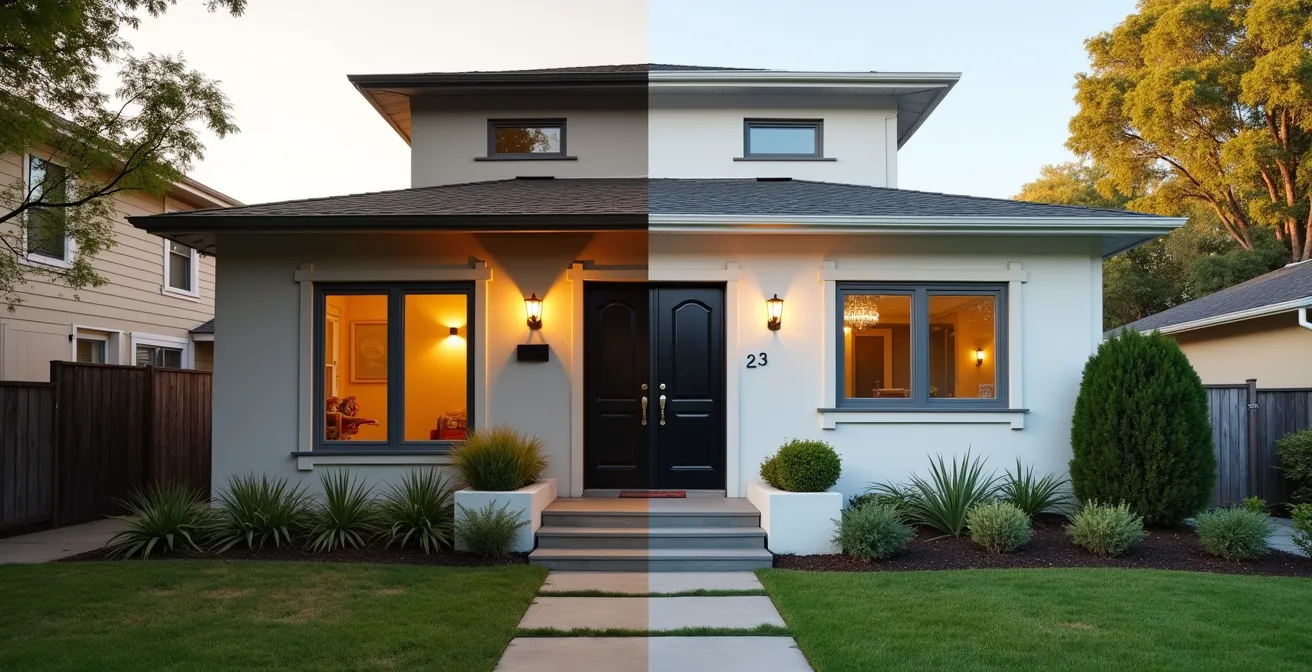
- How to Transform Your Home’s Facade for Under $1,000 in One Weekend?
- Neutral Grey or Warm Beige: Which Paint Color Sells Homes Faster?
- The Dripping Faucet Effect: How Minor Repairs Influence Buyer Perception
- How to Reconfigure Furniture to Make Rooms Look 20% Larger?
- How to Accurately Estimate Property Value in a Volatile Housing Market?
- How to Execute a Professional-Level Interior Design Project on a Mid-Range Budget?
- How to Maintain a Lush Landscape All Year With Minimal Weekly Effort?
Why Spending $50,000 on a Kitchen Remodel Rarely Increases Value by $50,000?
The biggest misconception sellers have is that a massive kitchen overhaul is a ticket to a higher sale price. They envision gleaming new cabinets, custom marble countertops, and top-of-the-line appliances, assuming every dollar spent will come back, and then some. The hard truth is that major, upscale kitchen renovations are often the worst investment you can make before a sale. They introduce your personal taste into a financial equation and carry a massive risk of over-capitalizing for the neighborhood.
The numbers don’t lie. Data consistently shows that the more you spend, the lower your percentage of return. While a full-gut renovation might feel transformative, it rarely impresses a buyer enough to cover its cost. In fact, Remodeling’s 2024 Cost vs. Value Report shows that while minor kitchen remodels can achieve a 96% ROI, major upscale renovations often recoup only around 50%. The profit isn’t in replacement; it’s in refreshment. A buyer sees a clean, functional, and modern-looking kitchen, not a ledger of your expenses.
The flipper’s strategy is to perform “surgical updates” that create the *perception* of a new kitchen for a fraction of the cost. Think of it as perception arbitrage. Instead of tearing out perfectly good cabinet boxes, you paint them a modern neutral color. Instead of custom countertops, you choose widely appealing and cost-effective quartz or granite. The focus is on the elements with the highest visual impact and the best ROC.
- Paint Cabinets: A professional paint job on existing cabinets costs a fraction of replacement ($700 vs. $10,000+) and can have a near 100% ROI.
- Replace Hardware: Swapping dated knobs and pulls for modern brushed nickel or matte black hardware is a $200 job that makes cabinets look brand new.
- Upgrade Lighting: Adding under-cabinet LED lighting is an inexpensive update that dramatically increases the perceived value and functionality of the space.
How to Transform Your Home’s Facade for Under $1,000 in One Weekend?
Buyer perception is formed in the first eight seconds—the time it takes to pull up to the curb and walk to the front door. This first impression, or “curb appeal,” anchors their entire valuation of your property. A neglected exterior signals a neglected interior, immediately putting buyers on the defensive and causing them to mentally subtract costs from their potential offer. Conversely, a sharp, clean facade creates an emotional connection and a presumption of quality that can add thousands to the perceived value.
The great news is that you don’t need a five-figure landscaping and construction budget to make a massive impact. A strategic investment of less than $1,000 and a weekend of work can completely transform your home’s presence. Curb appeal projects consistently deliver a high return, with many sellers recouping 70-90% of their costs at sale. The key is to focus on the details that create a cohesive, modern, and welcoming look. Think of it as staging your home’s exterior.
Your goal is a clean, crisp, and intentional look. Focus on these high-impact, low-cost weekend projects:
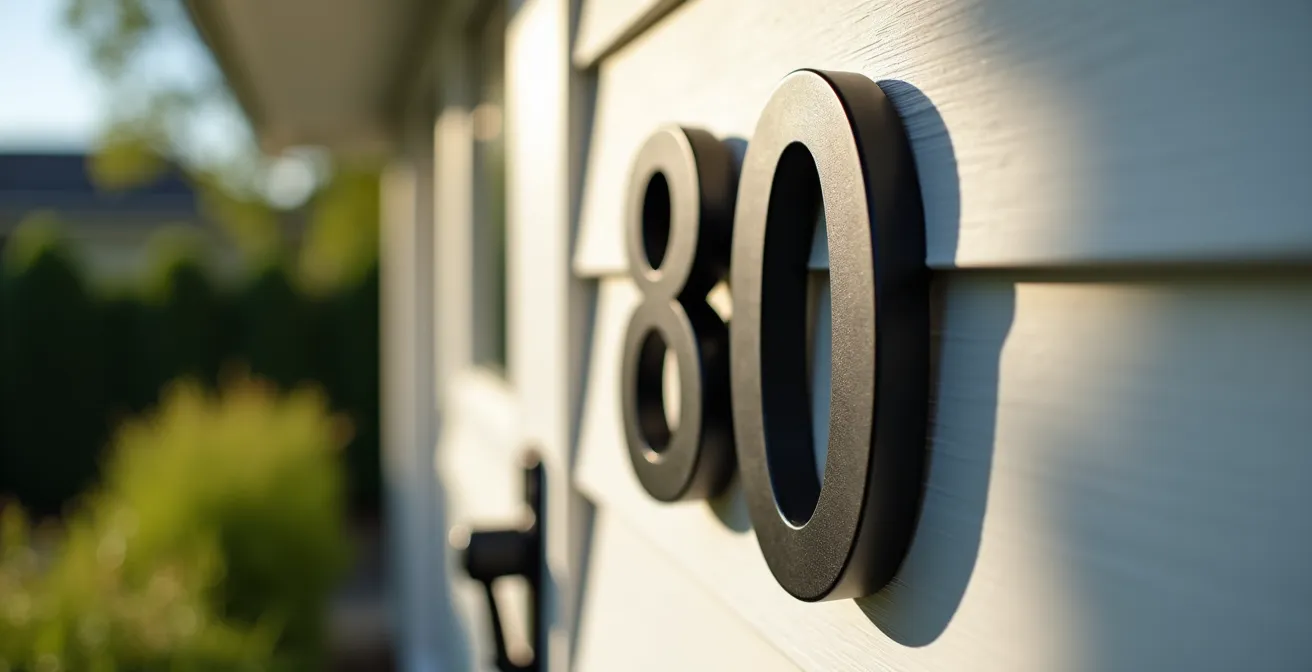
As the image above highlights, the magic is in the details. Sleek, modern house numbers, a new handle on a freshly painted door, and strategic lighting work together to create a high-end feel. Other powerful weekend wins include power washing the siding and walkways, painting the front door a bold accent color like black or deep blue, and updating exterior light fixtures. These small changes signal to a buyer that the home is well-maintained and stylish, setting a positive tone before they even step inside.
Neutral Grey or Warm Beige: Which Paint Color Sells Homes Faster?
If there is one non-negotiable, highest-ROI update in the flipper’s playbook, it’s paint. Nothing else provides as much transformative power for so little capital. A fresh coat of paint instantly erases years of wear and tear, neutralizes personal style, and makes a home feel clean, bright, and new. Best of all, it’s an investment where you can expect to see a full return on your money. The data is clear: freshly painted rooms in neutral colors consistently rank as the top home improvement for value.
The question isn’t *if* you should paint, but *what* color you should choose. The debate between grey and beige has raged for years, but the strategic answer is: it depends on your home’s architecture and target buyer. The goal is to create a blank canvas that allows buyers to envision their own lives in the space. You are removing objections and creating a seamless flow from room to room. Personal color preferences are a liability; a universally appealing neutral is an asset.
A sophisticated palette signals a well-cared-for home. Here’s how to choose strategically:
- Warm Greys (“Greige”): This is the modern standard. Colors like Sherwin-Williams’ “Agreeable Gray” or Benjamin Moore’s “Revere Pewter” are perfect for contemporary homes. They read as sophisticated and fresh without feeling cold.
- Warm Beiges and Off-Whites: For more traditional or rustic architecture, warm beiges and creamy whites can feel cozier and more inviting than grey. They evoke a classic, timeless appeal.
- Cohesive Flow: Use one main neutral color throughout the primary living areas. You can vary the shade slightly in bedrooms or bathrooms, but the palette should feel intentional and connected.
- The Ceiling Trick: Always paint ceilings a fresh, flat white—or even one shade lighter than the walls. This simple trick creates the illusion of height and makes the entire room feel larger and more airy.
- High-Impact Accent: For a touch of high-end drama, paint interior doors in a dark charcoal or soft black. This costs very little but creates a powerful “value anchor” that makes the home feel custom-built.
The Dripping Faucet Effect: How Minor Repairs Influence Buyer Perception
A buyer walks into your home, and the first thing they hear is a faint *drip… drip… drip* from the kitchen sink. In your mind, it’s a $5 washer replacement. In their mind, a red flag just went up. They’re not just thinking “leaky faucet”; they’re thinking “plumbing issues,” “water damage,” “deferred maintenance,” and “what else is wrong with this house?” This is the “Dripping Faucet Effect,” and it’s a perfect illustration of how minor, unfixed issues create a disproportionately negative impact on buyer perception.
Every small, visible problem—a cracked tile, a sticky door, a loose cabinet handle—adds an item to the buyer’s “mental to-do list.” This subconscious list of future work and expenses grows with every flaw they spot. Even if the total real cost of these repairs is under $500, the perceived cost and hassle in a buyer’s mind can be thousands of dollars, which they will mentally deduct from their offer price. Your job as a seller is to eliminate this mental to-do list entirely. The home must present as “turnkey” and hassle-free.
As one professional appraiser notes, these details directly influence the final number. While an appraiser establishes a value range based on comps, small issues can be the deciding factor that pushes your home to the bottom of that range.
An appraiser will come up with a value range for your home based on the inspection, research, comparables, etc., and cosmetics can play a role in determining where in that range your final value may fall.
– Professional Appraiser, Do Cosmetics Play a Role in Your Home’s Value
The solution is a systematic sweep of the property. Go through every room and make a list of every minor flaw. Tighten loose handles, replace burnt-out bulbs, caulk tubs and sinks, fix that running toilet, and patch and paint over all nail holes and scuffs. The goal is to present a crisp, clean, and meticulously maintained property. Swapping out dated faucets and drawer pulls with modern, cohesive hardware is an inexpensive upgrade that makes everything feel new and has an outsized impact on buyers.
How to Reconfigure Furniture to Make Rooms Look 20% Larger?
Once you’ve painted and repaired, the next layer of value creation is staging. Professional staging can cost thousands, but you can achieve 80% of the effect for free by strategically reconfiguring your existing furniture. The goal of staging isn’t to show off your decor; it’s to sell space, light, and flow. Buyers purchase square footage, and your job is to make every square foot feel as large and usable as possible. A cluttered room with oversized furniture pushed against the walls can make a space feel 20% smaller than it actually is.
The cardinal sin of amateur staging is “wall-hugging” furniture. Pushing every piece against a wall creates a dead zone in the middle of the room and highlights its smallness. The professional strategy is to “float” your main furniture pieces. Pull the sofa and chairs away from the walls and arrange them to create conversational zones, using area rugs to define these spaces. This creates clear, defined pathways around the furniture, which gives the room a sense of purpose and flow. The presence of this “negative space” makes the entire room breathe and feel more expansive.
The right furniture arrangement guides the buyer’s eye and enhances the room’s best features. The key is to emphasize both horizontal and vertical space.
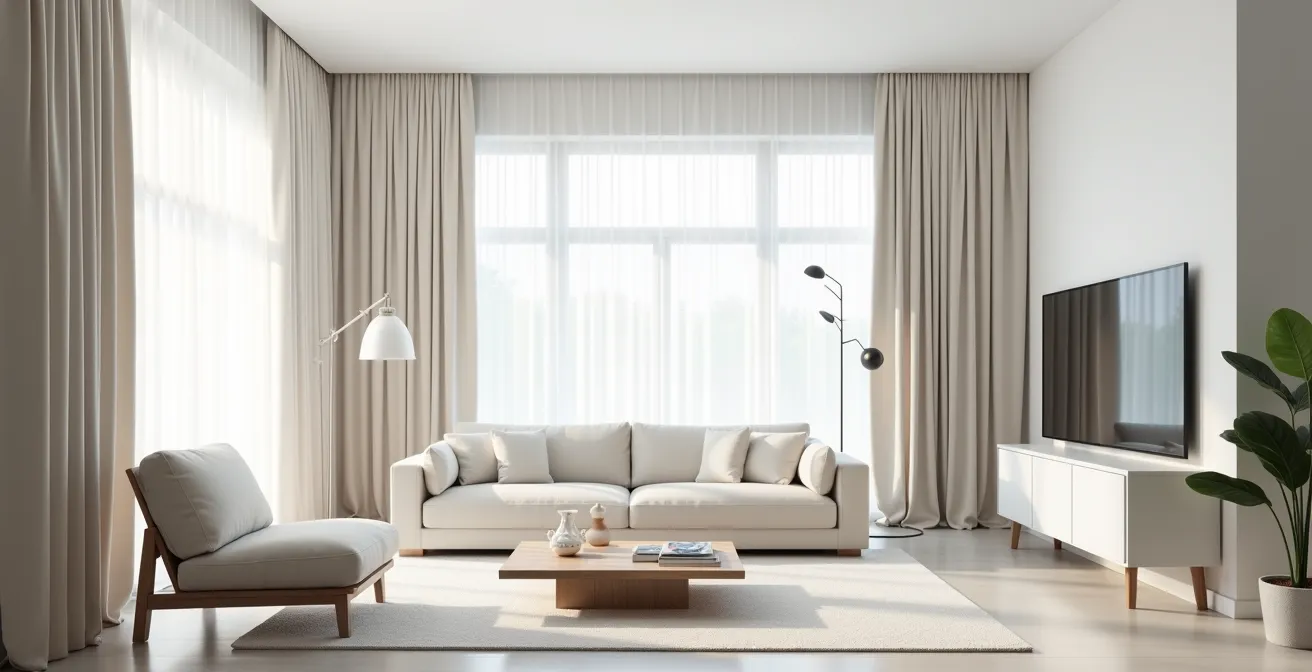
As this example shows, floating the sofa creates a clear pathway from the entry to the windows, making the room feel more intuitive and open. To enhance this effect, you must also think vertically. Draw the eye upward to create an illusion of height. Replace short, heavy curtains with floor-to-ceiling sheer linen panels hung as high and wide as possible. Swap a short, wide bookshelf for a tall, narrow one. Use a tall floor lamp or a piece of vertical art to add height. By maximizing light, creating flow, and emphasizing verticality, you make the room feel significantly more valuable.
How to Accurately Estimate Property Value in a Volatile Housing Market?
Executing cosmetic updates without a firm grasp of your property’s market value is like sailing without a compass. You might be making things “nicer,” but you have no idea if you’re heading toward profit or financial ruin. In a volatile market, where values can shift quarterly, a “gut feeling” or an outdated online estimate is worthless. You must think like an appraiser and ground your budget in a cold, hard analysis of the current market.
The profitability of your updates is directly tied to market conditions. For example, recent data shows that as the market tightened, the returns on certain projects soared; minor kitchen remodel ROI jumped from 71% in 2022 to 96% in 2024. This shows that in a competitive market, buyers are willing to pay a premium for move-in-ready homes, making smart cosmetic updates more profitable than ever. Your strategy must be informed by this real-time data, not by what worked two years ago.
To do this, use a Three-Tier Market Analysis approach. This method gives you a complete picture of your home’s baseline value, its current competition, and the market’s pricing ceiling.
| Analysis Tier | Purpose | What It Reveals | Impact on Valuation |
|---|---|---|---|
| Sold Properties (Comps) | Baseline market value | What buyers actually paid | Primary valuation anchor |
| Active Listings | Current competition | Your direct market rivals | Pricing strategy guidance |
| Expired/Withdrawn | Market ceiling | Prices the market rejected | Upper limit awareness |
Start with recently sold properties (last 3-6 months) that are similar in size, age, and location to establish your baseline. Then, look at active listings to understand what your home will be up against. How does your home’s condition and finish level compare? This tells you where you need to invest to be competitive. Finally, analyze expired listings. These are homes that were priced too high or were in poor condition. They represent the price and condition that the market has actively rejected, providing a clear warning against over-investing.
How to Execute a Professional-Level Interior Design Project on a Mid-Range Budget?
Knowing which updates to make is half the battle; executing them with a professional, high-end look is the other half. The difference between a home that sells for a premium and one that languishes on the market often comes down to design cohesion. A piecemeal approach, with mismatched fixtures and an incoherent style, screams “amateur DIY” to a buyer. To command top dollar, you need to create the illusion of a professionally designed space, even on a mid-range budget.
The secret is to avoid overspending on luxury upgrades across the board, which have a notoriously low return. Research confirms that moderate, well-chosen upgrades outperform expensive ones; one study showed a 52% average ROI on mid-range renovations versus 38% for luxury upgrades. The flipper’s strategy is to allocate capital intelligently using the “High-Low Design Strategy.” This involves splurging on a few highly visible “hero” pieces while saving aggressively on everything else.
This approach anchors the buyer’s perception of quality. A stunning light fixture in the dining room or a high-quality, heavy faucet in the kitchen elevates the entire space, making the more budget-friendly elements around them feel more expensive by association. It’s a powerful form of value anchoring. This ensures your budget is spent where it has the most psychological and financial impact.
Action Plan: Implementing the High-Low Design Strategy
- Invest in One “Hero” Piece Per Room: Identify and splurge on the one item that will have the most visual impact. This could be a dramatic light fixture, a high-end kitchen faucet, or designer cabinet hardware. This becomes the room’s focal point.
- Apply the “Rule of Three”: To create a professional layered look, incorporate three different textures (e.g., a smooth metal, a rough linen, a soft velvet), three different pattern sizes (large, medium, small), and three sources of light (ambient, task, accent) in each main room.
- Source Designer Dupes: For secondary furniture and decor, shop at online retailers like Wayfair or Overstock for items that mimic high-end designer looks for up to 70% less. No one will know the difference.
- Find Luxury Material Remnants: Visit local stone yards to find smaller, leftover pieces of high-end granite or marble (“remnants”) for a small bathroom vanity or kitchen island at a fraction of the full slab price.
- Shop Restaurant Supply Stores: For durable, high-quality kitchen faucets, sinks, and stainless steel shelving, restaurant supply stores often offer commercial-grade products at wholesale prices that look incredibly high-end.
Key Takeaways
- Stop thinking about personal taste; every cosmetic update must be a calculated investment with a measurable Return on Cosmetics (ROC).
- Focus on high-impact, low-cost “surgical updates”: fresh paint, modern hardware, and strategic lighting deliver the best ROI.
- Curb appeal and minor repairs are non-negotiable, as they directly combat the buyer’s “mental to-do list” which devalues your property.
How to Maintain a Lush Landscape All Year With Minimal Weekly Effort?
The final frontier of pre-sale value enhancement is the yard. Just as with the home’s facade, a lush, well-maintained landscape signals pride of ownership and a turnkey property. A scraggly lawn and overgrown flower beds do the opposite, suggesting neglect and adding to a buyer’s mental workload. The financial return on landscaping is one of the highest in home improvement, with some reports showing that sellers can see a 104% value recovery on landscape maintenance. This makes it a critical part of your pre-sale strategy.
However, “lush landscape” doesn’t have to mean “high effort.” The key is to implement low-maintenance strategies that deliver year-round appeal without requiring hours of work each week. A buyer should see a beautiful, green space, not a weekend chore. Your goal is to create an outdoor environment that looks effortless and inviting.
To achieve this, focus on smart systems and plant choices that work with your local climate, not against it. A thick layer of mulch is a flipper’s best friend; applying a 3-inch layer of mulch in all garden beds can reduce the need for weeding by up to 90% and dramatically conserve soil moisture, cutting down on watering. Another powerful strategy is to install a simple drip irrigation system on a timer, which provides water directly to plant roots with maximum efficiency and zero weekly effort on your part.
Choosing the right plants is also critical. Opt for native perennials that are adapted to your region’s rainfall and temperature, as they will thrive with minimal intervention and provide interest across multiple seasons. For an especially modern, drought-resistant appeal, consider xeriscaping with architectural plants like succulents and ornamental grasses. By grouping plants with similar water needs together, you can optimize your irrigation and create a landscape that essentially takes care of itself, presenting a perfect, low-effort dream to potential buyers.
By applying this pragmatic, profit-oriented mindset to every cosmetic decision, you move from being a hopeful homeowner to a strategic seller. Your house is no longer just a home; it’s an asset, and your job is to maximize its performance. Start today by walking through your property, not as its owner, but as its most critical buyer, and build your own high-ROI action plan.