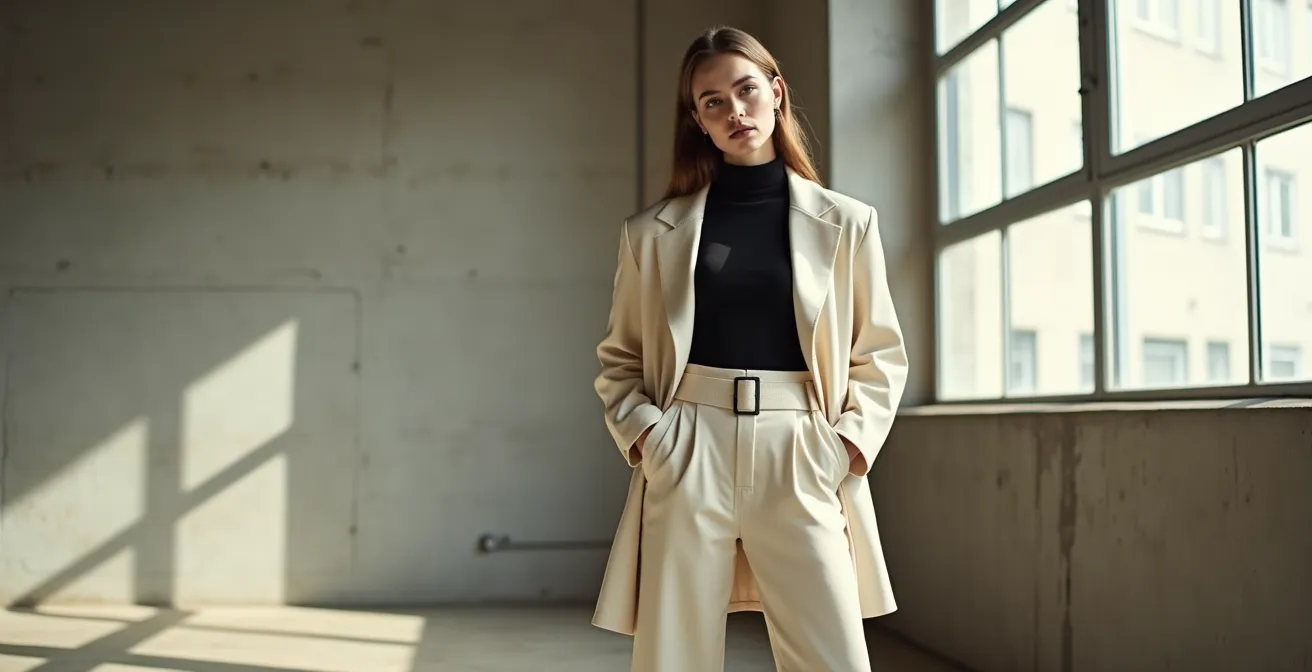
In summary:
- Stop trying to find your shape; the key is to create a new, intentional silhouette using volume.
- Every oversized outfit needs one “anchor point”—a single fitted element that grounds the look.
- Use techniques like the French tuck and strategic layering to create visual tension and deliberate lines.
- Fabric and structure are non-negotiable: the right shoulder seam and material make the difference between chic and sloppy.
- Integrate trends and build a capsule wardrobe by focusing on modern silhouettes, not just vintage pieces.
Let’s get one thing straight: the oversized trend isn’t just about wearing bigger clothes. It’s an attitude, a statement of comfort and confidence captured in a single frame. But there’s a fine line between looking effortlessly cool and feeling completely lost in a sea of fabric. You’ve seen the looks on the street, the perfect blend of volume and structure, and tried to replicate them, only to feel shapeless and sloppy. The common advice—”balance proportions”—is a tired cliché that misses the entire point.
The problem isn’t the volume of your clothes; it’s the lack of a clear story. A truly great oversized outfit doesn’t hide the body; it uses fabric to sculpt a new, compelling silhouette. It’s a game of visual tension, of directing the eye with intention. It’s about understanding that the secret isn’t found in a simple rulebook but in mastering the interplay between fabric, structure, and a single, powerful focal point. The goal is not to shrink yourself to fit the clothes, but to command the space they create.
This guide will deconstruct the art of oversized styling, moving beyond the basics. We’ll explore how to establish anchor points, manipulate fabric, and use strategic details to create outfits that are intentional, modern, and anything but sloppy. You’ll learn to see your outfits through a new lens—one that focuses on sculpting shape rather than just covering it.
This article breaks down the essential techniques for mastering the oversized aesthetic, from foundational principles to advanced styling strategies. Explore the sections below to build your confidence and refine your look.
Contents: A Guide to Mastering the Oversized Look
- Why You Need One Fitted Element to Make an Oversized Outfit Work?
- How to Use the “French Tuck” to Define Your Waist in Baggy Knits?
- Structured Denim or Flowy Silk: Which Oversized Fabric Flatters Petite Frames?
- The Shoulder Seam Mistake That Makes Oversized Blazers Look Ill-Fitting
- How to Layer Oversized Pieces Without Looking Bulky in Winter?
- How to Integrate Neon Accents Into a Neutral Wardrobe for a Modern Look?
- How to Wear 90s and Y2K Trends Today Without Looking Like a Costume?
- How to Build a Versatile Capsule Wardrobe That Fits Your Body Shape?
Why You Need One Fitted Element to Make an Oversized Outfit Work?
Forget the vague concept of “balance.” The real principle at play here is the anchor point. An oversized outfit without an anchor is just a mass of fabric; it lacks a focal point, leaving the eye to wander without direction. The anchor is the one piece in your outfit that provides structure and reminds the viewer that there is, in fact, a body underneath the volume. It’s the visual home base from which all the looser elements can flow, creating a dynamic and intentional look.
This isn’t just a styling opinion; it’s rooted in how our brains perceive aesthetics. The human eye is naturally drawn to harmony and order. According to fashion styling principles, the rule of thirds is often cited as the most appealing proportion, and creating an anchor point helps establish these visually pleasing divisions. A fitted pant under a baggy sweater, for example, clearly divides the body, creating a much more compelling silhouette than a baggy-on-baggy combination.

Think of it like a photographer framing a shot. You need a subject to be in focus. In an oversized look, that focus can be your waist, your legs, or your shoulders. By choosing one area to define, you create powerful visual tension between the fitted and the loose. This could mean pairing an oversized blazer with slim-fit trousers, a voluminous top with leggings, or even just rolling up your sleeves to show your wrists. This single point of definition gives the entire outfit purpose and prevents you from looking like you’re wearing clothes that are simply too big.
How to Use the “French Tuck” to Define Your Waist in Baggy Knits?
The French tuck is more than just a casual styling quirk; it’s one of the most effective tools for creating an anchor point without sacrificing comfort. Popularized by style experts, this technique involves tucking just the very front of a sweater, shirt, or knit into your waistband. Unlike a full tuck, which can feel restrictive and formal, the French tuck offers the best of both worlds: it defines your waistline from the front while allowing the fabric to drape loosely over your hips and back.
The magic of the French tuck lies in the subtle line it creates. It draws the eye to the waist, breaking up the torso and creating the illusion of longer legs. This small gesture adds instant polish and intention to an otherwise shapeless garment. It signals that your look is deliberate, not accidental. The French tuck technique is praised by fashion enthusiasts because it crafts a flattering silhouette that works for virtually all body types, making it a go-to move for anyone who values both style and ease.
While the classic front-tuck is the most well-known, there are several variations that work for different fabrics and effects. Understanding which tuck to use can elevate your styling game even further, allowing you to adapt the technique to everything from a chunky sweater to a silky button-down.
| Tuck Type | Best For | Visual Effect | Difficulty |
|---|---|---|---|
| Classic French Tuck | Button-downs, loose tees | Defines waist, elongates legs | Easy |
| Corner Tuck | Heavier fabrics, shackets | Asymmetrical interest | Medium |
| Half Tuck | Oversized sweaters | Casual, relaxed vibe | Easy |
| Knot Tuck | T-shirts, casual tops | Playful, beachy look | Easy |
Structured Denim or Flowy Silk: Which Oversized Fabric Flatters Petite Frames?
For petite individuals, the oversized trend can feel particularly intimidating. The fear of being completely swallowed by fabric is real. However, the key isn’t to avoid volume but to choose it in the right material and structure. The fabric you choose is just as important as the cut; it determines whether the garment will overwhelm your frame or drape elegantly around it.
Generally, fashion experts recommend that lighter fabrics like cotton, linen, and silk are ideal for petite frames. These materials have a natural fluidity and drape, meaning they follow the body’s lines without adding extra bulk. An oversized silk blouse, for instance, will move with you, hinting at the shape underneath. In contrast, heavy, stiff materials like thick wool or rigid canvas can create a boxy silhouette that visually shortens and widens a smaller frame.
However, this doesn’t mean structured fabrics are off-limits. Structured denim can be incredibly flattering, provided you choose the right cut. Here’s how to approach it:
- Structured Denim: Opt for pieces with a clear shape. A cropped, wide-leg jean in a sturdy denim can work wonders by raising the visual waistline and creating a strong, deliberate silhouette. Avoid overly long or baggy styles that pool at the ankle.
- Flowy Silk: When choosing flowy pieces, ensure there’s a point of definition. A silk dress or top with a built-in waist tie or paired with a belt prevents the fabric from becoming a shapeless tent. Asymmetry, like a high-low hem, can also create vertical lines that add length.
The goal is to avoid fabrics that are both bulky and shapeless. You can have volume, or you can have stiffness, but having both in an oversized piece on a petite frame is a recipe for being overwhelmed. Choose one or the other for an intentional, flattering look.
The Shoulder Seam Mistake That Makes Oversized Blazers Look Ill-Fitting
Nothing screams “ill-fitting” more than a poorly placed shoulder seam. On a traditionally tailored garment, the rule is simple: the seam should sit squarely on the edge of your shoulder. With oversized pieces, especially blazers, the rules change, but they don’t disappear. The mistake most people make is assuming “oversized” means the seam can land anywhere. In reality, the placement of the drop-shoulder seam is crucial for a look that reads as intentional rather than just sloppy.
A well-designed oversized blazer has a “drop shoulder,” where the seam is meant to fall down the upper arm. The key is that this drop should look deliberate. A good drop-shoulder seam will fall cleanly and create a strong, albeit relaxed, line. The mistake happens when you wear a standard-fit blazer that is simply several sizes too big. In this case, the shoulder seam lands in an awkward no-man’s-land on the curve of your shoulder, making the sleeves bunch up and the entire upper body look bulky and undefined.
Professional Styling Insights on Blazer Proportions
This principle is a cornerstone of high-end styling. In an analysis of modern trends, fashion stylist Sarah-Ann Murray, known for dressing A-listers, highlights that proportion is everything, even in oversized fashion. She emphasizes that the most successful oversized looks come from pieces designed with intentional structure. A blazer made from soft, flowing fabric but with clearly defined lines looks far more advantageous and chic than simply wearing an item that is poorly proportioned and too large.
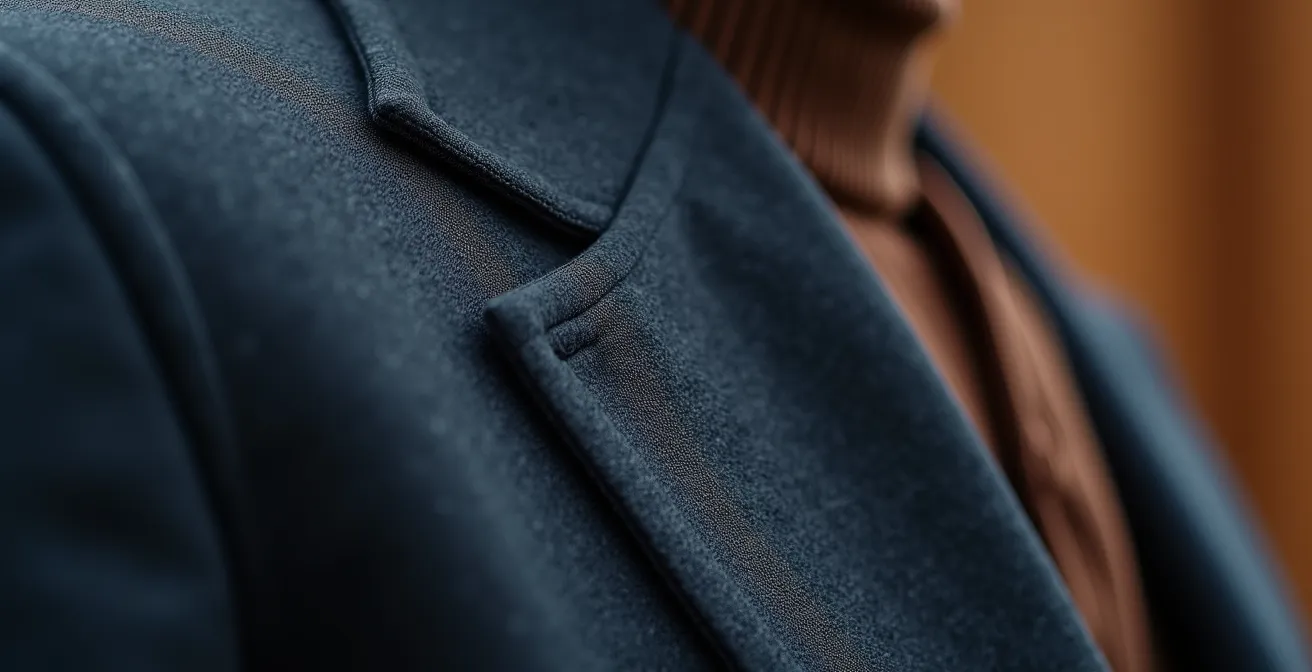
When shopping for an oversized blazer, pay close attention to the shoulders. The seam should either be perfectly on your shoulder (for a “boyfriend” fit) or drop cleanly several inches down your arm (for a true “oversized” fit). Avoid the in-between. This one detail is often the single biggest differentiator between an outfit that looks expensive and curated and one that just looks messy.
How to Layer Oversized Pieces Without Looking Bulky in Winter?
Layering in winter is a necessity, but when you’re working with oversized pieces, it’s easy to go from chic to Michelin Man. The key to successful oversized layering is not to eliminate bulk entirely, but to manage and sculpt it. It requires a strategic approach to fabric weights, textures, and hemlines to create a look that is warm, voluminous, and still has a discernible shape.
The foundational rule is to layer from thinnest to thickest. Start with a close-fitting base layer, like a fine-gauge turtleneck or a simple tee. This acts as your first anchor point. Your middle layer can be your oversized piece—a chunky knit or a baggy button-down. Your final, outer layer should be a piece of structured outerwear, like a long wool coat. The structure of the coat will contain the volume of the layers beneath it, giving the entire outfit a cohesive shape.
Beyond fabric weight, use these techniques to maintain definition:
- Vary Your Hemlines: Ensure each layer is visible. A cropped sweater over a longer shirt, with both peeking out from under a coat, creates vertical and horizontal lines that break up the bulk.
- Play with Textures: Mixing textures (e.g., a silk shirt, a cashmere sweater, a leather jacket) adds visual interest that distracts from the volume. Each texture catches the light differently, creating depth.
- Expose Anchor Points: Even in winter, you can create definition. Roll the sleeve of your coat to show the sweater and shirt cuffs beneath. This small move instantly reduces the feeling of being swaddled.
The shift towards more relaxed fits has been a major force in fashion, a trend that gained significant momentum during the pandemic and continues to dominate. Mastering layering is essential to adapt this comfortable aesthetic for colder climates without sacrificing style.
How to Integrate Neon Accents Into a Neutral Wardrobe for a Modern Look?
Once you’ve mastered silhouette and proportion, the next level is playing with color. A neutral, oversized wardrobe is a perfect canvas for a flash of something unexpected. A strategic pop of neon can elevate a simple look from minimalist to modern and edgy. The key word, however, is *strategic*. Used incorrectly, neon can look cheap or dated. Used with precision, it’s a powerful tool for creating a focal point and telling a new style story.
The first rule of integrating neon is to treat it like a potent spice: a little goes a long way. The goal isn’t to create a color-blocked outfit, but to introduce a single, confident jolt of energy. This is a technique seen on fashion icons like Rihanna and Zendaya, who masterfully use one statement piece—a neon green bag against a beige trench, or electric blue heels with a gray suit—to inject personality while maintaining an overall sense of sophistication. The contrast between the muted, voluminous neutrals and the sharp, saturated accent creates a powerful visual tension.
Your goal is to use the neon accent to draw the eye. It becomes a secondary anchor point, guiding the viewer’s gaze and adding a layer of complexity to the silhouette you’ve already sculpted. It says you’re not just wearing comfortable clothes; you’re making a deliberate, confident choice.
Your Action Plan: Integrating Neon with Intention
- Points of Contact: Identify all the potential places for a neon accent—shoes, a bag, a belt, socks, a hat, or a single garment like a turtleneck.
- Collect: Inventory your existing neutral oversized pieces. What are your go-to beige, black, gray, or white items?
- Coherence: Confront your options with your personal style. Does a neon bag feel authentic to you, or would a flash of neon socks be a better starting point?
- Memorability & Emotion: Assess the impact. Does a neon accessory make your neutral outfit feel more playful, powerful, or artistic? Choose the one that evokes the right emotion.
- Plan of Integration: Start with one piece. Plan an outfit where the neon element is the undisputed star against a backdrop of your most trusted neutral layers.
How to Wear 90s and Y2K Trends Today Without Looking Like a Costume?
The cyclical nature of fashion means that 90s and Y2K trends are firmly back in the spotlight. From low-rise cargo pants to baby tees, these nostalgic pieces are everywhere. However, there’s a significant risk of looking like you’re wearing a costume for a themed party rather than a contemporary outfit. The secret to modernizing these trends lies in interpretation, not replication. You must blend the essence of the trend with today’s silhouettes, fabrics, and proportions.
The most common mistake is wearing multiple throwback pieces together. A head-to-toe Y2K look will almost always feel dated. Instead, follow the “one-in, one-out” rule: for every nostalgic piece you wear, ensure the rest of your outfit is grounded in modern staples. For example, if you’re wearing oversized cargo pants, pair them with a sleek, fitted bodysuit and a contemporary blazer, not a crop top and platform sneakers from the same era. This creates a look that *references* the past without being stuck in it.
The key isn’t to wear a vintage piece, but to wear a modern interpretation. Focus on ‘Modern Silhouettes and Fabrications’ to keep the look current and avoid the costume effect.
– Fashion Editorial Team, Fashion Trend Analysis 2024
Fabric and fit are your best friends here. A slip dress, a quintessential 90s item, feels modern when rendered in a high-quality satin and layered over a fine-knit turtleneck, rather than a thin, shiny polyester worn on its own. It’s about capturing the *spirit* of the trend through the lens of today’s quality standards and styling conventions.
This table breaks down how to reinterpret key pieces to avoid the costume trap. The source is a complete guide to oversized fashion that delves into modern styling.
| Element | Modern Interpretation | Costume Risk | Styling Solution |
|---|---|---|---|
| Cargo Pants | Tailored fit, neutral colors | Oversized, too many pockets | Pair with fitted modern top |
| Slip Dress | Layered over t-shirt | Worn alone with strappy sandals | Add blazer and loafers |
| Low-Rise Jeans | Mid-rise compromise | Ultra-low with visible underwear | Balance with longer tops |
| Baby Tees | Quality fabric, subtle fit | Too tight, cheap material | Layer under oversized pieces |
Key Takeaways
- The secret to oversized styling is sculpting a new shape with intention, not trying to find your existing one.
- Every successful look pivots on a single “anchor point”—a fitted element or defined area that grounds the volume.
- Master techniques like the French tuck, strategic layering, and careful fabric selection to control volume and create deliberate lines.
How to Build a Versatile Capsule Wardrobe That Fits Your Body Shape?
Mastering individual oversized outfits is one thing; building a cohesive, versatile wardrobe is the next. This is where the concept of a capsule wardrobe becomes invaluable. A capsule built around oversized silhouettes isn’t about having a lot of clothes; it’s about having the *right* clothes that work together to tell a consistent style story. It applies all the principles we’ve discussed—anchor points, fabric choice, and intentional lines—at a system-wide level.
The first step is to move away from thinking in terms of individual pieces and start thinking in outfit formulas. Before you buy anything, define 2-3 go-to formulas that you know flatter your shape. For example: Formula 1 might be “Fitted Turtleneck + Oversized Blazer + Straight-Leg Jeans.” Formula 2 could be “Oversized Sweater (French-tucked) + Silk Midi Skirt.” Once you have your formulas, you can shop for pieces that fit within them, ensuring everything you own has a purpose.
Building on this, a successful capsule follows a few core rules:
- Strict Color Palette: Choose 3-4 versatile neutrals (like black, cream, gray, camel) and 2-3 accent colors (which could include your neon pop) that all work together.
- The 4:1 Ratio: For every four “workhorse” basics (a great blazer, perfect jeans), allow yourself one “statement” piece (a trendy, sculptural top). This ensures maximum versatility with a dose of personality.
- Prioritize Quality: In a small wardrobe, every piece counts. Invest in high-quality fabrics and construction. An oversized blazer in beautiful wool will look chic for years, while a cheap one will look sloppy after a few wears.
Interestingly, the oversized trend aligns perfectly with the principles of sustainability often associated with capsule wardrobes. Oversized pieces are more adaptable to body changes, have better resale value, and can be produced with less sizing complexity, reducing waste. It’s a style that can be both on-trend and mindful.
Start today by auditing your closet not by what you have, but by the outfit formulas you can create. Begin building a capsule that empowers you to wear volume with confidence and intention, crafting a signature silhouette that is uniquely yours.