In summary:
- Successful EV ownership in an apartment requires building a personal charging ecosystem, not relying on a single plug.
- Prioritizing your battery’s health by limiting daily fast charging is crucial for long-term range and value.
- Mastering public charging etiquette and using digital tools turns a potential frustration into a manageable routine.
- A Plug-in Hybrid (PHEV) can be a strategic bridge to full EV ownership if charging access is highly uncertain.
- Anticipating real-world challenges like winter range loss and having a redundant digital toolkit are non-negotiable.
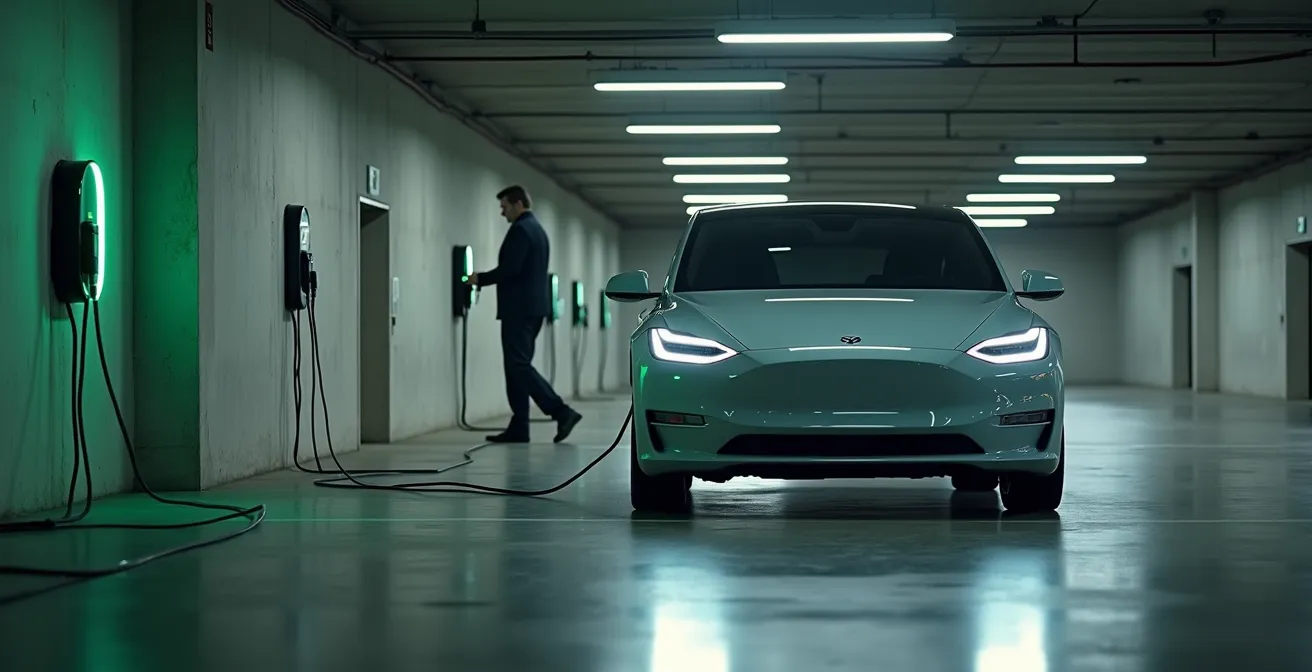
The dream of gliding silently past gas stations in a new electric vehicle often hits a hard wall: the apartment building parking lot. For the growing number of city residents eager to make the switch, the lack of a private garage feels like a dealbreaker. The common advice you hear—”just use public chargers” or “ask your landlord to install one”—oversimplifies a complex reality of high costs, logistical hurdles, and daily frustrations.
But what if the solution isn’t about finding one perfect plug? What if, instead, it’s about developing a strategic mindset? Transitioning to an EV as an apartment dweller is less about your parking spot and more about creating a personal, resilient charging ecosystem. This approach means understanding the trade-offs of different charging methods, mastering the digital tools at your disposal, and implementing smart habits that protect your most valuable asset: the battery.
This guide moves beyond the obvious to give you the operational playbook you need. We will dismantle the myths around fast charging, provide concrete tactics for navigating the world of public stations, and explore how to make intelligent choices—from the type of vehicle you buy to the apps you use—that make EV ownership not just possible, but practical and empowering, even without a dedicated home charger.
This article provides a comprehensive roadmap for prospective EV owners living in apartments. Below, you will find a detailed breakdown of the key strategies and considerations, from battery science to navigating public infrastructure, designed to equip you for a successful transition.
Summary: Your Strategic Guide to Apartment EV Ownership
- Why Fast Charging Every Day Degrades Your Battery Life by 10%?
- How to Use Public Chargers Without Getting Fined for Loitering?
- Plug-in Hybrid or Full EV: Which Is More Practical for Apartment Dwellers?
- The Winter Range Surprise That Strands New EV Drivers
- How to Charge Only to 80% to Save Time and Money on Road Trips?
- How to Prioritize Energy Efficiency Renovations for Maximum Bill Reduction?
- How to Design a Solar Landscape Lighting Scheme That Stays Bright All Night?
- How to Build a Stable IoT Ecosystem That Doesn’t Crash When Wi-Fi Drops?
Why Fast Charging Every Day Degrades Your Battery Life by 10%?
The allure of a DC fast charger (DCFC) is undeniable: adding hundreds of miles of range in under an hour seems like the perfect solution for an apartment dweller. However, relying on this method for daily charging is a recipe for accelerated battery degradation. The core issue is heat. Fast charging forces a massive amount of energy into the battery, generating significant thermal stress on its chemical components. Over time, this repeated stress reduces the battery’s ability to hold a full charge, a phenomenon known as capacity loss.
Think of it as the difference between sipping water throughout the day versus chugging a gallon in one minute. The latter is more stressful on your system. For an EV battery, this stress is quantifiable. The 80% threshold is a critical pivot point. To protect the battery, its management system dramatically slows down the charging rate once it reaches this level. In fact, comprehensive research from Recurrent Auto demonstrates that charging speed can drop by 70% or more when going from 80% to 100%. This means the last 20% of a fast-charging session is not only the most time-consuming but also the most damaging.
Achieving battery sovereignty is about treating your battery like the valuable asset it is. The most effective strategy is the 80/20 rule: aim to use slower Level 2 charging (like at work or a grocery store) for 80% of your needs, and reserve DC fast charging for the 20% of situations where it’s truly necessary, like long road trips. This simple shift in mindset preserves your vehicle’s range and resale value, giving you more freedom and control within your charging ecosystem.
How to Use Public Chargers Without Getting Fined for Loitering?
For apartment dwellers, public chargers are an essential part of the EV ecosystem, but they come with their own set of rules and etiquette. The biggest risk is incurring “idle fees,” which are penalties charged by networks when your car remains plugged in after its charging session is complete. These fees are designed to prevent drivers from monopolizing stations, but they can be a source of major anxiety if you can’t get back to your car the second it’s done.
The solution is to reframe charging time from a waiting game into a productive activity. This is the concept of “Charge Tasking”: strategically pairing your charging sessions with other necessary errands. Choose charging stations located at grocery stores, gyms, or cafes where you already plan to spend an hour or two. This turns a chore into a seamless part of your weekly routine and eliminates the stress of watching the clock.

Beyond personal productivity, using community-focused tools is key. As demonstrated in one study, apps like PlugShare, which enable drivers to check in and communicate their charging status, have reduced wait times by up to 40% in dense urban areas. To avoid fees, create a multi-layer notification system: set the alert in the charging app, create a personal phone timer for 5 minutes before the session ends, and consider leaving a dashboard note with your phone number as a courtesy to other drivers. This proactive communication and planning transforms you from a potential rule-breaker into a responsible member of the EV community.
Plug-in Hybrid or Full EV: Which Is More Practical for Apartment Dwellers?
The decision between a full Battery Electric Vehicle (BEV) and a Plug-in Hybrid (PHEV) is one of the most critical for an apartment dweller. While the allure of a zero-emissions BEV is strong, a PHEV offers a pragmatic compromise that can significantly reduce charging anxiety. This is especially relevant when you consider that nearly one-third of Americans live in multifamily dwellings, where reliable charging remains a significant challenge.
A PHEV provides an electric range of typically 25-50 miles, which is often enough to cover a daily commute. This allows you to reap the benefits of electric driving for most of your routine trips, using a standard 120V wall outlet if available or occasional public charging. Crucially, the gasoline engine backup eliminates range anxiety for long trips or on days when you can’t find an available charger. This flexibility makes it an ideal bridge technology for those not yet ready to commit to a fully electric lifestyle due to infrastructure gaps.
In contrast, a BEV demands a more robust charging strategy. It’s the right choice if you have reliable charging at your workplace, a guaranteed public charger nearby that you can incorporate into your routine, or if your landlord is open to installation. While the operating and maintenance costs of a BEV are lower over time, the higher upfront purchase price and complete dependence on charging infrastructure are significant factors. The following table breaks down the key considerations:
| Factor | PHEV | BEV |
|---|---|---|
| Average Purchase Price | $41,995 | $58,940 |
| Operating Cost per Mile | ~8¢ (mixed use) | ~4¢ (home charging) |
| Annual Maintenance | $600-$1,000 | $300-$550 |
| Charging Infrastructure Dependence | Low – gas backup available | High – fully dependent |
| Typical Electric Range | 25-50 miles | 250-350 miles |
| Ideal for Apartment Dwellers If: | Limited charging access, frequent long trips | Reliable workplace or nearby public charging |
Ultimately, the choice depends on an honest assessment of your driving habits and the charging infrastructure available to you. A PHEV provides a safety net, while a BEV offers the full electric experience for those who can build a reliable charging ecosystem.
The Winter Range Surprise That Strands New EV Drivers
One of the harshest realities for new EV owners, especially those in colder climates, is the “winter range surprise.” It’s common for an EV to lose 30-40% of its advertised range when temperatures drop below freezing. This isn’t a defect; it’s physics. Cold temperatures slow down the chemical reactions inside the battery, reducing its efficiency. Furthermore, a significant portion of the battery’s energy must be diverted to heating the cabin and the battery pack itself, energy that would otherwise be used for propulsion.
For an apartment dweller who can’t plug in overnight to precondition, this can be a serious problem. You might leave your parking spot with what you thought was 150 miles of range, only to find it’s closer to 90. This discrepancy can easily turn a routine commute into a stressful search for an emergency charger. Understanding and anticipating this is a cornerstone of a resilient charging strategy.
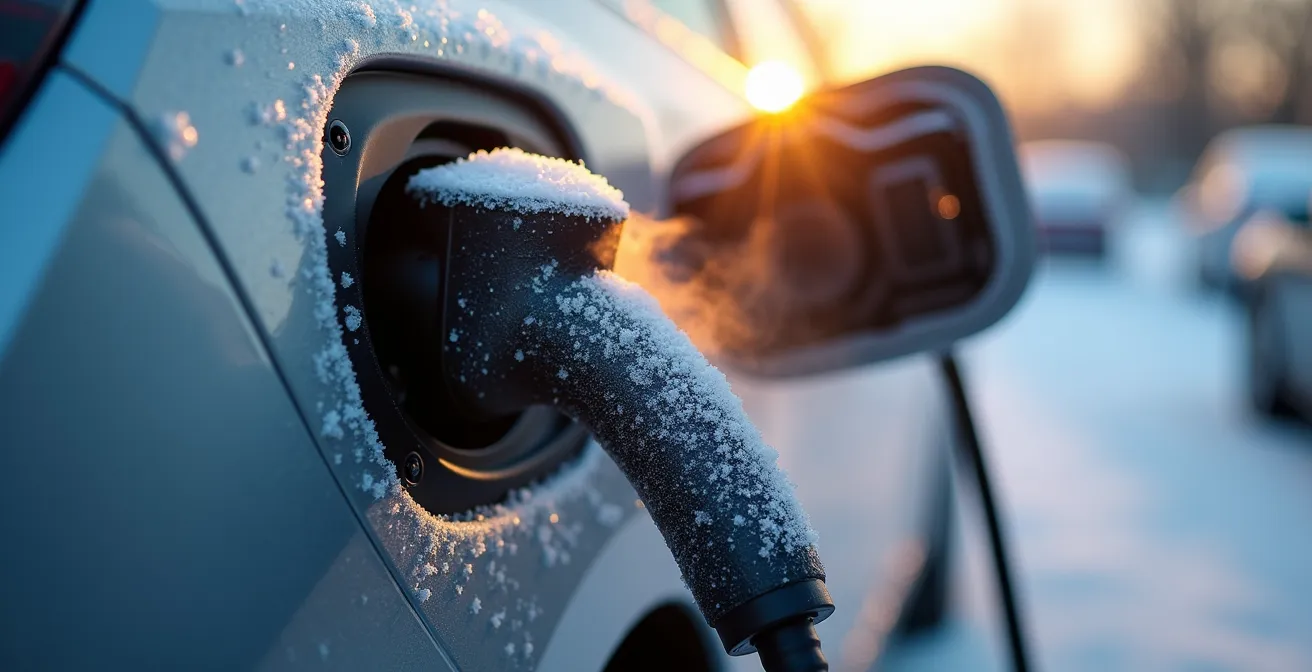
The key to mitigating winter range loss is proactive energy management. If you have access to any charger (even a standard outlet at work or a public Level 2), use it to precondition the cabin and battery 10-15 minutes before you depart. This draws power from the grid, not your battery, to get the systems to their optimal operating temperature. Additionally, relying on heated seats and a heated steering wheel is far more energy-efficient than blasting the cabin heater. Small habits, like clearing all snow and ice to improve aerodynamics, can collectively save precious range.
Your Action Plan: Winter EV Efficiency Checklist for Apartment Dwellers
- Precondition cabin 10-15 minutes before departure while still connected to any available charger.
- Slightly overinflate tires within manufacturer specs to compensate for the pressure drop from the cold.
- Utilize Eco or Range driving modes to limit aggressive acceleration and moderate cabin heating.
- Clear all snow and ice from the vehicle to improve aerodynamics, which can save 5-10% of your range.
- When possible, park in covered or underground garages to protect the battery from extreme cold and reduce “vampire drain.”
- Prioritize using heated seats and steering wheel over the main cabin heater to conserve the most energy.
How to Charge Only to 80% to Save Time and Money on Road Trips?
While the 80% charging rule is vital for daily battery health, it becomes a powerful time-saving strategy on road trips. The instinct to charge to 100% at every stop is counterproductive. As we’ve established, charging an EV battery slows dramatically as it gets full. The time spent going from 80% to 100% at a DC fast charger can often be as long as the time it took to get from 20% to 80%. This final, slow trickle of energy is what creates long, frustrating charging stops.
The smarter approach is a strategy known as “Charger Leapfrogging.” Instead of one long stop to charge to 90% or more, you make two or more shorter stops, charging only to the 70-80% range needed to comfortably reach the next charger. You operate within the battery’s fastest charging window (typically 10-80%), minimizing your stationary time.
Case Study: The “Charger Leapfrogging” Strategy
A real-world test illustrates this perfectly. An analysis cited by GreenCars found that making two 25-minute charging stops to go from 20% to 70% each time was 20 minutes faster on a long trip than a single 70-minute stop to go from 10% to 90%. Drivers employing this leapfrogging method not only saved significant travel time but also reduced thermal stress on their batteries and often avoided higher per-minute pricing that some networks implement during peak demand.
To execute this strategy effectively, you need the right digital tools. Apps like A Better Route Planner (ABRP) are essential. You input your vehicle model, starting charge, and destination, and it automatically calculates the optimal charging stops, durations, and target charge levels to minimize total travel time. It understands your car’s specific charging curve and plans stops to keep you in that fast-charging sweet spot. This data-driven approach removes guesswork and turns road-tripping from a source of range anxiety into a simple, efficient process.
How to Prioritize Energy Efficiency Renovations for Maximum Bill Reduction?
For an apartment dweller, the most impactful “renovation” you can undertake isn’t to your unit, but to your building’s infrastructure—and your landlord’s mindset. While you can’t install insulation or new windows, you can spearhead the installation of EV charging stations, an upgrade that dramatically increases property value and tenant appeal. The key is to approach your landlord not with a request, but with a business case.
A successful pitch requires preparation. Don’t simply ask for a charger; present a solution. Start by researching all available federal, state, and local utility incentives for installing EV charging infrastructure. Many programs cover a significant portion of the hardware and installation costs, drastically reducing the financial burden on the property owner. Tools from charging network providers like ChargePoint often have incentive finders to simplify this research.
Next, demonstrate demand. The most powerful tool you have is social proof. Organize with other interested neighbors—even 3 or 4 tenants presenting a united front is far more compelling than a single request. Frame the installation as a competitive advantage in the rental market, a way to attract and retain high-quality tenants in an increasingly green-conscious world. You can even prepare a simple Return on Investment (ROI) calculation, showing how the cost (after incentives) can be recouped through a modest monthly charging fee or increased property value, often within a 2-4 year payback period. Bundling the request with other efficiency upgrades, like a switch to LED lighting in the garage, can make it even more attractive.
How to Design a Solar Landscape Lighting Scheme That Stays Bright All Night?
While installing a personal solar array on your apartment balcony isn’t feasible, the desire to power your EV with clean energy is still within reach. The modern solution lies in shifting your thinking from a personal “lighting scheme” to a collective energy strategy: community solar programs. This model is a game-changer for renters and apartment dwellers who want to tap into the benefits of solar without owning a roof.
Here’s how it works: you subscribe to a portion of a large, off-site solar farm located in your utility’s service area. You don’t own the panels, but you receive credits on your monthly electricity bill corresponding to the energy your share of the farm produces. This directly lowers your overall energy costs, including the portion used for charging your EV at public stations or, if you have one, a shared building charger. It’s a way to ensure the kilowatts you put into your car are offset by clean, renewable generation elsewhere.
Case Study: Community Solar for Apartment EV Owners
This model has proven highly effective. In states with robust programs like California, participants in community solar initiatives save an average of 10-15% on their electricity bills. This provides a direct, tangible reduction in EV charging expenses. For apartment dwellers, it’s the most practical way to link their clean transportation choices with a commitment to renewable energy, completing the sustainability loop that often feels broken by a lack of personal solar access.
You can also advocate for smaller-scale solar solutions within your complex. Proposing solar-powered pathway or security lighting for parking areas and near future charging stations can be framed as a safety and modernization enhancement. Suggesting solar canopies over parking spaces not only provides shade but also future-proofs the property for direct solar-to-EV charging. These ideas position you as a forward-thinking resident focused on improving the entire community, making them far more likely to be adopted.
Key takeaways
- EV ownership in an apartment is a system of strategies, not a search for a single plug.
- Your top priority is battery health: use the 80/20 rule, limiting daily fast charging to preserve range and value.
- Building digital redundancy with multiple apps and an offline RFID card is non-negotiable for reliable public charging.
- Anticipating real-world factors like winter range loss and planning accordingly separates successful owners from frustrated ones.
How to Build a Stable IoT Ecosystem That Doesn’t Crash When Wi-Fi Drops?
Your electric vehicle is the most sophisticated device in your personal Internet of Things (IoT) ecosystem. But unlike a smart speaker that loses its connection, a charging failure due to a dropped Wi-Fi or cellular signal can leave you stranded. For an apartment dweller totally dependent on public infrastructure, building a stable and redundant digital toolkit is not just a convenience; it’s a critical part of your charging strategy.
The first layer of this ecosystem is a multi-app approach. Do not rely on a single charging network’s app. Best practice involves using a combination: PlugShare for its invaluable community-sourced reviews and real-time station status, A Better Route Planner (ABRP) for optimizing long-distance travel, and the native apps of major networks like ChargePoint or Electrify America for initiating sessions. One study of urban EV drivers found that those using this multi-app strategy reported 35% fewer charging-related delays, as they could always find a backup if one network’s station was down or its app was failing.
However, the most crucial element for when all digital systems fail is the analog backup: the RFID card. Most major charging networks provide a physical, credit-card-sized card that can activate a charger by simply tapping it on the station’s reader. This works even when your phone has no service or the station’s own network connection is spotty. Keeping these cards in your glovebox is the ultimate failsafe, the equivalent of a spare tire for your digital charging life. Finally, practice good digital hygiene. Use virtual credit card numbers or services like Apple/Google Pay to protect your financial data and enable two-factor authentication on all your charging accounts.
Stop waiting for the perfect charging spot to appear. Start building your personal charging ecosystem today. Evaluate your daily commute, explore the apps and strategies we’ve discussed, and take the first step toward a confident and empowered electric future, right from your apartment.
Frequently Asked Questions about How to Transition to an Electric Vehicle When You Live in an Apartment?
What charging apps work offline at public stations?
Most major networks like ChargePoint and Electrify America offer RFID cards that work without a cellular connection. Keep these cards in your glovebox as a reliable backup for when apps or mobile connectivity fail at a charging station.
How can I protect my payment data at public chargers?
Use virtual credit card numbers, Apple/Google Pay, or other payment services that offer robust fraud protection. It’s also critical to enable two-factor authentication on all your charging network apps and use a secure password manager to protect your account credentials.
What IoT tools help apartment EV drivers manage charging?
A smart IoT strategy for an apartment EV driver includes: setting up IFTTT automations for charging alerts and reminders; using multiple charger-locator apps (like PlugShare and ChargeHub) for redundancy; leveraging your car’s built-in LTE for remote status checks; and maintaining offline maps of charging networks on your phone for emergencies in areas with no service.