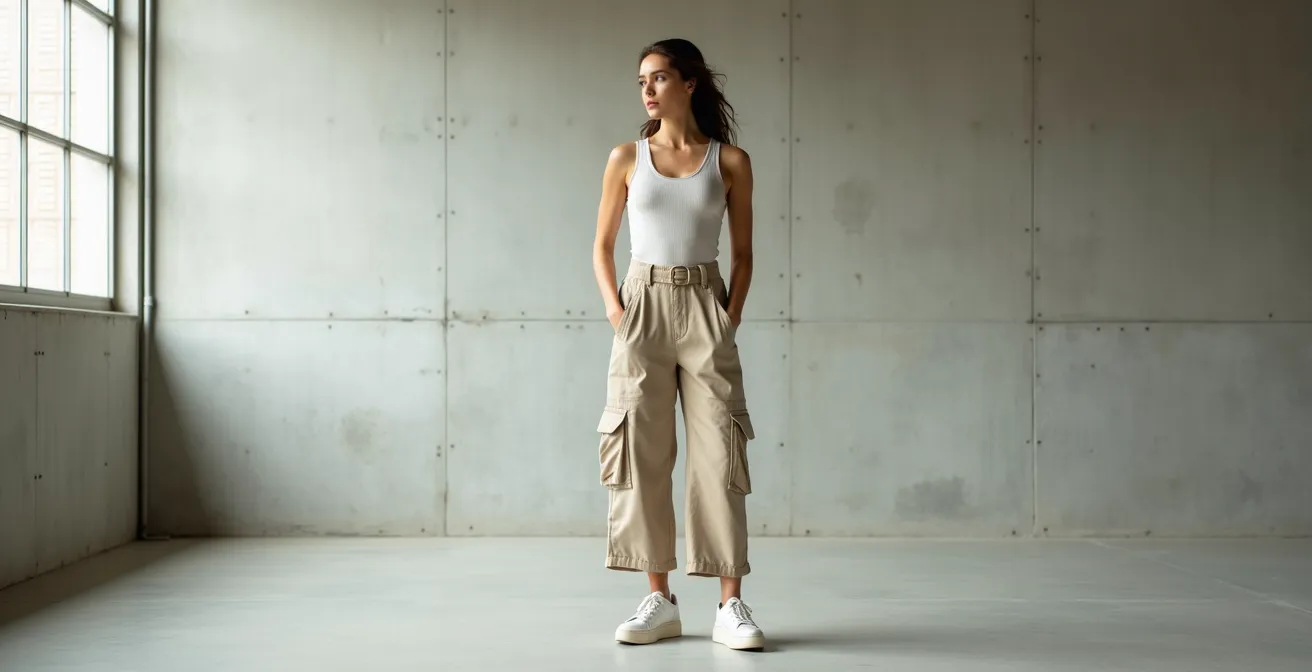
Successfully wearing 90s and Y2K fashion today isn’t about recreating old outfits; it’s about avoiding the ‘costume’ trap by mastering the art of modern aesthetic referencing.
- The key is the 70/30 principle: 70% of your outfit should be modern, timeless staples, with only 30% dedicated to the nostalgic trend piece.
- Focus on translating the *essence* of a trend through updated silhouettes, sophisticated textures, and intentional proportion play, rather than copying it literally.
Recommendation: Start by choosing one single nostalgic piece from your past (like cargo pants or a slip dress) and consciously build a contemporary look around it using modern shoes, a structured blazer, or minimalist jewelry.
If you’re a millennial, the current wave of 90s and Y2K fashion isn’t just a trend; it’s a high-definition replay of your formative years. That butterfly clip, the faint memory of a dial-up modem, the impossible decision of which Spice Girl you were—it’s all coming back. And with it, a valid fear: how do you revisit the trends you wore as a teenager without looking like you’re heading to a themed party? Many will tell you to just “add one retro piece” or that “confidence is key,” but this advice misses the fundamental challenge. The real goal isn’t to copy-paste the past.
The secret lies in a strategic shift in mindset, from thematic dressing to what we can call aesthetic referencing. It’s about deconstructing *why* we loved a trend—the rebellious slouch of grunge, the utilitarian ease of cargo pants, the sleek futurism of a slip dress—and reinterpreting that feeling with the wisdom and resources of an adult. It means understanding silhouette, texture, and proportion in a way our teenage selves never could. It’s the difference between wearing a costume and telling a compelling style story.
This guide is built on that principle. We’ll explore the cyclical nature of trends to understand why this is happening now. Then, we’ll break down exactly how to integrate specific, tricky pieces like cargo pants and low-rise jeans into a sophisticated wardrobe. We’ll establish the core principles for mixing nostalgia with modernity, applying them to everything from grunge aesthetics to oversized silhouettes, and even to how you source vintage decor for your home. This is your playbook for wearing your nostalgia, masterfully.
To navigate this revival with style and intention, this article breaks down the essential strategies. Here is a summary of the key areas we will explore to help you master the modern take on retro trends.
Summary: A Millennial’s Guide to Nailing Nostalgic Trends
- Why Fashion Trends Cycle Every 20 Years and What Is Coming Next?
- How to Style Cargo pants With Modern Shoes to Look Adult?
- Low Rise or High Rise: Which Y2K Jean Style actually Flatters Your Body?
- The “Head-to-Toe” Mistake That Makes You Look Like a Movie Character
- How to Mix 90s Grunge Pieces With Modern Minimalism?
- How to Curate a High-End Wardrobe Exclusively Through Ethical Second-Hand Shopping?
- How to Source and Integrate Vintage Decor Without Your Home Looking Dated?
- How to Style Oversized Clothing Without Looking Sloppy or Losing Your Silhouette?
Why Fashion Trends Cycle Every 20 Years and What Is Coming Next?
The feeling that fashion is on a perpetual loop isn’t just in your head; it’s a well-documented phenomenon often called the “20-year rule.” The current explosion of Y2K and 90s aesthetics, with over 35 billion views on TikTok and 7 million posts on Instagram, is a textbook example of this cycle in hyperdrive. But why 20 years? It’s not an arbitrary number. It’s rooted in a generational pattern of experience, rejection, and rediscovery. This is best explained by what some trend analysts call the “Three-Generation Theory of Fashion Cycles.”
The theory posits that a trend’s life follows a simple arc. The first generation (e.g., millennials who were teens in the late 90s/early 2000s) experiences the trends firsthand. For them, low-rise jeans and tube tops are tied to real, sometimes awkward, memories. The second generation, their children, sees these as their parents’ “cringey” old clothes and naturally rejects them in favor of their own styles. It’s the third generation—today’s Gen Z, who have no direct memory of the era—that rediscovers and romanticizes these trends. For them, Y2K isn’t a lived experience; it’s a cool, vintage aesthetic discovered through a nostalgic, social media-filtered lens.
This cycle, according to an analysis of fashion’s cyclical nature, is now accelerated by platforms like TikTok, which act as a digital archive where aesthetics can be unearthed and go viral overnight. So, what’s next? Following the 20-year rule, we’re on the cusp of a mid-to-late 2000s revival. Think the indie sleaze of skinny jeans and ballet flats, the boho-chic layers, and the early days of blog-era fashion. The key for a millennial is not to fear this cycle, but to understand it and use it to your advantage, picking and choosing with a curator’s eye.
How to Style Cargo Pants With Modern Shoes to Look Adult?
Cargo pants are arguably one of the most emblematic—and trickiest—pieces to emerge from the Y2K revival. Worn the wrong way, they can instantly transport you back to a high school hallway. The secret to modernizing them lies almost entirely in what you put on your feet. Footwear acts as a powerful tool for “material code-switching,” instantly elevating the utilitarian, cotton-twill nature of the pants into something more intentional and sophisticated.
The fundamental rule is to create contrast. The ruggedness of the cargo pant needs to be balanced by a shoe that communicates polish, elegance, or sharp modernity. Forget the chunky skate shoes of the past. Instead, think about the context and the message you want to send. Your choice of shoe dictates whether your outfit reads as weekend casual, creative office-appropriate, or unexpectedly chic for an evening out.
This styling chart demonstrates the power of pairing the right shoe with cargo pants to achieve a polished, adult look.
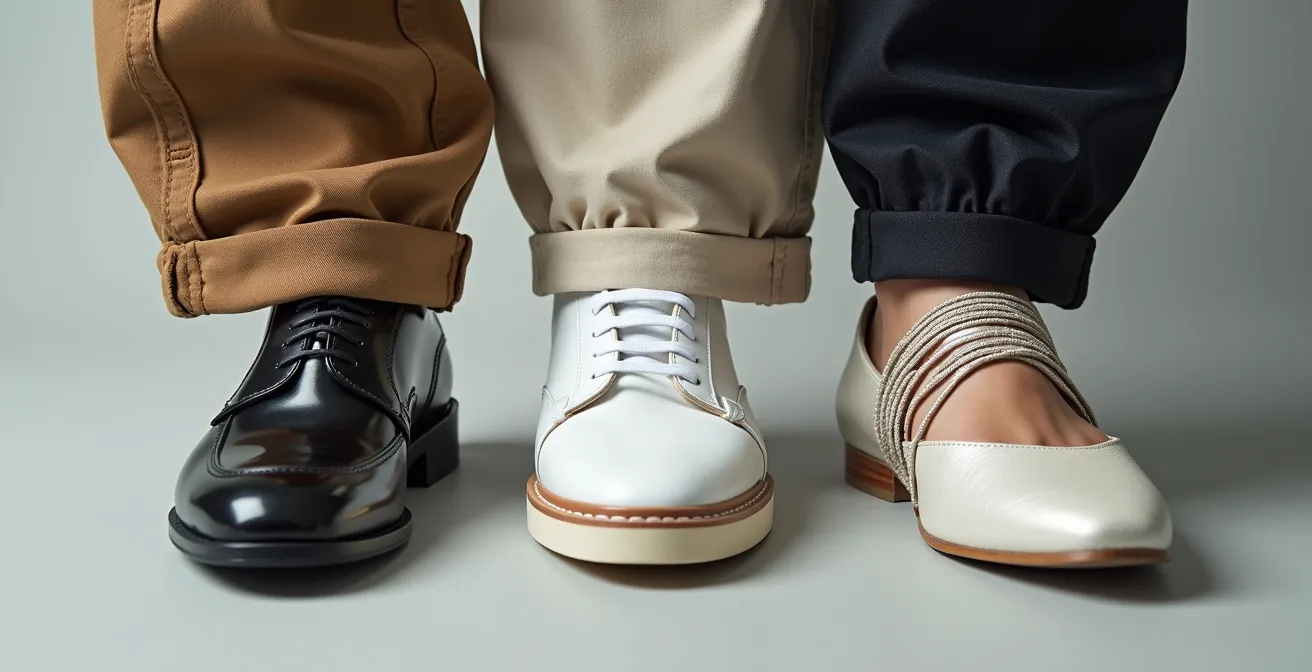
To master this, focus on silhouette and material. A strappy, delicate heel against a silky cargo fabric creates a beautiful tension. A sharp, pointed-toe loafer in patent leather peeking out from a slimmer-cut cargo feels deliberate and smart. Even sneakers can work, provided they are minimalist, clean, and sleek. Pay close attention to the ankle interaction: a clean break above a loafer looks polished, while a slight “puddle” of fabric over a sneaker maintains a relaxed feel without looking sloppy. Here are some modern pairings:
- For a polished casual look: Pair your cargos with sleek, minimalist leather sneakers.
- For creative office environments: Choose pointed-toe flats or sharp loafers, especially with slimmer cargo styles.
- For evening occasions: Opt for delicate, strappy heeled sandals, particularly with silky or satin cargo fabrics.
- To create contrast: Select shoes with luxurious materials like patent leather, satin, or metallic finishes.
Low Rise or High Rise: Which Y2K Jean Style actually Flatters Your Body?
No single item from the Y2K era is as divisive as the low-rise jean. For many millennials, it brings back memories of questionable fit and constant adjustments. Yet, as they return, the question isn’t a simple “yes” or “no,” but rather, “which rise truly works for me?” The modern approach to jeans is less about blindly following a trend and more about understanding your proportions to choose a silhouette that flatters and feels good. The Y2K revival has thankfully brought back a spectrum of rises, not just the ultra-low.
The key is to see each rise—low, mid, and high—as a tool for shaping your silhouette. A low rise can elongate a shorter torso, while a high rise is brilliant for making legs appear longer and defining the waist. The once-overlooked mid-rise has become the modern sweet spot, offering a hint of nostalgic lower-slung style with far more comfort and versatility. It sits just below the navel, providing a perfect balance that works for nearly all body types.
This is further supported by modern styling advice. As one fashion editor from Style Rave Fashion Analysis notes, the contemporary way to wear lower rises is a world away from the Y2K pairing with a tiny crop top.
The 2024 way to wear lower rises is not with a crop top, but by pairing them with longer-line tops, bodysuits, or layering with an open oversized shirt to create a new, elongated silhouette that feels fresh.
– Fashion Editor, Style Rave Fashion Analysis
This advice is crucial; it’s about using layering and proportions to make the trend work in a grown-up context. To help you choose, here is a breakdown of how each jean rise typically works for different body types and how to style it for today.
| Jean Rise | Best For | Styling Tips | Modern Update |
|---|---|---|---|
| Low Rise | Long torsos, athletic builds | Pair with longer tops or bodysuits | Choose curved-fit for curves, slouchy for straight body types |
| Mid Rise | Universal – all body types | Sits just below navel, Y2K spirit with sophistication | The modern sweet spot between extremes |
| High Rise | Short torsos, pear shapes | Tuck in tops to elongate legs | Balance with cropped or fitted tops |
The “Head-to-Toe” Mistake That Makes You Look Like a Movie Character
The single biggest pitfall in styling vintage or retro pieces is falling into the “head-to-toe” trap. This is when an outfit shifts from being an “aesthetic reference” to literal “thematic dressing,” making you look less like a stylish person and more like a character from a period film. Think of a full Juicy Couture tracksuit, a plaid skirt suit à la *Clueless*, or a complete grunge ensemble with a band tee, flannel, and ripped jeans. While fun for a party, it lacks the sophistication needed for daily life.
The solution is a simple but powerful guideline used by stylists: the 70/30 Principle. This rule dictates that your outfit should be composed of 70% modern, timeless, or classic pieces and only 30% dedicated to the nostalgic trend you’re referencing. This 30% is your statement, your nod to the past. The other 70% acts as the contemporary canvas that grounds the look firmly in the present day. This ratio ensures your outfit feels current and intentional, not like a costume you pulled from a storage bin.
To execute this effectively, it helps to identify an “Aesthetic Anchor” for your outfit. This is one distinctly modern, high-quality item—be it an architectural handbag, a sharp blazer with a current cut, or a pair of sculptural earrings—that acts as the gravitational center of your look. It sends a clear signal that your nostalgic choices are deliberate. It’s the difference between looking dated and looking discerning.
Your Checklist for Avoiding the Costume Look
- Apply the 70/30 Rule: Ensure your outfit is 70% modern/timeless basics and only 30% nostalgic trend pieces.
- Choose one ‘Aesthetic Anchor’: Select an ultra-current item (a modern blazer, architectural jewelry, a current handbag model) that plants the outfit firmly in today.
- Distinguish your goal: Aim for ‘Aesthetic Referencing’ (style inspiration) not ‘Thematic Dressing’ (costume).
- Analyze and avoid costume elements: Steer clear of specific era cuts, dated fabric sheens (unless used ironically), and period-specific color combinations that feel too literal.
- Mix with modern quality: Integrate your Y2K or 90s pieces with contemporary fabrics and modern fits to elevate the entire look.
How to Mix 90s Grunge Pieces With Modern Minimalism?
The raw, anti-establishment energy of 90s grunge seems, on the surface, to be the polar opposite of clean, considered minimalism. Yet, fusing the two is one of the most sophisticated ways to wear nostalgia today. The key is to focus on “Essence over Item.” Instead of reaching for a literal vintage band tee, capture the *mood* of grunge—its dark palette, its love of texture, its slouchy silhouettes—and translate it through the high-quality lens of minimalism.
This fusion is all about creating compelling contrasts in texture and form. Imagine a luxe, charcoal-grey silk camisole (minimalist) worn under an oversized, vintage plaid flannel (grunge). Or pairing beautifully distressed, high-quality denim with a sharply tailored black wool blazer. The minimalist pieces act as a clean, quiet backdrop that allows the single grunge element to feel intentional and textural rather than unkempt. This is what you might call “Investment Asymmetry,” where high-quality minimalist staples elevate more affordable or genuinely worn-in grunge pieces.
This artistic flat lay shows how contrasting pieces—a luxe silk camisole, a vintage flannel, a sharp blazer, and distressed denim—can be arranged to create a cohesive and modern look.
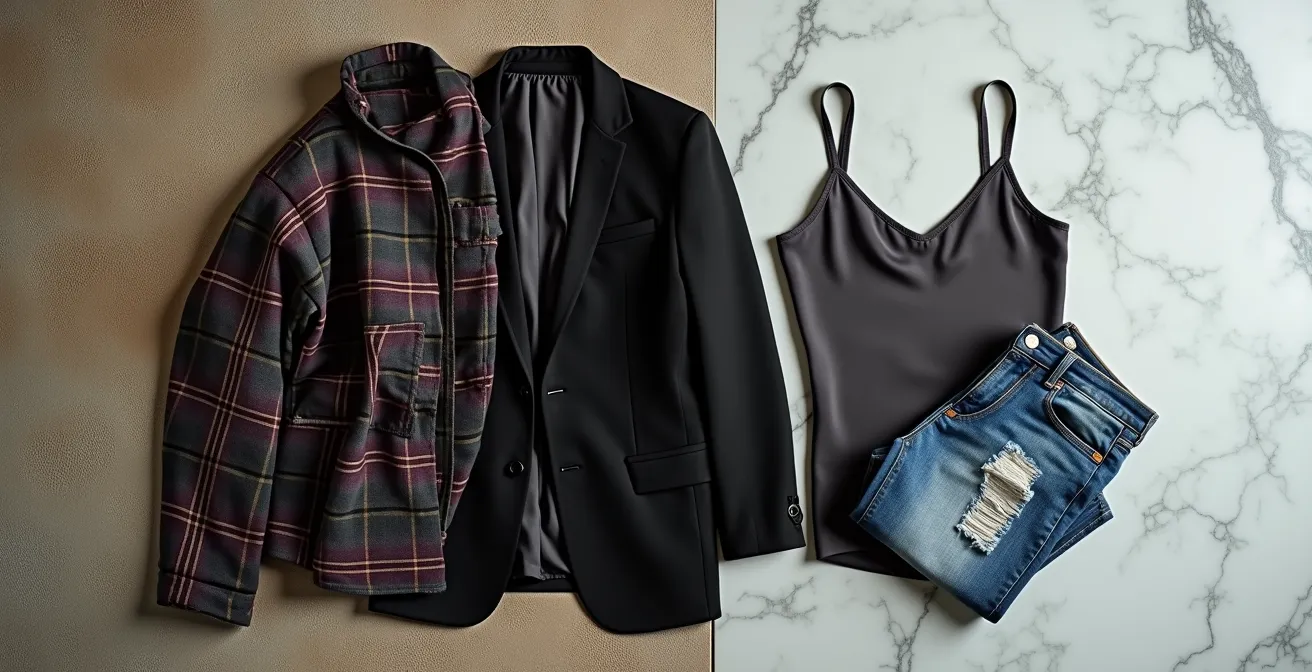
To successfully execute this high-low mix, adhere to a disciplined color palette. Use minimalist neutrals like black, white, charcoal, and camel as your 70% base. Then, introduce your 30% grunge element within that same color story—a black distressed knit, a faded grey flannel, or dark-wash denim. This keeps the look cohesive and chic, preventing it from becoming visually chaotic. The ultimate rule is to choose just one primary grunge element per outfit and surround it with clean, simple, and beautifully made minimalist pieces.
How to Curate a High-End Wardrobe Exclusively Through Ethical Second-Hand Shopping?
Styling nostalgic trends with a modern eye is one thing; sourcing them ethically and intelligently is another. Curating a high-end wardrobe through second-hand shopping is no longer about dusty thrift store bins. It’s a strategic hunt for quality, longevity, and what could be called “Future Vintage.” This means shifting your focus from worn-out fast fashion to nearly-new pieces from contemporary “quiet luxury” brands or timeless designer staples that hold their value and style.
The first step is to apply the “Brand DNA Litmus Test.” When browsing online consignment stores or local high-end resale boutiques, train your eye to distinguish between a brand’s fleeting, seasonal runway pieces and its timeless core items. A classic Burberry trench or a Max Mara coat found second-hand is a far better investment than a trendy piece from a single, memorable collection. Your goal is to acquire items that were built to last, both in construction and in style.
Mastering this requires developing a bit of a “material forensics” skill set. Learn to identify quality beyond the label. Check for high-density seams, fully lined jackets, the feel of natural fibers like wool, silk, and cashmere, and the weight of solid metal hardware on bags and belts. A significant part of this strategy is also patience and timing. Hunt for investment pieces like wool coats or leather boots during the off-season (i.e., in summer), when demand and prices typically drop. Finally, always allocate 15-20% of your item’s budget to professional tailoring. A perfect fit is what truly transforms a great second-hand find into a piece that looks like it was made for you.
How to Source and Integrate Vintage Decor Without Your Home Looking Dated?
The principles for tastefully modernizing your wardrobe apply just as powerfully to your living space. Integrating vintage decor without your home looking like a cluttered antique shop or a dated time capsule follows the exact same logic: the 70/30 Principle. As one interior design expert noted in a Saks Fifth Avenue style guide, a room should have 70% modern foundations and 30% vintage “character” pieces to prevent the “flea market” look. This ratio creates the perfect balance between clean, contemporary living and soulful, story-rich accents.
Sourcing these character pieces requires learning to distinguish between “quality vintage” and items that are just “old.” Quality vintage is defined by timeless silhouettes, solid construction, and materials that get better with age. An item with classic lines, like a mid-century modern credenza, transcends its era. An item with a heavily trend-specific shape, however, can instantly date a room. Look for signs of good craftsmanship, such as dovetail joints in wooden furniture or solid brass hardware. Materials that develop a beautiful patina, like leather, brass, and marble, are hallmarks of quality vintage, whereas synthetic materials that simply show wear and tear are signs of something just being old.
The table below provides a quick checklist for evaluating potential vintage finds. Use it as a guide when you’re at a flea market, an estate sale, or browsing online marketplaces to ensure you’re bringing home a treasure, not just someone else’s old stuff.
| Quality Vintage | Just Old | Integration Tips |
|---|---|---|
| Classic lines transcending era | Heavily dated specific trends | Mix with 70% modern foundations |
| Solid wood construction | Particle board or laminate | Look for dovetail joints |
| Materials that patinate (leather, brass, marble) | Synthetic materials showing wear | Unite with consistent color or material theme |
| Timeless silhouettes | Trend-specific shapes | Use modern anchor pieces for balance |
Key Takeaways
- Master the 70/30 Principle: Your outfit should be 70% modern staples and only 30% nostalgic trend pieces to avoid a costume look.
- Focus on Essence Over Item: Capture the mood and feeling of a trend (e.g., grunge’s texture, Y2K’s utility) rather than recreating an exact outfit.
- Prioritize Silhouette and Material: Use modern tailoring, updated proportions, and sophisticated fabric contrasts to elevate retro pieces.
How to Style Oversized Clothing Without Looking Sloppy or Losing Your Silhouette?
The oversized silhouette was a pillar of 90s fashion and remains a cornerstone of modern style, but mastering it is an art form. The risk is being overwhelmed by fabric, losing your shape, and looking sloppy rather than intentionally chic. The secret to success lies in the “One Point of Definition” rule. No matter how voluminous your outfit is, you must define your silhouette at one strategic point to give it structure and shape.
This point of definition can be your waist, highlighted with a French tuck or a belt; your wrists, revealed by rolling up the sleeves of an oversized blazer or shirt; or your ankles, showcased by pairing a wide-leg pant with a fitted shoe or choosing a cropped length. This single anchor point prevents the outfit from looking like you’re simply wearing clothes that are too big. Furthermore, it’s crucial to choose pieces designed with “intended volume”—those with dropped shoulders, cocoon shapes, or architectural cuts—rather than just sizing up in a standard-fit item. These pieces are cut to create a specific oversized shape that drapes correctly.
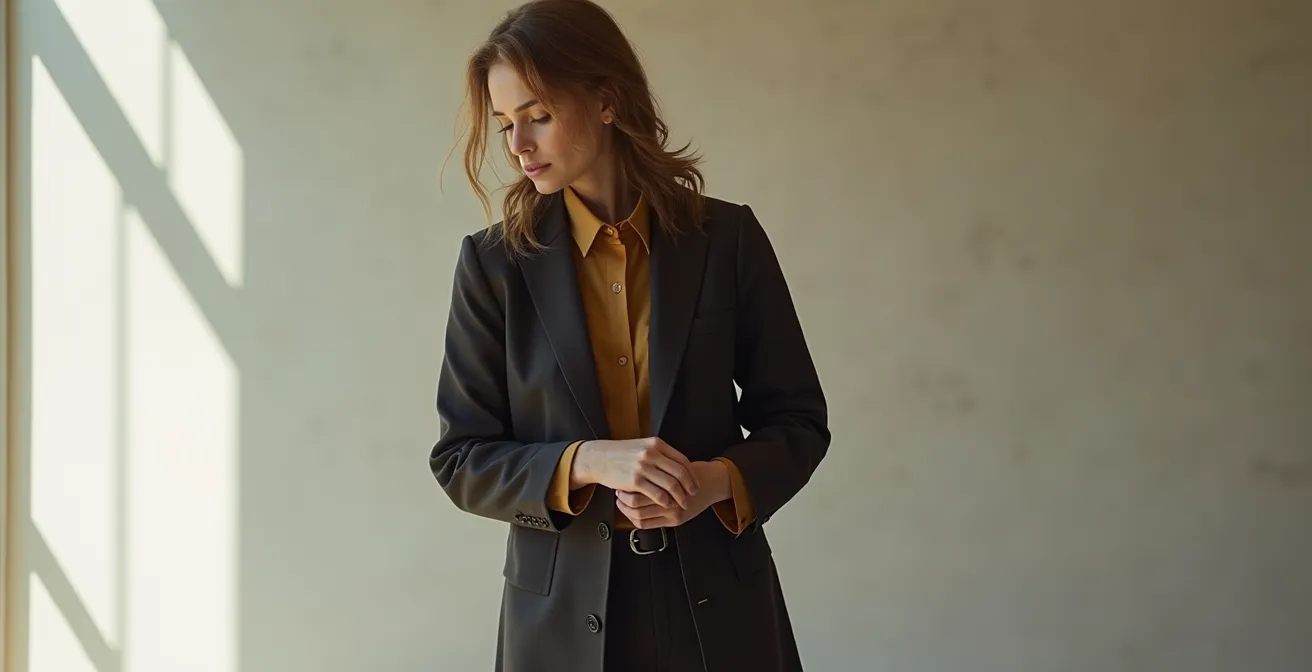
This is perfectly illustrated by the evolution of the oversized blazer. The Y2K version was often a standard blazer in a larger size, sometimes cinched at the waist. As a modern case study, the 2024 architectural oversized blazer maintains its volume through structured shoulders and high-quality, heavy fabrics that hold their shape, while still being expertly tailored to fit perfectly at the shoulders and have the correct sleeve length. This intentionality is what separates a modern oversized look from a sloppy one. Lastly, always remember to balance proportions: if your top is oversized, keep your bottom half fitted, and vice versa. Never wear oversized pieces on both your top and bottom unless you are a master of avant-garde styling.
Now that you’re equipped with the strategies to reinterpret nostalgia, the next step is to apply them. Start by auditing your own closet for those long-forgotten gems, choose one, and begin building your first modern, sophisticated, 70/30 outfit today.