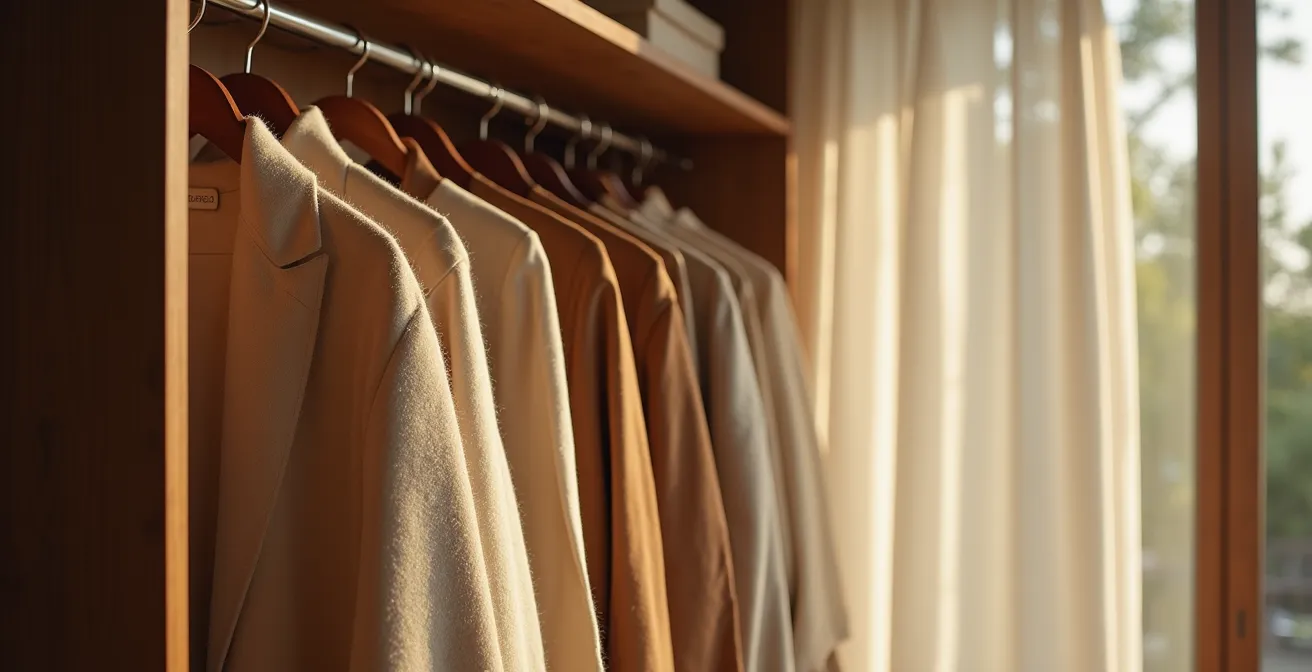
Contrary to popular belief, building a luxury second-hand wardrobe isn’t about luck; it’s a skill based on decoding garments and understanding the global fashion system.
- True value is found by acting as a “textile detective,” authenticating materials and reading historical cues on tags, not just looking at brand names.
- Ethical curation means recognizing greenwashing tactics (like “recycled polyester”) and understanding the real-world impact of clothing donations on countries overseas.
Recommendation: Shift from a mindset of “thrifting” to “curating” by applying a systematic approach to authentication, timing, and integration to build a collection that is both luxurious and conscious.
The thrill of the hunt, the promise of a rare find—for the fashion lover, second-hand shopping is an adventure. You sift through racks, hoping to unearth a vintage Burberry trench or a perfectly worn-in silk blouse. But often, the reality is an overwhelming sea of fast fashion discards, leaving you to question if a truly high-end, cohesive wardrobe can be built this way. Many guides will offer generic advice: “look for quality” or “be patient.” But they miss the fundamental point. Curating a luxury second-hand wardrobe is not a passive game of chance; it’s an active, skilled pursuit.
This approach requires you to become a textile detective, equipped with the knowledge to see beyond the surface. It’s about understanding the subtle language of a garment: the weight of a zipper, the scent of real leather, the story told by a faded care tag. As Fashion Revolution Founder Orsola de Castro notes, the joy is in the potential for transformation.
You will probably find that there are multiple pieces that you can customize or chop or swap, restyle, and re-wear. I would never deny that joy to anyone.
– Orsola de Castro, Fashion Revolution Founder
This guide moves beyond the basics. We’ll explore the ethical mirages of fashion donations and greenwashing. We will equip you with forensic techniques to authenticate designer goods, date true vintage pieces, and build a capsule collection that is timeless, valuable, and genuinely sustainable. It’s time to trade luck for expertise and transform your wardrobe from a random assortment into a masterfully curated collection.
To guide you on this journey from shopper to curator, this article breaks down the essential skills and knowledge you’ll need. Explore the sections below to master the art of the ethical high-end hunt.
Summary: The Savvy Sourcer’s Guide to Ethical Luxury
- Why Donating Clothes Often Just Moves the Waste Problem Overseas?
- How to Authenticate Designer Bags Found at Thrift Stores?
- True Vintage or Modern Reproduction: How to Read Care Tags to Know the Era?
- The “Recycled Polyester” Label That Fast Fashion Brands Use to Trick You
- When to Shop at Resale Sites to Get the Best Deals on Winter Coats?
- How to Build a Versatile Capsule Wardrobe That Fits Your Body Shape?
- How to Source and Integrate Vintage Decor Without Your Home Looking Dated?
- How to Identify and Buy Authentic Artisan Crafts Without Exploiting Locals?
Why Donating Clothes Often Just Moves the Waste Problem Overseas?
The act of donating unwanted clothes feels virtuous, a simple way to participate in the circular economy. We imagine our pre-loved items finding a new home, reducing waste and benefiting others. However, the reality is far more complex and often problematic. This feel-good gesture can contribute to a system of waste colonialism, where the Global North outsources its textile waste problem to developing nations under the guise of charity. A significant portion of these donated garments are not suitable for resale due to poor quality, damage, or cultural inappropriateness.
Countries like Ghana, home to the massive Kantamanto Market, are at the receiving end of this deluge. They import an astounding 15 million garments weekly, but the infrastructure to manage them is completely overwhelmed. An Ellen MacArthur Foundation study reveals the scale of the crisis: their analysis found that 40% of imported clothing becomes waste, equating to roughly six million items discarded every single week in this market alone. These items, often made of non-biodegradable synthetic fibers, end up in overflowing landfills or clog waterways, creating an environmental and social catastrophe.
Case Study: The Financial Burden of Textile Waste in Accra
The sheer volume of clothing waste has a direct financial impact on local communities. In Accra, the local municipal authority spends approximately $500,000 annually just to collect and dispose of textile waste from the Kantamanto market. A recent report highlights that despite this expenditure, the city can only manage to clear about 70% of the market’s total waste. This leaves a staggering 30% to accumulate in the environment, demonstrating how the “solution” of donation has created an unmanageable financial and ecological burden for the receiving country.
Understanding this ethical mirage is the first step for a conscious curator. It reframes second-hand shopping not just as a way to find deals, but as a direct intervention to keep quality garments in circulation and reduce the demand for new production that fuels this damaging cycle. Every quality vintage piece you rescue is one less item contributing to a landfill overseas.
How to Authenticate Designer Bags Found at Thrift Stores?
Unearthing what looks like a designer bag in a thrift store sends a rush of adrenaline through any fashion hunter. But before you celebrate your find, the real work of a textile detective begins: authentication. The market is flooded with convincing fakes, and telling the difference requires a trained eye and a multi-sensory approach. Relying on a logo alone is a rookie mistake; true “garment forensics” involves examining the piece from every angle.
Start with the hardware. Authentic luxury brands invest in heavy, high-quality metal for zippers, clasps, and studs. Feel the weight of it in your hand. Zippers should glide smoothly without snagging, and clasps should close with a satisfying, solid click, not a hollow tick. Next, trust your nose. Genuine leather has a distinct, rich, and slightly earthy scent. Counterfeits often use synthetic “pleather” which gives off a chemical or plastic-like odor. If it smells like a shower curtain, it’s a red flag. The lining is another critical clue. Luxury houses use quality materials like durable cotton, jacquard, or silk, often featuring a branded pattern. The texture should feel substantial and consistent, not flimsy or cheap.
This extreme close-up of genuine leather reveals the natural, imperfect grain that is a hallmark of quality. Synthetic materials often have a repetitive, uniform pattern, whereas true leather showcases unique variations, a key detail to look for during authentication.

Finally, inspect the branding with a magnifying glass if possible. Look at the font on any logos or heat stamps. Counterfeiters often get the “kerning”—the spacing between letters—wrong. In an authentic piece, the spacing will be perfect and consistent. For more modern bags, a serial number can be a direct key. Many brands have online portals or forums where you can check if the number corresponds to a legitimate model. By combining these sensory checks, you move from hoping an item is real to knowing its true identity.
True Vintage or Modern Reproduction: How to Read Care Tags to Know the Era?
In the world of second-hand, not all old clothes are created equal. There’s a significant difference between a recent fast-fashion item and a “true vintage” piece (typically defined as being over 20 years old). Knowing the difference is key to building a collection with genuine historical and material value. While style and cut are good indicators, one of the most reliable tools for a textile detective is the humble care tag. These small labels are like a garment’s passport, holding clues to its age and origin.
The materials and information listed on a tag can instantly date an item. For example, the presence of a Woolmark logo (the iconic yarn swirl) dates a garment to 1964 or later. Tags made from a papery material like Tyvek became common in the 1970s. If a tag includes information in multiple languages and features universal care symbols (the wash basin, the triangle for bleach), it’s likely from the late 1990s or newer. A very old piece, from the 1950s or earlier, might only have a simple “union-made” tag or just the brand label with no care instructions at all.
Beyond the content, the “Made in” label is a powerful historical marker. Geopolitical shifts throughout the 20th century are frozen in time on clothing tags. Finding a garment made in a country that no longer exists is a definitive sign of its vintage status. This is where your knowledge of world history directly translates into curation skill, allowing you to instantly verify a piece’s age.
| Label Text | Era | Historical Context |
|---|---|---|
| Made in British Hong Kong | Pre-1997 | Before handover to China |
| Made in West Germany | Pre-1990 | Before German reunification |
| Made in Yugoslavia | Pre-1992 | Before country dissolution |
| Made in Czechoslovakia | Pre-1993 | Before split into Czech Republic and Slovakia |
By learning to read these historical cues, you elevate your sourcing game. You can confidently distinguish a truly special piece with a story from a modern item designed to look old. This skill is fundamental to the curation mindset, ensuring your wardrobe is filled with items of authentic, lasting value, not just fleeting trends.
The “Recycled Polyester” Label That Fast Fashion Brands Use to Trick You
As consumers become more environmentally aware, fast fashion brands have co-opted the language of sustainability to market their products. One of the most common and misleading tactics is the promotion of “recycled polyester.” On the surface, it sounds like a perfect solution: turning old plastic bottles into new clothes. However, this is an ethical mirage designed to distract from a much larger problem. While it does divert some plastic from landfills, it perpetuates a reliance on synthetic, non-biodegradable materials that have their own devastating environmental impact.
The primary issue is microplastic pollution. Every time a garment made of recycled polyester (or any synthetic fabric) is washed, it sheds thousands of tiny plastic fibers. These microplastics are too small to be filtered out by wastewater treatment plants and end up in our oceans, rivers, and soil, contaminating ecosystems and entering the food chain. A sobering report from Greenpeace highlights that nearly 50% of the clothes we discard contain these synthetic fibers that will never biodegrade. Recycled polyester doesn’t solve this; it simply repackages the problem.
Furthermore, these garments are of notoriously low quality. They pill easily, lose their shape, and retain odors, leading to a shorter lifespan and a quicker journey to the landfill—where they will sit for centuries. A savvy curator must learn to identify high-quality natural fibers (wool, cotton, linen, silk) and distinguish them from these inferior synthetics. Simple, hands-on tests can reveal the true nature of a fabric far more reliably than a marketing label.
Your Action Plan: Identifying Natural Fibers vs. Synthetics
- The Burn Test: (Perform with extreme caution) Snip a tiny, hidden piece of fabric. Natural fibers like wool and cotton burn to a fine ash, while synthetics like polyester melt into hard, plastic-like beads.
- The Stretch Test: Pull the fabric gently. High-quality wool or cotton will have some give but snap back into shape. Recycled polyester often feels overly stretchy and doesn’t fully recover, indicating it will lose its form quickly.
- The Pill Test: Rub a small area of the fabric against itself vigorously for ten seconds. Low-quality recycled synthetics will often begin to pill (form small bobbles) almost immediately.
- The Water Test: Place a single drop of water on the fabric. Natural fibers are absorbent and the water will sink in. Polyester is water-repellent, and the droplet will bead up on the surface.
By arming yourself with this knowledge, you can see through the greenwashing and invest in garments that are genuinely sustainable, durable, and valuable. Choosing a 30-year-old wool coat over a new “recycled” polyester one is always the more ethical and stylish choice.
When to Shop at Resale Sites to Get the Best Deals on Winter Coats?
While in-person thrifting offers the thrill of discovery, online resale platforms provide access to a global closet. However, navigating these sites to find a high-end winter coat at a good price requires strategy, not just endless scrolling. The key is timing. Just like in traditional retail, the second-hand market has seasons, and understanding its ebbs and flows is crucial for striking the best deal on a quality wool, cashmere, or shearling coat.
The sweet spot for coat-hunting is counterintuitive: it’s not in the autumn when everyone else is looking, but during the post-holiday lull. The period from late January through February is prime time. This is when the market becomes flooded with a new wave of inventory for two main reasons. First, people are offloading unwanted Christmas gifts that didn’t fit or suit their style. Second, the “New Year, new me” decluttering craze leads to massive closet clean-outs. This surge in supply creates a buyer’s market, driving prices down.
Another strategic window is tied to the high-fashion calendar. Fashion influencers and insiders often sell off last season’s high-end outerwear two to four weeks after the major Fashion Weeks (February and September) conclude. They need to make space—and funds—for the new trends they’ve just seen on the runway. This is a golden opportunity to acquire a barely-worn, recent-season designer coat for a fraction of its original price.
Strategic Sourcing: The Post-Fashion Week Offload
By setting up alerts for specific brands like Max Mara, Acne Studios, or Totême on platforms like Vestiaire Collective or The RealReal, you can be notified the moment these pieces are listed. Focusing your search in the weeks following London or Paris Fashion Week can yield spectacular results, as a wave of high-quality, trend-adjacent coats hits the market simultaneously. This strategic timing transforms shopping from a passive browse into a targeted, successful mission.
Ultimately, curating a collection of beautiful, high-quality coats is the goal. By being patient and strategic, you can source investment pieces that will last for decades, building a versatile and luxurious outerwear wardrobe without paying retail prices.
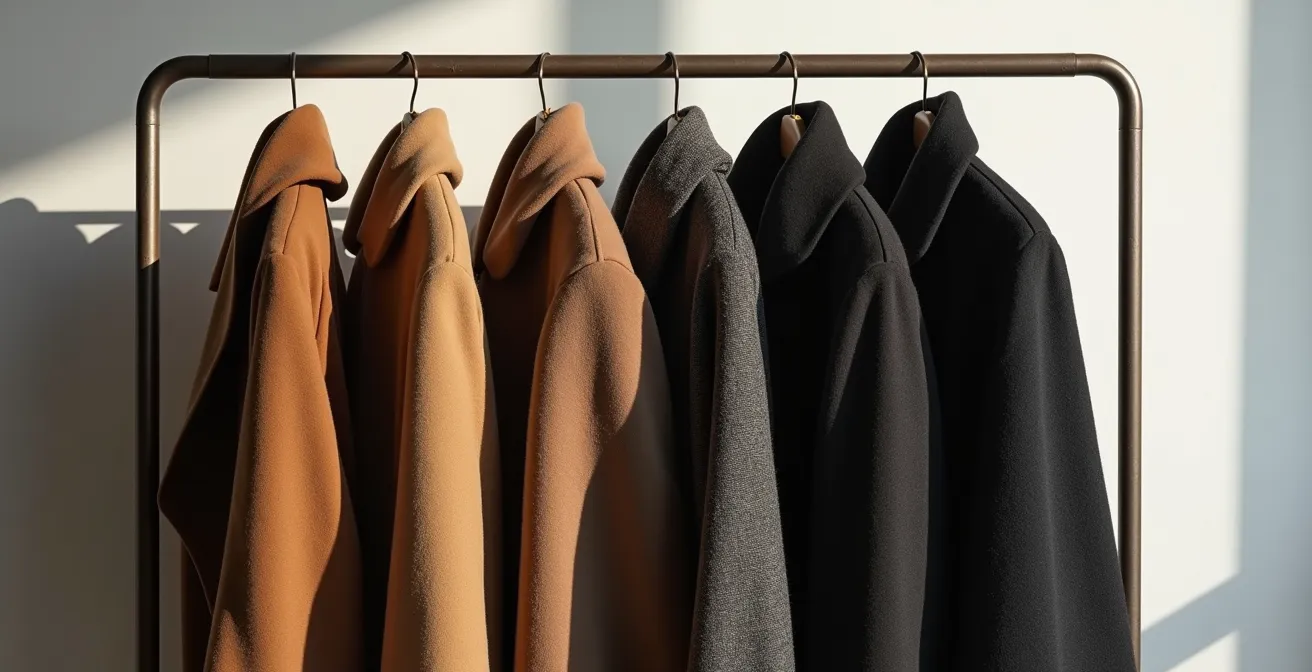
How to Build a Versatile Capsule Wardrobe That Fits Your Body Shape?
The concept of a capsule wardrobe—a curated collection of essential, interchangeable items—is the ultimate expression of the curation mindset. It’s not about restriction; it’s about intention. The goal is to create a functional, stylish, and sustainable wardrobe where every piece works with every other piece. Sustainable fashion experts demonstrate that with careful selection, as few as 30 items can create 30+ completely different outfits. When built through second-hand sourcing, this becomes a doubly impactful act of conscious consumption.
A common mistake is starting with a generic list of “basics.” A truly effective capsule is deeply personal, built around your specific body shape, lifestyle, and color palette. Before you even set foot in a thrift store, create a digital color palette on your phone with 3-4 neutral base colors (like navy, cream, charcoal) and 2-3 accent colors that you love and that flatter your skin tone. This becomes your guide, ensuring every piece you acquire integrates seamlessly.
Instead of starting with basics, adopt the “unicorn” approach. Build your capsule around one spectacular, unique second-hand find—a vintage silk blazer, a perfectly tailored pair of wool trousers, or a statement coat. This “unicorn” piece sets the tone and color story for the entire collection. From there, you can source the supporting items. When considering any new item, apply the “Three-Outfit Rule”: before you buy it, you must be able to mentally style it into at least three distinct outfits using pieces you already own. If you can’t, it doesn’t belong in your capsule, no matter how beautiful it is.
Finally, focus on silhouette and fabric over trends. Understand what cuts flatter your body shape. If you have a pear shape, look for A-line skirts and structured shoulders. If you’re an apple shape, V-necks and straight-leg trousers can be incredibly flattering. Pay close attention to the quality of the fabric and the simplicity of the seams. A well-made garment from natural fibers with simple lines can almost always be tailored to fit you perfectly, making a $10 thrifted blazer look like a $1000 bespoke piece.
How to Source and Integrate Vintage Decor Without Your Home Looking Dated?
The same principles that guide a curated wardrobe can transform a living space. Sourcing vintage decor and furniture is a sustainable way to imbue your home with character and history, avoiding the homogenous look of mass-market retailers. However, there’s a fine line between a home that looks thoughtfully collected and one that looks like a cluttered antique shop. The secret to avoiding a dated feel lies in balance and intentional integration.
The most effective strategy is the 80/20 Rule. This principle suggests that your space should be composed of roughly 80% modern, clean-lined pieces and 20% vintage or antique items. This ratio allows the vintage pieces to act as focal points and conversation starters, their unique character shining against a contemporary backdrop. For example, a weathered 19th-century farm table can look stunning when surrounded by sleek, modern dining chairs. A collection of vintage art glass pops against a minimalist, neutral-colored wall.
When sourcing your “20%,” focus on items with timeless silhouettes and high-quality materials. A mid-century modern teak credenza, an Art Deco mirror, or a classic Chesterfield sofa are pieces that transcend trends. Look for natural materials like wood, brass, marble, and wool. Their inherent texture and patina add warmth and soul to a room in a way that particleboard and plastic cannot. Don’t be afraid of a little wear and tear; a few scuffs or a faded spot tell a story and add to the piece’s authenticity.
The key is to treat each vintage find not as clutter, but as a piece of art. Give it room to breathe. An ornate gilt mirror, for instance, should be the star of the wall it hangs on, not crowded by a dozen other frames. By thoughtfully mixing old and new and celebrating the unique character of each vintage item, you create a space that feels layered, personal, and timelessly chic—never dated.
Key Takeaways
- Adopt the Textile Detective Mindset: Shift from passive shopping to active investigation, using forensic techniques to assess a garment’s true material, age, and authenticity.
- Embrace the 80/20 Curation Rule: Build your wardrobe and home around a foundation of 80% modern staples and 20% unique, high-impact vintage finds to create balance.
- Think Globally, Act Locally: Understand that your purchasing choices have global consequences. Prioritizing second-hand keeps quality items in circulation and reduces the strain on the global textile waste system.
How to Identify and Buy Authentic Artisan Crafts Without Exploiting Locals?
As your curation skills expand beyond clothing, you might be drawn to the unique beauty of artisan-made crafts, whether sourced locally or during travels. These items—hand-woven textiles, intricate beadwork, or hand-thrown pottery—can add unparalleled soul to your collection. However, the market is rife with mass-produced imitations, and it’s crucial to ensure your purchase supports the original artisans rather than an exploitative supply chain. Identifying authenticity here is another form of “garment forensics.”
The first sign of true craftsmanship lies in its perfect imperfection. A machine can produce thousands of identical items with flawless uniformity. A human hand cannot. Look for subtle variations in stitching, slight irregularities in a woven pattern, or minor differences in the size and shape of beads. These are not flaws; they are the signature of a handmade object and a guarantee of its authenticity. A machine-made copy will often look too perfect, too uniform.
Examine the construction details closely. In textiles, hand-finished seams will feel softer and look slightly less regular than the hard, perfectly straight lines of a factory serger. Buttonholes on a handmade garment will often have tiny, dense stitches for reinforcement that look different from one another, whereas machine-cut buttonholes are identical. The materials themselves also tell a story. Authentic crafts typically use locally sourced, natural materials that may have slight variations in color or texture, unlike the perfectly dyed synthetic fibers of a cheap knockoff.
This comparative approach is the most effective way to train your eye. By knowing what to look for, you can quickly differentiate a piece that carries a cultural story and supports a skilled artisan from one that was mass-produced for a fraction of the cost. Your purchase becomes an act of preservation, not just acquisition.
| Feature | Authentic Vintage Artisan | Fast Fashion Copy |
|---|---|---|
| Seams | Hand-finished, irregular stitching | Machine-perfect, uniform |
| Buttonholes | Slightly uneven, hand-sewn reinforcement | Identical sizing, machine-cut |
| Pattern Matching | Precise alignment at seams | Misaligned patterns |
| Wear Patterns | Natural patina in stress areas | Artificial distressing |
By investing in genuine artisan work, you not only acquire a beautiful and unique object but also contribute to the livelihood of craftspeople and the preservation of cultural heritage. It is the ultimate expression of a conscious and curated lifestyle, where every item in your possession has a story and a positive impact.
Your journey from a passive shopper to a skilled, ethical curator is an empowering one. By applying these detective skills, you transform the act of shopping into an art form—one that builds a wardrobe of lasting value, expresses your unique style, and makes a positive impact on the planet. Start your next hunt with this new mindset and discover the treasures waiting for you.