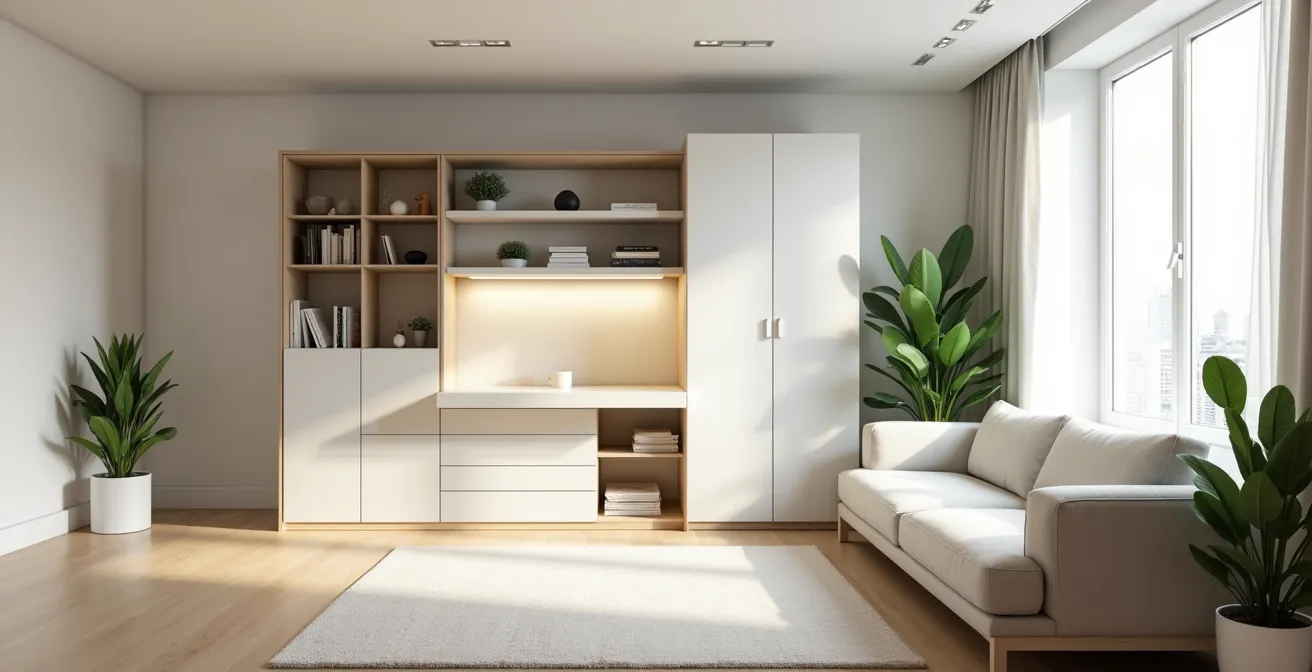
Maximizing a small living area isn’t about buying more foldable furniture; it’s about fundamentally re-engineering your space with a zoning and flow mindset.
- Treat vertical walls as valuable ‘vertical real estate’ to draw the eye up and store items strategically.
- Define functional zones using light and layout, not just physical barriers, to maintain an open and airy feel.
Recommendation: Start by mapping your daily rituals to identify friction points and opportunities for creating dual-purpose areas that truly work for you.
For the urban dweller, the living room is a battlefield of compromise. It’s where you unwind after a long day, host friends, and, increasingly, where you take Zoom calls and answer emails. The daily ritual of shuffling laptops off the coffee table just to have a meal feels all too familiar. You’ve probably heard the standard advice a thousand times: “buy a sofa bed,” “use mirrors to create an illusion of space,” or the ever-helpful “just declutter more.” While these tips have their place, they often feel like small patches on a larger problem.
What if the solution isn’t about adding more clever objects, but adopting a cleverer mindset? The secret to reclaiming your home lies in spatial engineering. This means thinking like a designer to create intentional zones and a seamless flow that supports your life, rather than just storing your stuff. It’s about a fundamental shift from seeing your space as a container for things to viewing it as a dynamic system designed around your daily rituals. This approach transforms the challenge from a frustrating puzzle into a creative opportunity.
This guide will walk you through that very process. We’ll explore how to leverage every inch of your home, from overlooked vertical real estate to the psychology of room division. You’ll learn how to select furniture that serves multiple functions without sacrificing comfort or style, and how to engineer a home office that promotes well-being and can vanish when the workday is done. It’s time to stop fighting your space and start making it work for you.
Summary: A Strategic Guide to Multi-Purpose Living
- Why Ignoring Vertical Wall Space Shrinks Your Usable Square Footage?
- How to Choose a Sofa Bed That Is Actually Comfortable for Daily Sleep?
- Rug or Bookshelf: Which Room Divider Maximizes Light and Privacy?
- The Oversized Sofa Mistake That Paralyzes Traffic in Small Living Rooms
- When to Invest in Murphy Beds vs. Pull-Out Couches for Occasional Guests?
- How to Integrate Smart Storage Solutions That Hide Clutter Permanently?
- How to Design a Living Space That Is Both Instagram-Worthy and Family-Friendly?
- How to Engineer a Home Office Setup That Prevents Physical Pain and Video Fatigue?
Why Ignoring Vertical Wall Space Shrinks Your Usable Square Footage?
In the chess game of small-space living, most people only play on a horizontal board. We obsess over the floor plan, forgetting that our most underutilized asset is the vast, open territory of our walls. Ignoring this “vertical real estate” is a critical mistake; it effectively reduces your usable living area by forcing everything—storage, decor, lighting—to compete for precious floor space. When your floor is cluttered, your home feels smaller, regardless of its actual dimensions. The key is to draw the eye upward, creating a sense of height and spaciousness while simultaneously getting items off the ground.
The market is already responding to this shift in thinking, with a 5.91% CAGR projected for modular units through 2030. This isn’t just about adding a few floating shelves. It’s about a strategic approach. Think floor-to-ceiling bookshelves that become a library and a feature wall in one. Consider wall-mounted cabinets that float above the floor, creating storage without visually weighing down the room. A pegboard system in an entryway or office nook offers a flexible, reconfigurable solution for everything from keys to office supplies.
By implementing vertical storage, you’re not just organizing; you’re performing a kind of architectural magic. You reclaim square footage, create clear pathways for foot traffic, and build a more open, breathable environment. It’s the first and most crucial step in shifting from a cluttered floor plan to an engineered, multi-functional space. Don’t just live within your four walls—leverage them.
This principle of “thinking up” is a cornerstone of intelligent small-space design, setting the stage for every other decision you’ll make.
How to Choose a Sofa Bed That Is Actually Comfortable for Daily Sleep?
The term “sofa bed” often conjures images of wobbly frames, thin mattresses, and a guaranteed sore back. For the urban dweller whose living room doubles as a bedroom, this is a non-starter. A truly functional sofa bed cannot be a compromise; it must excel as both a stylish sofa for daily use and a genuinely comfortable bed for nightly sleep. The secret is to look beyond aesthetics and focus on the mechanism and mattress quality, which are the true determinants of comfort.
Modern sofa beds have evolved far beyond the old pull-out couch with a dreaded metal bar. Today’s options include memory foam sleepers that contour to your body and hybrid systems that combine the support of springs with the comfort of foam. These innovations prioritize sleep quality, making them viable for everyday use. When choosing, consider not just the mattress material but also the ease of conversion. A clunky, difficult-to-open mechanism will become a daily frustration.

As you can see, the right model transforms a living space into a serene bedroom without compromise. To make an informed decision, it’s helpful to compare the leading options based on what matters most: sleep quality, ease of use, and sitting comfort.
This comparison from a recent analysis helps demystify the options, showing that high-quality daily sleep is achievable. The key is to invest in a system designed for it.
| Mechanism Type | Daily Sleep Quality (1-5) | Ease of Conversion (1-5) | Sitting Comfort (1-5) |
|---|---|---|---|
| Pull-out with innerspring | 4 | 3 | 4 |
| Clic-clac futon | 3 | 5 | 3 |
| Memory foam sleeper | 5 | 3 | 4 |
| Hybrid mattress system | 5 | 3 | 5 |
Case Study: Modern Sofa Beds as Primary Sleep Solutions
Brands like Murphy Door are demonstrating how modern sofa beds can serve as primary sleeping solutions in studio apartments. Their innovative designs often include hidden storage compartments under seat cushions and within armrests, seamlessly blending function with a clutter-free aesthetic. These models prove that a sofa bed can be a centerpiece of smart design, not just a backup option.
Ultimately, selecting the right sofa bed is an investment in both your living space and your well-being, ensuring restful nights and stylish days.
Rug or Bookshelf: Which Room Divider Maximizes Light and Privacy?
Creating distinct zones for living, working, and dining is essential for a multi-purpose room to feel organized and intentional. The challenge is achieving this separation without erecting solid walls that block precious natural light and make the space feel cramped. The solution lies in using “suggested” rather than solid dividers. This is a core principle of zoning and flow: guiding the eye and the body to recognize different functional areas while maintaining a sense of openness.
A well-placed area rug is a master of subtle zoning. It can anchor a seating area, visually separating the “living room” from the “office” without a single vertical barrier. This method is unparalleled for maximizing light and preserving an open floor plan. However, it offers no privacy. For that, a physical divider is needed, but it must be chosen carefully. The best options are those that delineate space while allowing light to pass through. An open-back shelving unit is a perfect example. It provides storage and a clear visual boundary, yet its transparent structure prevents it from feeling like a heavy wall. Light filters through, and it can be styled with books and objects to feel like an intentional part of the decor.
Other clever solutions for creating zones without sacrificing light include:
- Ceiling-mounted curtains: They can be drawn for full privacy when needed (e.g., for a guest sleeping area) and pulled back completely to open up the space.
- Translucent or frosted glass panels: These offer a sleek, modern way to create partial privacy while still allowing for light transmission.
- Strategic lighting: Using different types of light—a focused task lamp for the desk area, warm ambient light for the sofa—can also help define zones through illumination alone.
Case Study: Zoning in a 500-Square-Foot Studio
A successful redesign of a 500-square-foot studio apartment used a combination of strategic rug placement and an open-back bookshelf to create distinct living and sleeping areas. The design maintained natural light flow from the main window while providing clear visual separation, proving that even in a very small footprint, thoughtful zoning can create the feeling of multiple rooms.
The choice between a rug and a bookshelf isn’t an either/or; often, the most effective solution is a combination of both, creating layers of definition that are both functional and beautiful.
The Oversized Sofa Mistake That Paralyzes Traffic in Small Living Rooms
There’s a common temptation in decorating any space, big or small: falling in love with a large, plush sofa. But in a compact living area, this is often the single most debilitating mistake you can make. An oversized sofa doesn’t just take up space; it dictates and paralyzes the entire room’s traffic flow. It creates awkward choke points, makes it difficult to access other furniture or storage, and devours the visual breathing room that makes a space feel calm and functional. This is a classic case of poor footprint-awareness, where the permanent space an item occupies far outweighs its practical utility.
This issue is particularly acute given that modern one-bedroom apartments average just 866 square feet in cities like New York. With such limited real estate, every piece of furniture must justify its footprint. Before committing to a large sofa, it’s crucial to conduct a “test drive” to simulate its impact on your daily life. This simple exercise can save you from a costly and cumbersome mistake.
Here is a practical method to test furniture before buying:
- Map it out: Use painter’s tape on the floor to outline the exact dimensions of the sofa you’re considering.
- Live with it: Leave the tape on the floor for a full week. Walk around it, try to open nearby drawers, and notice how it affects your natural pathways. Does it feel like an obstacle?
- Measure clearances: Ensure there are at least 36 inches of clear walkway in major traffic paths. Anything less will feel cramped.
- Consider alternatives: Instead of one massive sectional, would two comfortable armchairs and a sleek loveseat offer more flexibility and better flow? Modular pieces that can be reconfigured are also a brilliant choice for multi-purpose rooms.
Choosing a sofa that is appropriately scaled to your room is the foundation of good spatial engineering. It ensures that your largest piece of furniture enables, rather than obstructs, the life you live in your space.
When to Invest in a Murphy Bed vs. a Pull-Out Couch for Occasional Guests?
When your living room must also serve as a guest room, the choice of sleeping solution is critical. The two primary contenders are the classic pull-out couch and the more integrated Murphy bed. While a sofa bed seems like the obvious choice, it has a major drawback: its footprint is permanent. Whether used for sitting or sleeping, it occupies the same amount of floor space 100% of the time. A Murphy bed, on the other hand, is a master of spatial transformation, offering a full, comfortable bed when needed and completely disappearing when not in use.
The decision to invest in a Murphy bed often comes down to frequency of use and the value of reclaimed space. A Murphy bed is a significant investment, but its return is measured in square footage. As one analysis highlights, a typical Murphy bed can recapture approximately 35 square feet of usable floor space 95% of the time when folded away. In a small condo, 35 square feet is the difference between a cramped living area and space for a yoga mat, a child’s play area, or a proper home office setup. This is a powerful argument for anyone who needs their space to be truly multi-functional on a daily basis.
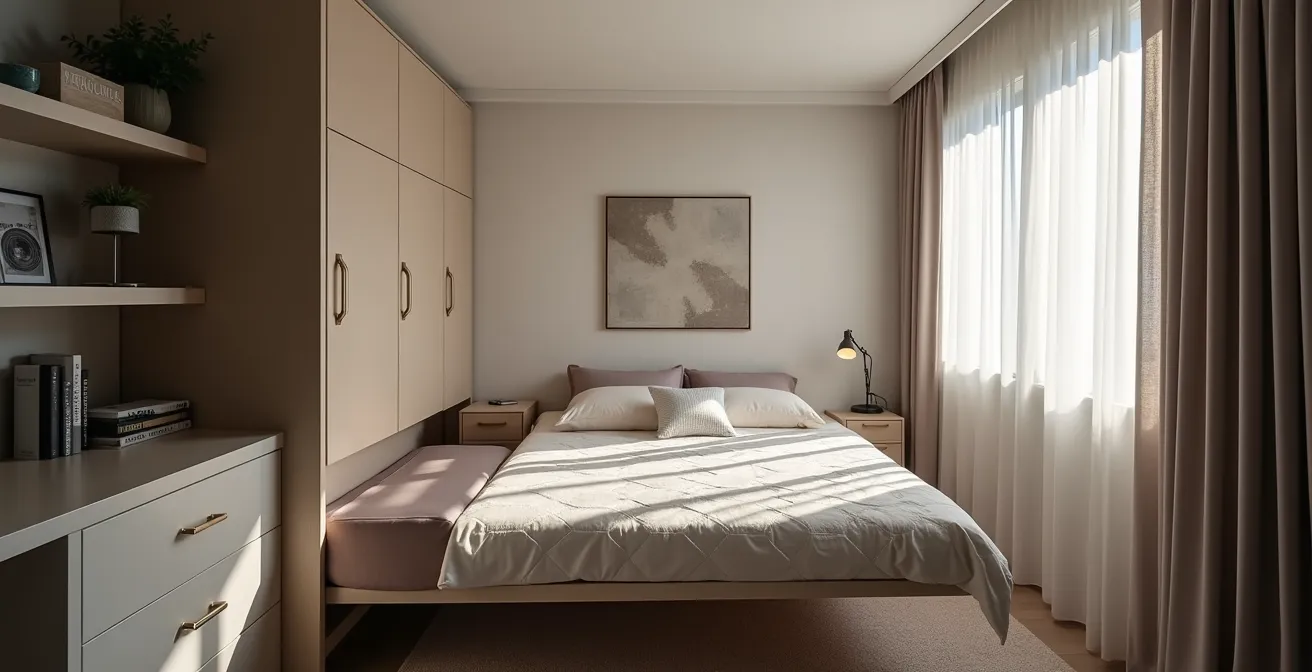
As this image illustrates, the transformative power of a Murphy bed is unmatched. Modern designs go far beyond a simple fold-down mattress. They are sophisticated systems that can integrate desks, sofas, or even dining tables that appear when the bed is stowed. Many include built-in shelving or cabinets for bedding and personal items, creating a complete, self-contained solution that enhances the room’s primary function—be it a living room, office, or studio—the vast majority of the time.
For the occasional overnight guest, a high-quality sofa bed might suffice. But if you host regularly or, more importantly, if you desperately need to reclaim your floor space for daily living, a Murphy bed is not a luxury—it’s a strategic investment in the functionality of your home.
The right choice depends entirely on your lifestyle and how you prioritize the dynamic use of your limited square footage.
How to Integrate Smart Storage Solutions That Hide Clutter Permanently?
Clutter is the persistent enemy of small-space living. It’s not just a matter of untidiness; it’s a constant visual noise that makes a room feel chaotic and smaller than it is. The growing storage crisis is evidenced by data showing that over 11% of U.S. households currently rent self-storage units—they’re literally paying for space outside their home to store their excess belongings. The solution isn’t just to “organize” but to create smart, integrated storage systems that make it easy to keep clutter hidden permanently. This requires a behavioral approach, not just more bins and boxes.
The goal is to create systems that align with your natural habits, making it almost effortless to put things away. This is a core part of ritual-based design. For example, if mail and packages always pile up by the door, don’t fight the habit—design for it. Create a designated “quarantine bin” in your entryway console where all incoming items go immediately. Once a week, you can process this bin, preventing the slow creep of clutter into your main living area.
Similarly, smart technology can be a powerful ally. Using NFC tags on storage boxes that link to a digital inventory on your phone means you’ll never have to tear apart a closet looking for one specific item again. Sensor-activated LED strips inside deep drawers or cabinets illuminate every corner, ensuring no item is ever lost to the darkness. By designing storage around human behavior, you create a home that is easier to maintain, making “clutter-free” a sustainable reality, not a temporary state.
Action Plan: Your Behavioral Storage Audit
- Points of Contact: List all the “entry points” where clutter originates in your home (e.g., front door for mail, bedside table for books, kitchen counter for paperwork).
- Collect & Inventory: For each point, take stock of what currently accumulates there. Are they items needing action, storage, or to be discarded?
- System Design: Design a specific “home” for these items at their point of entry. Could an entryway quarantine bin solve the mail pile? Does a “purgatory box” for uncertain items make sense?
- Behavioral Triggers: Implement a simple rule to manage the system, like the “one-in, one-out” rule for clothing or setting a 6-month expiration date on items in the purgatory box.
- Integration Plan: Prioritize implementing one new system per week. Start with the area that causes the most daily friction.
By engineering solutions that work with your habits, you can finally win the war against clutter and maintain a serene, organized living space.
How to Design a Living Space That Is Both Instagram-Worthy and Family-Friendly?
The desire for a beautiful, curated home often feels at odds with the chaotic reality of daily life, especially with kids or pets. Spills, scratches, and a constant stream of toys can make an “Instagram-worthy” space seem like an impossible dream. However, style and durability are not mutually exclusive. The key is to design with a strategic, layered approach, understanding what needs to be bulletproof and what can be beautiful yet replaceable. This is where the 80/20 design rule comes into play.
This rule dictates that you should invest 80% of your budget and effort into the durable, family-proof basics. These are the workhorses of your living room: a sofa upholstered in performance fabric, a washable area rug, and sturdy, closed storage to hide the inevitable clutter. These foundational pieces should be chosen for their resilience and timeless appeal. The remaining 20% is where you have fun and express your style. This budget is reserved for swappable, less expensive accessories like cushion covers, throw blankets, art prints, and decorative objects. If a cushion gets stained or you tire of a color, it’s an easy and affordable fix, allowing your room to evolve without a major overhaul.
Adopting this mindset also involves designating specific zones and surfaces for mess. A durable, non-precious coffee table can be the “sacrificial surface” for crafts, homework, and snacks, protecting your more valuable furniture. By choosing materials rated for high stain and scratch resistance for your core items, you create a space where you can relax and live without constantly worrying about damage.
Case Study: The Living Spaces Approach
Retailers like Living Spaces showcase how multifunctional furniture can be both stylish and practical. Their designs for storage beds, benches, and desks with integrated shelves eliminate the need for extra pieces, saving space while maintaining a cohesive look. Some models even integrate technology like USB ports and Bluetooth speakers, proving that functionality and high-end style can coexist beautifully in a family-friendly home.
A truly stylish home isn’t one that looks untouched; it’s one that is intelligently designed to embrace life, messes and all, with grace and durability.
Key Takeaways
- Spatial engineering—thinking like a designer about zones and flow—is more effective than simply buying multifunctional items.
- Your vertical walls are valuable real estate; using them for storage and decor is crucial to freeing up floor space.
- Smart design is ritual-based, creating systems that work with your daily habits to reduce clutter and friction.
How to Engineer a Home Office Setup That Prevents Physical Pain and Video Fatigue?
In a multi-purpose living area, the home office is often the most challenging zone to get right. A makeshift setup on the sofa or dining table can quickly lead to back pain, eye strain, and the dreaded “Zoom fatigue.” Engineering a proper home office, even a small one, is not a luxury; it’s an essential investment in your physical and mental well-being. The goal is to create an ergonomic environment that supports your body and a sensory experience that helps you transition between work and life, even when they happen in the same room.
Ergonomics is the foundation. This means ensuring your monitor is at eye level, your wrists are straight when typing, and your chair provides adequate lumbar support. An adjustable monitor arm, an external keyboard and mouse, and a supportive chair are non-negotiable. Even without a dedicated desk, these items can be used to modify a dining table into a comfortable workstation. Investing in these tools is investing in your long-term health.

Beyond physical posture, lighting plays a massive role in preventing eye strain and video fatigue. Staring at a bright screen in a dimly lit room is a recipe for headaches. The 3-Layer Lighting Method is a professional approach to creating a visually comfortable workspace:
- Ambient Light: General room lighting from ceiling fixtures should provide a base level of 300-500 lux.
- Task Light: A focused desk lamp, positioned at a 45-degree angle, should illuminate your work surface with a brighter 750-1000 lux.
- Bias Light: A soft LED strip placed behind your monitor reduces the harsh contrast between the screen and the wall, significantly easing eye strain.
Finally, creating a “fake commute” ritual is a powerful psychological tool. A 10-minute walk before and after your workday, or even a specific playlist that signals the start and end of work, helps your brain transition. It creates a boundary that prevents your work life from bleeding into your personal time, which is the ultimate goal of a well-engineered multi-purpose space.
Your small space holds more potential than you think. Start engineering it today by implementing these strategies to unlock a more functional, comfortable, and fulfilling home life.